
The Charter City project with its own legislation and self-governing body that was recently welcomed by the Honduran congress could have become an extreme example of the Haussmann in the Tropics chapter by Mike Davis. In a critique of urban progress in which the State intervenes in favor of foreign investment, landowners, and the local elite, the chapter affirms the following: “As in 1860s Paris, under the fanatical reign of Baron von Haussmann, urban redevelopment still strives to maximize both private profit and social control.”1 The height of spatial segregation, the model city expands privatization to the entire urban territory and its social interactions, which supposes a challenge to the notion of the city itself.
Charter City, the title of the exhibition presented at the Museo de Arte y Diseño Contemporáneo in Costa Rica, confronts us with the conditions that permit the establishment of model cities or (bad) banana companies. In opposition to the figure of the “artist-demolitionist” embodied by Baron Haussmann, I would like to approach Adán Vallecillo’s proposal from the perspective of the author as a builder, here understood as trade, materials, tools, and processes. It is not rare to find levels, Sargento clamps, bolts, and tape measurers in Vallecillo’s works. The election of objects is not solely tied to their meanings but also to their physical properties and the relationships generated between them. Vallecillo often proposes an alternative use of objects that are suddenly disconnected from their instrumental nature in order to be part of other logics, as in the work titled Misantropía (Misanthropy) where Sargento clamps only fasten other clamps.
To transform metaphors into raw materials—a desire by Cildo Meireles that Adán Vallecillo also puts into practice—is one of the most important achievements in this artist’s work. And it is the reason why I prefer to approach Charter City through its materiality and with an example: in Segmentario (Segmentary) we encounter a group of fragments of patched tires full of valves. These devices that allow for some things to open or close, connect or disconnect, and modulate or isolate the flow of liquids or gases, turn into an almost ominous presence in Vallencillo’s pieces. If the valve is one of the essential control instruments in the industry, then its proliferation across small sections is truly unsettling.
Vallencillo’s use of manufactured industrial materials signals a relationship of dependency with the industrialized countries, as it also underscores physical properties and the common use of the materials. Expanded polystyrene, for instance—commonly used as a thermal insulator—serves as a fridge in the work titled Cuba Libre (Free Cuba) and as a structural base in the work Hipérbole (Hyperbole). But in each case, I establish different relationships with the same element: the first use may showcase the material’s impermeable condition, while the second user may underscore its lightweight. As I observe the high foam buildings crowned with steel watches, I wonder what are the reasons for a model city here. Polystyrene answers with its capacity for shock absorption.
The increasingly wider gap between secure places and violent ones worsens spatial and social segregation. The city becomes less accessible to people and to the common good because of public policies solely focused on producing and monitoring the private spaces. The safe city, the one with condominiums and urban developments is confined inside gated spaces with private security and monitoring equipment. Monografía registers long sequences of posters of security companies from Tegucigalpa, while the work titled Masterguetto piles locks attached to the same immovable column as a superfluous protection resort. Thus, the risk is present as a structural condition and not as an anomaly.
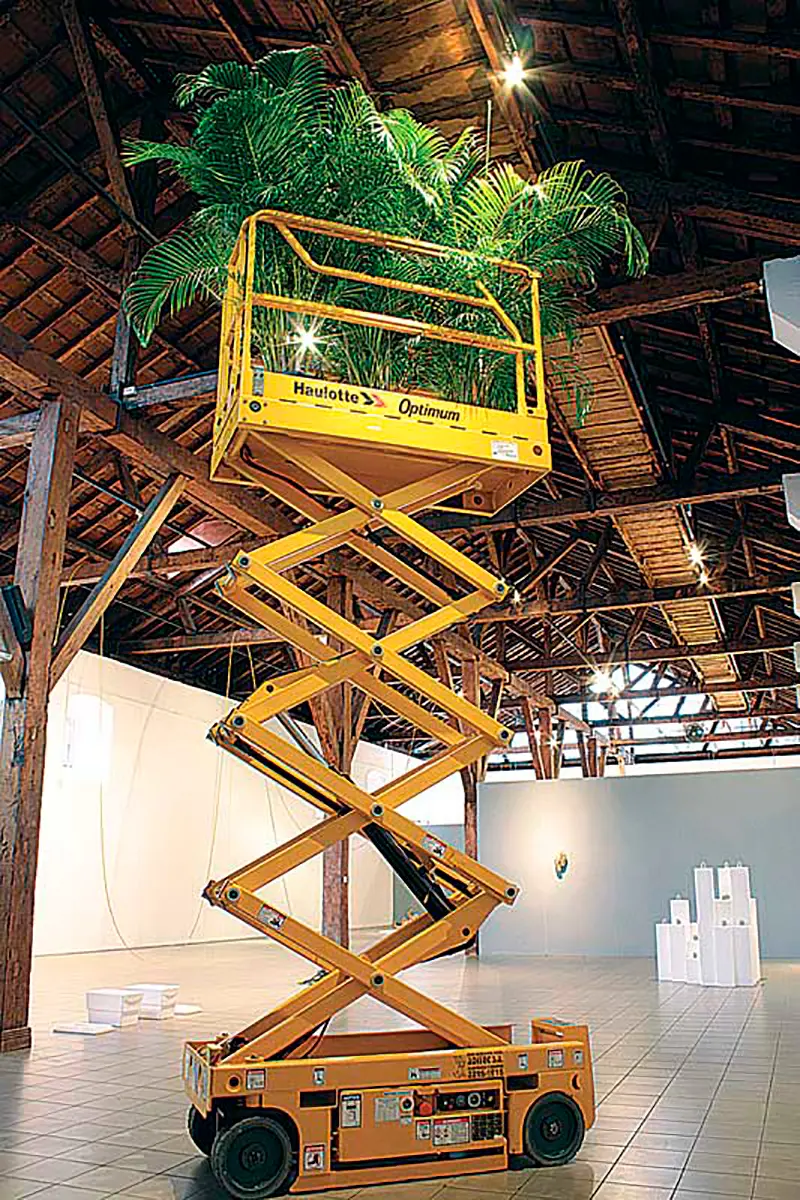
The disturbance of space-time measuring acquires poetic and critical effectiveness in the work by Adán Vallecillo. In the work that shares the same name of the exhibition, a long measuring tape is curved across space. Charter City is formed as an inexact system—a rather arbitrary one—incapable of describing reality. The failure of the measurement is counterbalanced by the telescopic glass at both extremes of the meters. Like an optical prosthesis of the measuring instrument, the reflection continues right where the gaze cannot reach. A similar dislocation is suggested by Tres Tristes Trópicos (Three Sad Tropics), with the palm trees high on top of a hydraulic platform.
The exhibition is constituted by the tension between the abstract space and the everyday object. For my part, I understood the enormous energy with which this work by Adán Vallecillo addresses urban conditions through the thinking of Henri Lefebvre. The abstract space—affirmed this Marxist philosopher—coincides with capitalism and its urban planning codices and homogenization of the experience. The abstract space in the works by Adá Vallecillo is both present through its very configuration and negated by objects with memory, remnants, and traces of lived experiences; namely, all those things rejected by the normative order of the rational and homogeneous space. Thus, the city proposed by this artist-builder is also a territory of struggles, as perhaps announced by the bugs with valves or by the work titled Atari, whose title remits to the Japanese word that—in the game of go—wards adversaries that they have made a dangerous play.
NOTES
1. Mike Davis, Planeta de Ciudades Miseria (Planet of Slums), Foca, Madrid, 2007, p. 136.
2. “¿Mis títulos?... Yo he sido elegido como el artista-demoledor (My titles?... I have been named artist-demolitionist),” Haussmann quoted by Walter Benjamin, in Libro de los Pasajes, Akal, Madrid, 2007, p.154.
TAMARA DÍAZ BRINGAS