
Histórias às margens, a twenty-year retrospective of Adriana Varejão’s work presented at the Museu de Arte Moderna in São Paulo from September to December 2012, inaugurated a previously untrodden path in the exhibition career of a Brazilian artist who has gained an important space in the international contemporary scene.
Curated by Adriano Pedrosa, the vast exhibition proposed a selection of works from various landmark collections—Tate Modern, The Solomon R. Guggenheim Museum, the “La Caixa” Foundation for a “wide-angle” project posited as an explicit narrative of research sequences, anchored on two decades of creation by Varejão.
The MAM/SP’s exhibition calendar was created for its public (visiting around the same time the 30th São Paulo Biennial) the unique opportunity of seeing an anthology show with 42 works selected from Varejão’s series, including her most recent project, Carnivorous Plants, created especially for this show. Three works stand out among those included in the show: Carnivorous Plants, a large 18-meter panel with 52 canvases created for this exhibition, a self-portrait on a plate that closed the exhibition path, and an outline of Guanabara Bay.
In the museum’s exhibition space, the curator opted for a chronological sequence, paced along the lines of force of a lucid visual poetics: the presence of the body, Varejão’s omnipresent self-portraits, her recordings of Brazilian colonial landscapes, the historical element of Portuguese colonization, and the baroque element of monumental ceramic tiles. Lines of force expanded by an acute critical vision. Histórias às margens outlined a proposal for contact with large-format works, presented to the public within a broad project of reflection developed by the artist and concentrated on the open gaps of official history.
A large part of Adriana Varejão’s visual poetics exposes the invisibility of many stories that deviate from a totalizing History. In her art, citing landscapes of colonization in Brazilian territories, she often explores the fissures of a disconcerting reality.
From her series Baroques, Seas and Tiles, Tongues and Incisions, Proposal for a Catechesis, and Terra Incognita, begun in the 1980s and 1990s, Varejão creates a corrosive visual reconstruction of the cracks and splits of Portuguese colonization, as a biting alternative to the single official version of events entrenched in memory.
To confront the visual narratives made official by colonization, highlighted in the large-format sets of tiles that characterize the Brazilian baroque, the artist re-elaborates in her political art images that are in open disagreement with the parameters of the official imagination.
In her works, Adriana Varejão exposes the reinterpretations and frictions of an idealized coexistence between the colony and the center, recorded and disseminated by both Portuguese and Brazilian officialdom in monumental panels. Those monumental tiles, the azulejões found in religious buildings throughout Brazil, are a source of materials prodding intense and complex debates around a forbidden colonial past, which the artist reconstructs and presents as an open wound in her pictorial series.
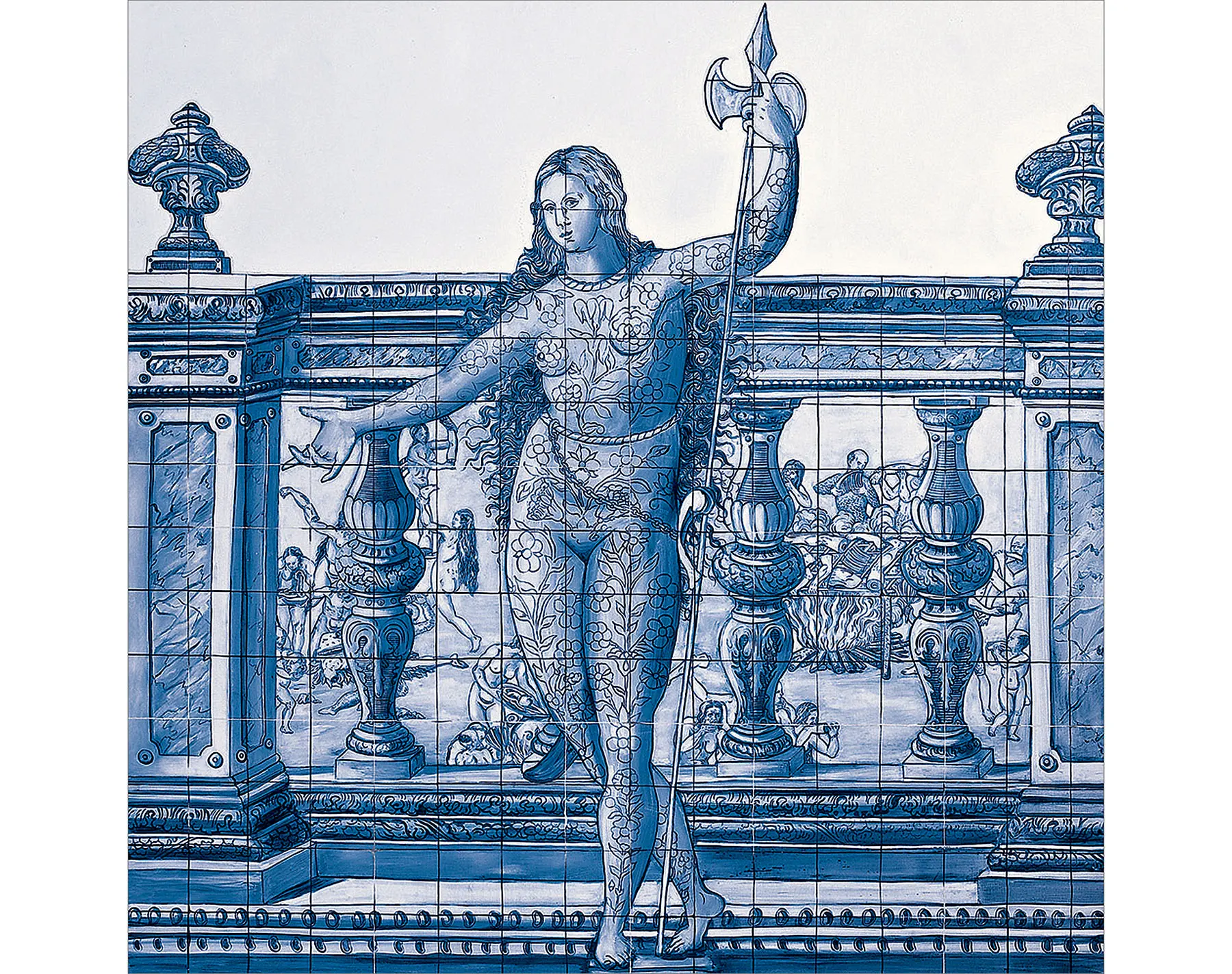
From among the works on display in this show, we must highlight Entrance Figure, 1997, from the series Proposal for a Catechesis (oil on canvas, 200 x 200 cm), as part of a conscious effort in transgression achieved by shifting comfortable points of view. Indeed, this large-format pictorial tile created by the artist cancels the usual cold and shiny enameled context of such tile panels and moves towards another mode of apprehending the historical narrative, insisting on the recreation, in oil, of an unorthodox scene.
This pictorial panel presents an anthropophagic celebration against a white and blue background, an ecstasy as cannibalism erodes the colonial imaginary, softened by the female figure that invites enjoyment of the spectacle of exposed viscera next to mutilated bodies.
Also as part of this process of investigation and reorientation in Histórias às margens, Varejão’s Invitation Figure III (2005, oil on canvas, 200 x 200 cm) proposes a new resource, created on the basis of fragments of a narrative confronted by hidden domination. Once again it is a female figure that guides viewers towards the revelation of a painted-tile background where floral motifs alternate with quartered arms and legs, bringing to memory the horror and barbarism, the underside, of many periods during the colonial era.
The vitality of Adriana Varejão’s visual poetics reveals a wide set of interests, explored during the past two decades in a variety of pictorial proposals. Among those interests, Varejão investigates the institutional presence of Chinese porcelain and its use for the recording of domination and the unfoldings of colonizing violence.
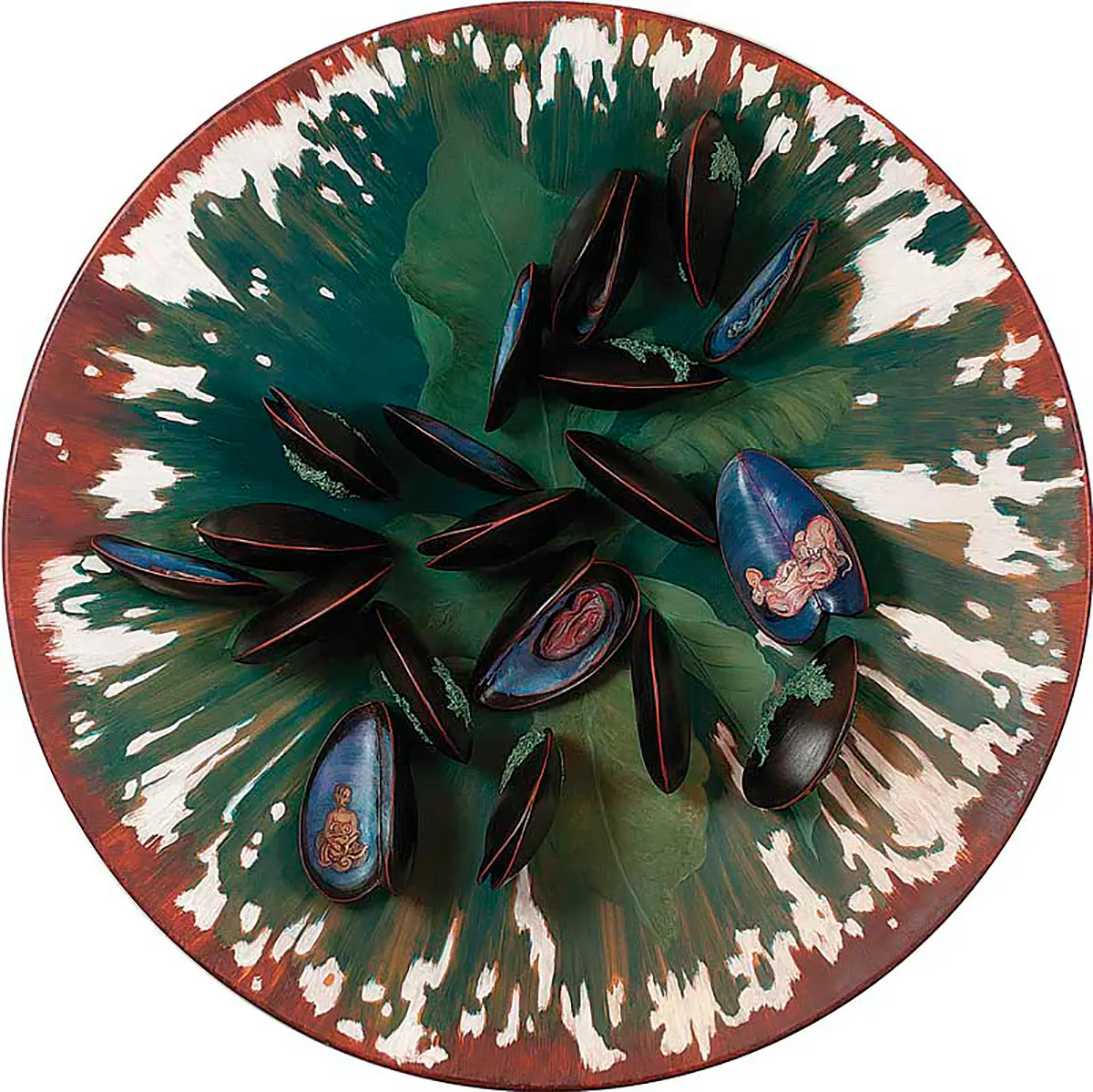
Among her most recent works, Seafood Plate, 2011, suggests a return by the artist to situations she had explored in the previous series, as when she used broken pieces of porcelain in collages intended to reflect on the notion of the fragment and perversion. In fact, this large-format object (150 x 25 cm), made in oil on fiberglass and resin, unveiled for the show’s visitors a new pictorial experience.
The experiment in painting, composed of greens, earth tones, blues, and violets, invited our gaze to study the interior of open “seafood” attached to the bottom and the edges of the plate. Inside the creatures, semi-open, the fantasy of female bodies is painted among the denizens of the sea.
As the visible face and sensible record of a sensorial, tactile, and gustatory dimension, works like Ama Divers (2011), Children and Quince Fruit (2011), and The Savage One (2011) are part of an oeuvre built on the data of the artist’s conscious poetic and visual option. Moving back and forth along the pathways proposed by unceasing creativity, viewers found reason and meaning and were made aware of the cracks and the many other ways of apprehending and/or visualizing time-forgotten narratives.
CLÁUDIA FAZZOLARI
Art History professor, art critic, a member of the Brazilian Art Critics Association (ABCA) and the International Art Critics Association (AICA).