
In conjunction with the Reina Sofía Museum of Madrid and the Tate Modern in London, the Museum of Modern Art in New York organized a retrospective exhibition of Alighiero Boetti. It was on view in its last station, in New York, from July to October, 2012.1
The exhibition is very moving, especially if one happens to belong to the same generation and shares Boetti’s artistic interests, which in my case. Brazilian artist Antonio Dias, another member of the same artistic generation, an early fan of Boetti, introduced me to his work in 1971 during passage through Milan. Boetti had gone to Afghanistan some months earlier. From what I remember forty years later, Antonio described some of his works where he used postage stamps in combinatorial color compositions, something I didn’t find particularly interesting. Further, I dismissed his trip to Kabul as one of those searches for exoticism, Eastern enlightenment, and/or maybe drugs. At the time I became more interested in the early 1960s work of Giulio Paolini, an artist also admired by Antonio. In any case, this was my (late) first introduction to Arte Povera artists.
After that superficial introduction, I encountered Boetti’s work here and there, very punctually and inconsistently. I still couldn’t make much sense in terms of an overall pattern or read him as an artist. My favorite piece then and today was Iter-vallo (1969/1986) a checkerboard formed by square steel plaques alternately covered and uncovered by a sheet of vellum paper. It looks like a small Carl Andre piece, but with poetry in it. The piece is in the catalog but unfortunately not displayed in the MoMA show. Then, there were his pervasive maps of the world - his most famous pieces, but they left me cold.
Generally speaking, MoMA’s exhibit now presented me with a new and unexpected artist. The presentation is not only the strong artist one assumes Boetti to be, but it also manages to make us see the person as an integral part of the production. And the trip to Afghanistan that had impeded a possible meeting in 1971 was not based on any mystical interests. One story, not necessarily true but a consistent one, tells how, after a sale of works, Boetti immediately rushed to the airport and asked for the first flight out. It happened to be to Kabul and there he went.2
With Boetti’s diversity of pieces, one might think of Duchamp. While Duchamp is an acknowledged role model for him, Boetti often lacks his accuracy. Normally this would count as a minus; here it looks like a humanizing plus. Boetti is primarily an honest artist who does not pursue the effect of spectacle, and who shares his struggles with the public. Some of his pieces betray shifts of purpose or show remnants of awkward sentimentality, and that makes the exhibition friendly and accessible.
More than others in his generation and more concretely in those grouped by Germano Celant under the “Arte Povera” label, Boetti focused on issues of classification and order. MoMA’s exhibit fittingly presents his (dis)orderly and intoxicating trajectory in this pursuit. After walking through the show one realizes that disorder actually only exists for the formalist mind, one that when looking at art stops at the appearance of the pieces without ever entering them.
The backbone that holds the exhibition together is Boetti’s mind. He declared thinking to be the sixth sense, and that is what he exercises the most. And, in uneven battles, his mind is continually confronting the pitfalls of linear logic and a taste that sometimes contradicts him.
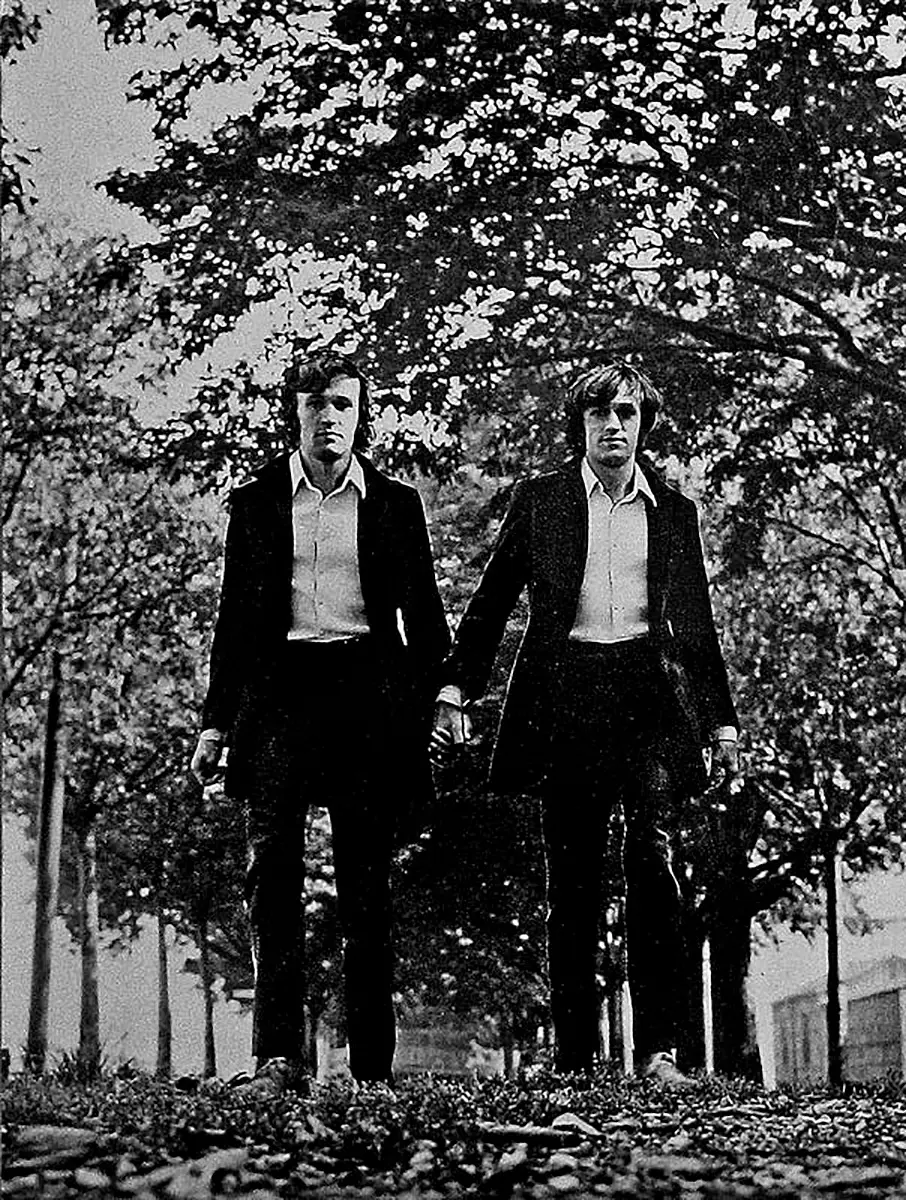
Refreshingly, the quality of order sought by Boetti lacks personal hubris. He challenges rather than dictates, and because of this strategy, much of his work is also about distancing. He is a third party to work and public, he messes things up but stays out of it. The evolution of his name from his child’s Alighiero, to his first adult use of Alighiero Boetti, to the final split of his name during the 1970s into “Alighiero e (or “and”) Boetti” with which he finished the nomenclature of himself, is symbolic. That very relative self was already illustrated in his postcard Gemelli (Twins) (1968). In it he appears twice, holding hands with himself. It is not a split generated by pathology—at least not as far we may know—but one that represents other kinds of dualities: observing the world and being observed, the opposition of rational to arbitrary thinking, and, more importantly, the making of order and disorder. To that, one might add a conflictive relation between creation and authorship.3
The exhibition starts chronologically and explicitly with works that seem to stress the use of materials. Boetti was one of the artists included by Germano Celant in his first Arte Povera show in 1967. A brilliant public relations ploy, the approach of Arte Povera was relatively conservative. It challenged traditional art by means of the use of alternative and non-artistic materials, but without really challenging or revising the essence of art. While Boetti used found or bought materials alien to the art tradition, which is why he qualified to be included, his work wasn’t really about materials. The presence of quotidian hardware and lumber stuff was used to exclude some art associations and interferences, and deal with other, more interesting issues like grouping, classification, and order.
It is not surprising therefore that Boetti soon distanced himself from the Arte Povera label. In her essay in the catalog, Claire Gilman invokes Italo Calvino as Boetti’s soul mate and remarks: “To frame a painting is a ‘civilized act’ because it reveals the undifferentiated world to have passed through consciousness.” Frame, for Boetti is a broad concept. Gilman finishes her essay with: “Like Calvino […] Boetti makes fiction of reality with all the uncertainty, irresolution, and subjectivism this term implies.” 4 This seems to sum up both a certain transmutation that Boetti achieves in his work, as well as his unresolved struggles.
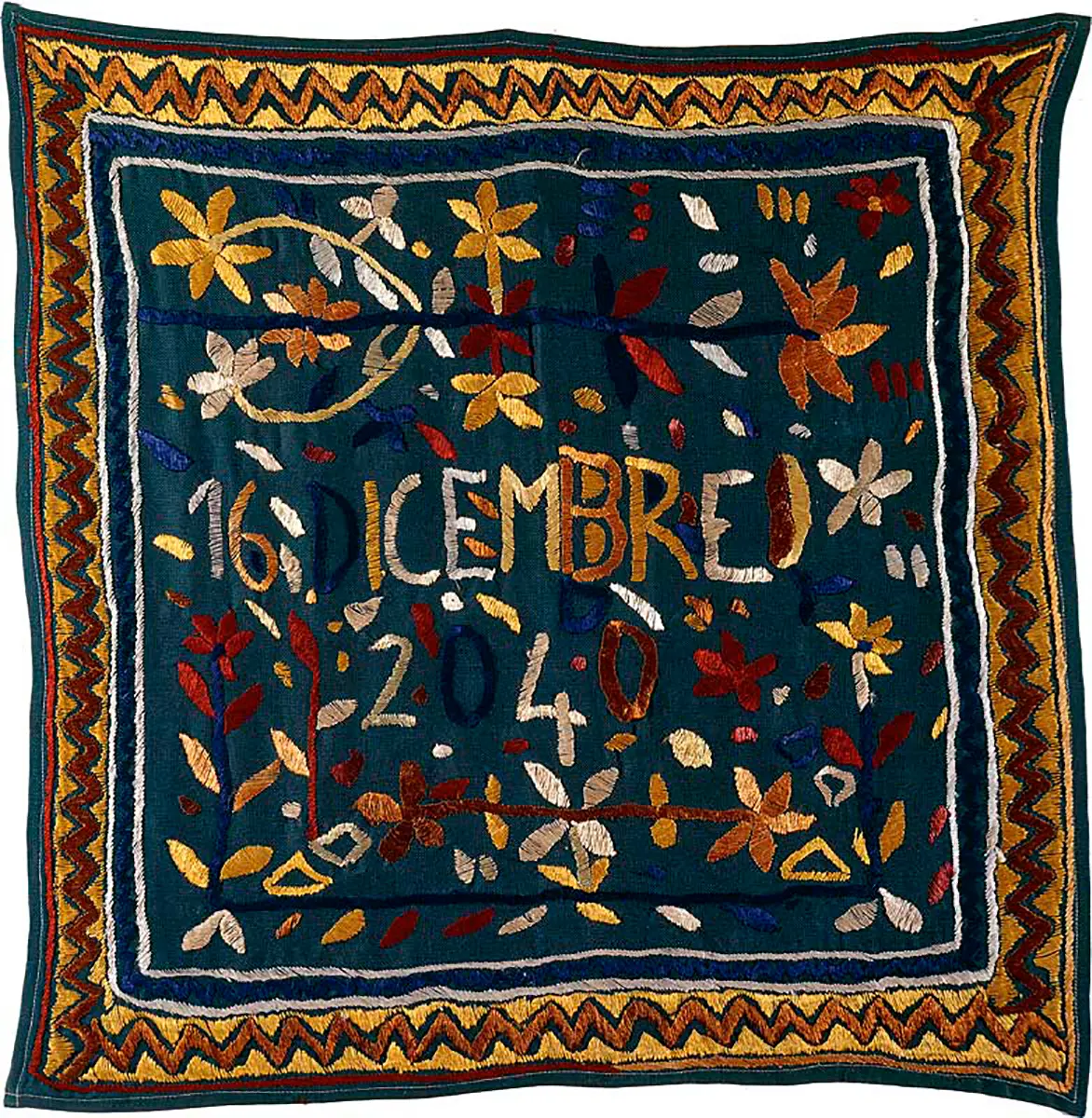
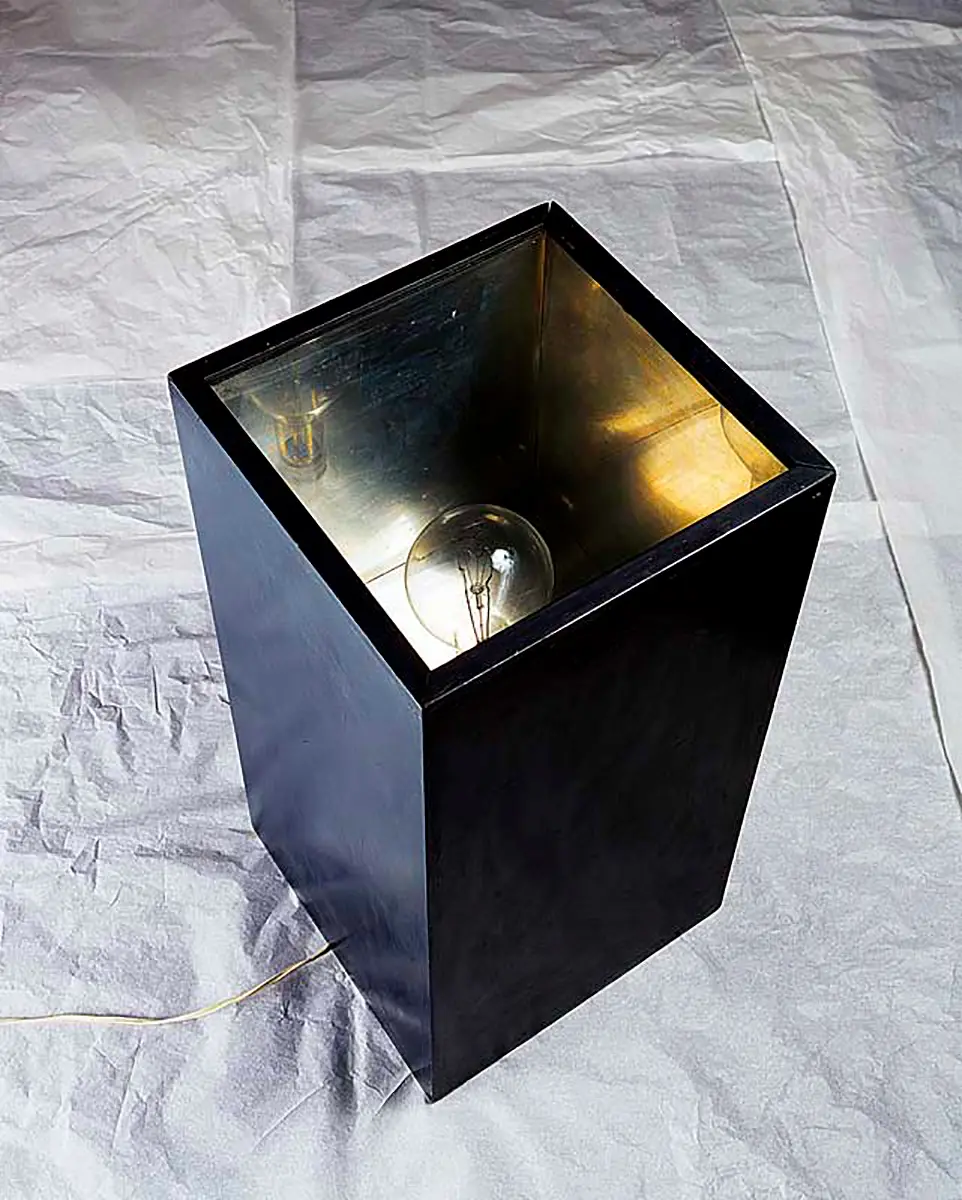
Boetti’s focus on order and disorder is already clearly present in one of the earliest works in the exhibition, Lampada annuale (Annual Lamp) of 1966. A light bulb turns on once a year for 11 seconds in some unpredictable moment. Time here is reorganized into a real but unreadable sequence and becomes the true material for his work. A later piece, a series of telegrams started on May 4, 1971, begins with “Two days ago it was May 2, 1971” and continues with following telegrams posted four days, eight days, sixteen days, and so on after that date. The whole system of timekeeping centers on one arbitrary day and expands into a geometric progression of intervals. Time in Boetti’s work is a recurrent mysterious entity. In one statement he ponders how a current date is trivial and over time it starts to acquire richness. “1970” is meaningless in its own moment, but twenty years later it grew with a nostalgic aura. He worked on the centenary of his birth: a plaque simply engraved with a “December 16, 2040,” and another one with the date he predicted for his death, which he set as July 11 of 2023. This prediction was, unfortunately, an error. He died in 1994 leaving us with the feeling that we only see half of his work.
Boetti sets down rules that with his help, or that of others, produce (within reason) unpredictable results. The exhibition’s title: Game Plan, therefore, is no accident. The establishment of rules can lead to chaos or too trite results. Tic-tac-toe is predictable after the first move while chess is not. Therefore, to design games that are open enough to be unpredictable but that also eliminates failure is a difficult task and Boetti remains on the shy side of this. The title Il cimento dell’armonia e dell’invenzione (The Contest Between Harmony and Invention) synthesizes some of the problems he faced. In 1969 Boetti adopted the title from Vivaldi’s cycle of concerti written between 1723 and 1725. It is the group that includes The Four Seasons. The confrontation posed by Vivaldi is typical for much of anybody’s creative process, where one has to balance initial creation with the form it has to take for communication. For Boetti’s work, this is an emblematic opposition. Cimento is not a clearly translatable word. Used as “contest” in the English translation both for the concerts and for Boetti’s piece, it is also construed as referring to dispute, ordeal, and fight. In Spanish Vivaldi’s cycle is sometimes translated as “conflict.” This latter interpretation actually may be more fitting for Boetti. In Italian cimento is not much clearer and also has several meanings. In Vivaldi’s case, it is presumed to refer to the risk given by his pleasure in experimentation when he overlays the “ritornello” with programmatic elements.5
In any case, Boetti’s concern does not seem to be focused on which of these— harmony or invention—wins the competition. Rather he’s interested in the tension created between them. A contest would mean that as an artist he would identify with the invention while harmony would represent the need to let others know about his achievement. Boetti’s handling of order, however, does not seem to be an act of asserting inventiveness, as is generally the case in art-making. Instead, he uses the tension between invention and harmony to help him elucidate and question the role and placement of authorship. In Il cimento dell’armonia e dell’invenzione, Boetti retraces the printed lines in several pages of graph paper. His “thoughtless,” and therefore somewhat dangerous variations of pressure on the pencil, modulates the result. It’s not unlike Sol Lewitt’s pencil murals made the same year, in which other people follow his instructions. The mistakes made during the process give an unpredictable richness to the end result. Authorship understood as hand-controlled art is removed at least one step from the result. The work happens rather than being made.
The issue of authorship as a signature style equivalent to personal handwriting pretty much went out the window with the advent of pop art. Image branding took its place instead. The next step then was to set up conditions or game rules so that somebody else could either play or make. This shifted authorship from production, or from the design of production, to the design of games. Using the notion of “game” to define works of art changed how we perceived art. A good realist rendering today is not anymore (or not only) a virtuoso copy of a model. Now it is about transferring information from outside the canvas onto the canvas, dot by dot. One then watches something akin to a game of “dots and boxes,” played better by some and less well by others.
In 1971 Boetti had his centenary and death dates embroidered in Afghanistan. To his surprise, they came with shifts of color (because a particular thread color had run out) and with the addition of unsolicited ornaments. This event opened the door to commissioned work done under relatively loose rules. It also introduced an unresolved issue: when and how is labor allowed to become creation? How far may deviations go until authorship is shifted to anonymity or becomes meaningless? Or, as in LeWitt’s pencil murals, when do mistakes become an asset?
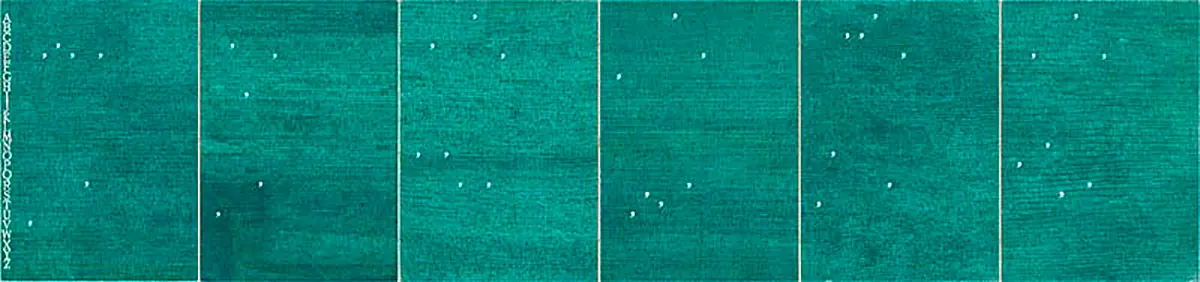
In his Mettere il mondo al mondo (Putting the World Into the World) (1972-73), and I sei sensi (The six senses)(1974), pieces he repeated with variations over the years, Boetti hired teams of people to fill pages with ballpoint lines following a given rhythm. The stunning painterly texture is the product of accidental variations produced by the different people and their haphazard markings. The pieces are less open to the reader. Commas lined up with corresponding letters invite the decoding of words, limited and passive interactivity.
From that point of view, Boetti’s games are mostly speculative within his own mind and take the form of monologues rather than dialogues. The viewer is not encouraged to really play but, in the better pieces, is forced to reconsider knowledge. The hired makers of Boetti’s works, on the other hand, have margins for improvisation, this being freedom of choice with respect to the content of the text, color, or deviation from a norm. This freedom, however, is only to the extent that the art-making stays within the artist’s plan, as long the variations don’t matter. In that sense, the challenge was posed by Boetti only half-heartedly, and much more radical examples were produced by other contemporary artists. The memorable bathroom constructed by Roberto Platte in 1968 in Buenos Aires comes to mind. During Juan Carlos Onganía’s regime, one of Argentina’s most repressive dictatorships, the construction set in the middle of an art exhibition implicitly and successfully encouraged the contributions of political graffiti by the public.6
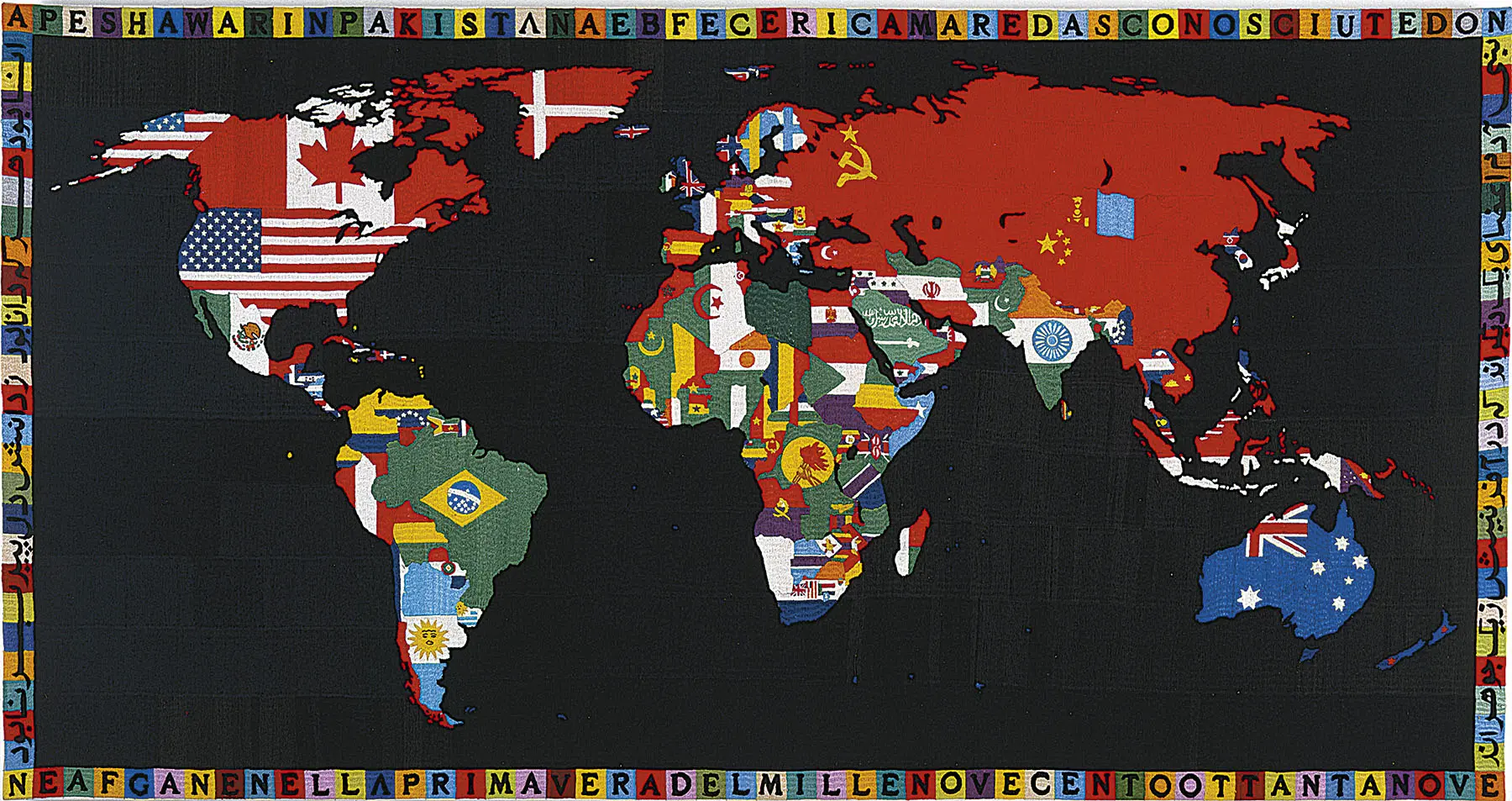
For a more formalist minded public, there is a separate and visually stunning display of Boetti’s carpets, with the prominent display of his iconic world maps among them. His trip to Afghanistan paid off with the production of hundreds of wonderfully looking carpets. Over time, the image of a world depicted with the national outlines and filled with the design of corresponding flags has become Boetti’s signature. However, in terms of his art speculations, they are also among the weakest. Flags taking the shape of corresponding countries are a very basic tautological construction that doesn’t reveal anything. The power of those carpets lies in two external factors: the appealing colors that provide a painterly effect, and the relatively uncontrolled way they were done. About them, he commented that he didn’t do anything: “. . . the world is shaped as it is, I did not draw it; the flags are what they are, I did not design them. In short, I created nothing.”7 This is true to the extent that at one point he forgot to indicate the oceans. The weavers (people with whom he never had direct contact and who didn’t know maps or the image the work was supposed to represent) filled the space with the thread that happened to be most available. This resulted in pink and green oceans, a result that subsequently prompted Boetti to leave those decisions open, including as well space for texts in Persian, the content of which, because he couldn’t read Persian, remained mysterious to him.
In 1994 the Dia Center for the Arts in New York showed Boetti in dialogue with Frédéric Bruly Bouabré. 8 Since I was interested in both artists it was unforgivable that I missed the exhibition. It seemed a little odd to pair a Torino ‘sophisticated’ artist with a “naïf” Bété artist from the Ivory Coast who used postcard size color pencil drawings in his cycle called World Knowledge to record everything known by the Bété. After seeing Boetti’s show in MoMA, that pairing turns out to be amazingly perfect. Both artists, in their own way, are classifiers and comprehensive organizers of the world. Both “pass the undifferentiated world through consciousness.” During the preparation of that Dia exhibition, shortly before Boetti died, they became good friends. Boetti gave Bouabré a watch with his name engraved on the face. According to Bouabré, the watch stopped the day Boetti died.9 Time, for once, was actually of the essence.
(Edited by Selby Hickey)
NOTES
1. Alighiero Boetti: Game Plan, July 1-October 1, 2012.
2. Christian Rattemeyer, personal conversation 09/12/12.
3. Rattemeyer makes his own list of dualities: “rule and chance, logic and indeterminacy, order and disorder, singularity and multitude, similarity and difference, classification and boundlessness, male and female, seeing and not seeing.” Ibidem, p. 29.
4. Claire Gilman, “Figuring Boetti,” in Alighiero Boetti: Game Plan, catalog for the exhibition, Museum of Modern Art, New York, 2012, p.141.
5. I have received this explanation from Maurizio Pennica, personal e-mail, 09/20/12.
6. Roberto Platte, Baño, “Experiencias ‘68,” exhibition at the Instituto Di Tella, Buenos Aires, 05.8 to 05.23, 1968. The installation was immediately closed by the army.
7. Christian Rattemeyer “From Alighiero to Boetti,” Game Plan p.44. The quote appears again in Mark Godfrey, “Boetti and Afghanistan” p. 167, and appropriately appears as signage in the space dedicated to the carpets.
8. Worlds Envisioned, Dia Center for the Arts, 10.6,1994-06.25, 1995, curated by Lynn Cook (who also curated this Boetti show for the Reina Sofía version) and André Magnin.
9. Yaya Savané, An interview with Frédéric Bruly Bouabré, Worlds Envisioned, Dia Center for the Arts, NY 1994, p. 93
LUIS CAMNTIZER
Uruguayan artist. Emeritus Professor at the SUNY College, Old Westbury.