
Last September, Bergamin Gallery presented a representative selection of works by Aluísio Carvão, who played a significant role in the genesis of contemporary art in Brazil alongside such figures as Hélio Oiticica, Abraham Palatnik, Lygia Pape, Lygia Clark, Franz Weissmann, Amílcar de Castro, Mario Pedrosa, and Ferreira Gullar. Encompassing every period in Carvão’s career, this solo show included works that functioned as period-diving landmarks in the artistic development of this “foreigner” who arrived from Belém do Pará to join, in Rio de Janeiro, the then-ongoing debate about the construction of a space for painting that was not defined by emotion, hedonism, or even patriotism. Carvão soon aligned himself with the artists that were to launch the Concrete movement, with whom he shared a desire to discover new ways of generating the particular language of form and color, taking painting to the extreme of its potential. Interestingly, that crucial encounter with the Concrete group was, to a degree, an accident. Coming from a disadvantaged background, Carvão had started working at a young age, and after trying several jobs (illustrator, set designer, actor) he had settled as an art teacher in the state of Amapá, where he was living in the 1940s. In 1949 he won a professional development scholarship given by the Ministry of Culture. He moved to the federal capital and after completing his training, in 1952, he began attending Iván Serpa’s legendary free course in painting.
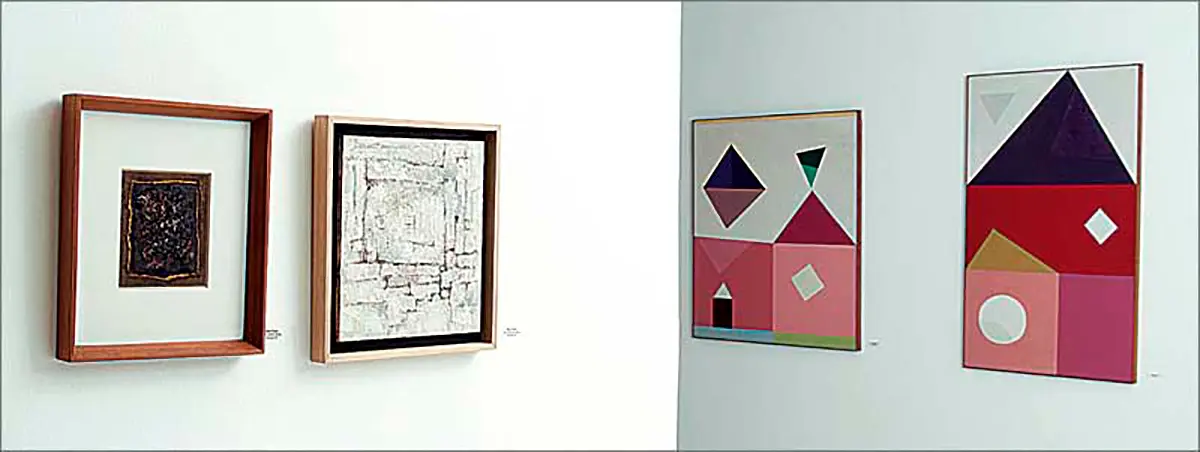
His contact with those artists and critics was decisive for Carvão. Lead by Iván Serpa, they founded the Frente group, which pioneered geometric abstraction in Brazil and debuted with an exhibition at Ibeu gallery in 1954. The group’s members had their own mode of expression, but they were united in the desire of breaking free from figuration and with a nationalistic kind of painting. From that period date, Carvão’s more markedly constructivist works, with more rigid schemes and more timid colors, among which the retrospective’s curator, Denise Mattar, highlights Composition 36, an oil-on-chipboard work of rigorous vertical and horizontal lines and few colors used with parsimony. The composition transmits a sense of modernity aligned with the architecture of cities that, at the time, were in a process of fast expansion, with its unadorned rationality. Also present in this exhibition are works like Cube Color, from 1960, a cement and red pigment cube which was one of Carvão’s most important three-dimensional explorations. With this work, the artist achieved his desire to, literally, give the color a body. It was during this decade that he began using unconventional materials in his work, such as the bottle caps seen in Surface II, from 1967, or the small metal plaques applied on the wood of Whispering Surface II from the same year, and Aquarium II, which expand his art by adding sound and motion effects.
Carvão’s more passionate than rational relationship to color and his will to experiment, notable in his Chromatics series (1957 to 1960, paintings left unframed for better integration into their space), drove him to sign the Neo-Concrete Manifesto written by Ferreira Gullar in 1959. Throughout his career, Carvão used a variety of materials and displayed a preference for color as a pigment, regardless of how it was produced. Included in this show are works in graffito, wax, and pastel.
In 1961, Aluísio Carvão attended the Hochschule für Gestaltung in Ulm, Germany, as a visiting student. That same year he won the Grand Prix at the National Modern Art Salon and a travel scholarship; he went to Europe, where he remained for two years. After returning to Rio de Janeiro, he began teaching at the Museu de Arte Moderna. In 1967 he took part in the emblematic exhibition Nova Objetividade Brasileira at the MAM in Rio. Throughout that decade and the next, Carvão intensified his investigation of alternative materials and constructions in space.
In the 1980s, Carvão taught also at the Parque Lage Visual Arts School, influencing artists of a generation that gained notoriety for its celebration of painting. He returned to the canvas as support, with a more lyrical approach to color, now generously distributed in singular shapes that compose equally unique works of art, such as Casapipa pipas lua, Ccasapipaula sol, and Pipaporta, Casapipa, Pipa lua, Flâmula. Unlike his equally geometric works of previous periods, painting here is no longer engaged in a monolog with itself, but in a conversation with the artist’s remembrances. In contrast with his own name, which expresses an absence of color (“carvão” means “coal” in Portuguese), Aluísio Carvão uses, with great talent and skill, the entire palette.
SYLVIA WERNECK