
The identity and safeguarding of individuals as social and cultural beings are intimately connected to history and memory. Yet, one of contemporary society’s most unsettling symptoms is its collective amnesia, which generates a schizoid subject unconnected from his or her past and his or her surroundings. Compelled by the demands of purely economic functions, the contemporary individual is increasingly unmoored from his or her subjectivity and given fullness—if at all—only in the objective domain; this creates a dystopian social entity that is, in many instances, inoperative.
Throughout her career, Ana Tiscornia (Uruguay, 1952) has been concerned with this medullar fracture of Being. Her work becomes a plea against the repression of memory as an ideological tool, and a rousing call for individuals who venture into the uncomfortable unknowns proposed by her works.
The artist was educated in architecture, the visual arts, and print-making; her work, which mainly comprises collages, photographs, installations and intervened objects, is marked by the dichotomy of memory and oblivion as ideological instruments that manipulate and determine the contemporary social subject.
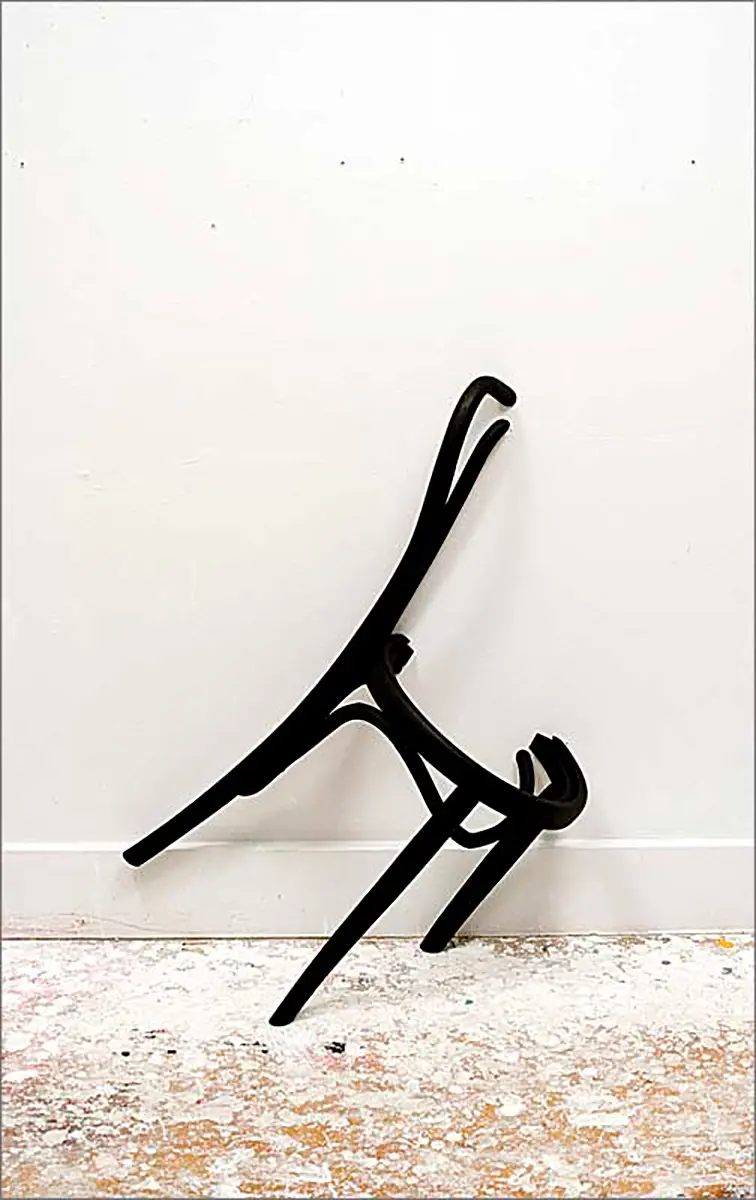
Other Impertinences, the artist’s first exhibition at Alejandra Von Hartz gallery, in the Wynwood District of Miami, includes a number of objects, sculptures, and collages that are the result of her intervention and manipulation of everyday materials, furniture items, and similar structures, that, disarticulated through a chaotic effort, generate a tenacious tension between cardinal polarities such as order and confusion, memory and oblivion, persistence and impermanence.
Ana Tiscornia’s formative years as an artist and an individual are inseparably connected to political activism. In the late 1960s, the Uruguayan intelligentsia lived in a cultural and political climate where any form of cultural activity was closely connected to socio-political critique. The arrival of dictatorship in 1973 meant a radical shift as well as one of the darkest moments in Uruguayan history.
With their alarming disarticulation of inhabitable space, Ana Tiscornia’s works represent a fracture in the utopian project in a historical sense. In this way, the dislocated fragment becomes the cornerstone of chaos, installed as a new order. Appropriating architecture—a language for building par excellence, based on Renaissance reticulates and Cartesian axes as a sense of order, trust, and progress—Tiscornia makes us aware of the shifting grounds on which our contemporary era is based.
Red Grid (2011) and Green Line (2012), both included in this show, are symptomatic in that regard. Created as a collage on paper, Red Grid contemplates a free-hand drawing in red where we can see the reticulate and elementary primary shapes such as the circle and the triangle. The consummated project lies on the ideal projected on the sheet of paper: an incomprehensible tangle of dislocated structures, inaccessible staircases, and barred openings that contradict our notion of the inhabitable space.
Green Line, acrylic on canvas, again repeats this irreconcilable structure of impeccable technical skill. A green line traverses the painting at the level of the viewer’s horizon. This element appears as our only possible grip while reasserting the notion of the dominant chaos.
How Things Stand 2 is the result of an intervention on a typical Thonet-style chair. A symbol of Art Nouveau’s conciliation of graceful lines and mechanical reproduction, the Thonet chair soon became the preferred furnishings of cafés and meeting places. The broken lines and unbalanced structure of How Things Stand 2 allude to our era’s fracture between communication, mass production, and meaning.
For its part, Situation with Blue Spot (2012) incorporates wooden fragments into an anarchic composition. A finished circle, painted in blue, appears in the upper right corner. The color blue has special connotations in Ana Tiscornia’s oeuvre. Associated with her native country and its recent history, this color appears in the first instance as a symbol of identity and a complaint. At the same time, the use of the circle, for centuries associated with formal perfection, alludes to the search for perfection and order, and, in that connection, the realization of the purest ideals.
With its high poetic charge, Other Impertinences is an effective social parable about the contemporary age, a call to awareness, and, above all, a starting point for the recovery of memory as the sole viable grip for the construction of our society.
JANET BATET