
The Argentine gallery Del Infinito Arte inaugurated its new Bogotá location in July. An extraordinary event: it is the first international gallery to open its doors in that city, proof of the momentum gained by art in Colombia, a country with local scenes renowned for their independent processes, a capital city with a diverse and growing art circuit, and two expansive international art fairs.
The gallery’s activities began with a solo show by Martín Reyna. Its second show presented a selection of works by Andrés Sobrino, also from Argentina. Sobrino’s exhibition, a brief overview of his career, was dominated by the presence of a number of abstract paintings characterized by their chromatic sobriety and their exploration of minimal elements as a conceptual and formal value. Sobrino’s movement towards signs, as noted in his series of black and white paintings Homenaje a Malevich, was complemented with other, freer paintings where the artist executes straight-edged geometric shapes and applies flat colors that are assured, bright, high-contrast.
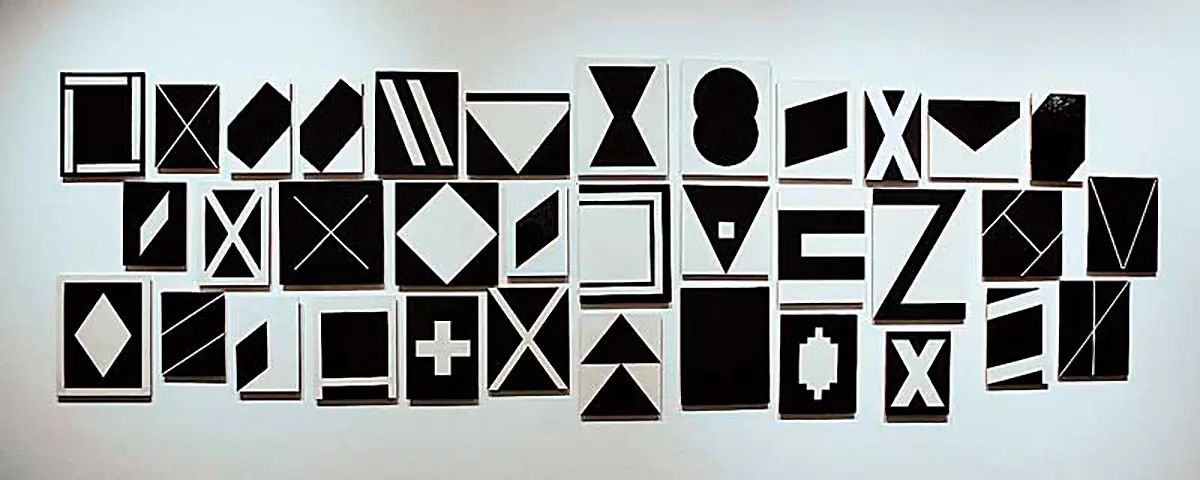
Sobrino’s connection to the entire history of abstract art in Argentina—River Plate constructivism, Madí, and later artists like Rogelio Polesello and Roberto Aizenberg—is evident here. But perhaps what is most revealing in this Bogotá presentation of his work is his correspondence with some local artists who have been working in response to the highly politicized Bogotá scene, developing productions that return to the forms of modernity, or what is left of it, to continue interrogating the very nature of art. Artists like Jaime Tarazona and Fernando Uhía, whose recent works explore abstraction as a conceptual operation capable of resisting the ideological content implicit in the representation, or in order to continue questioning the sensorial nature of reality. Like the Colombian artists mentioned, Sobrino takes advantage of some elements of what can be called abstraction’s mimetic camouflage, such as its appropriation of the grammar of design, its elimination of expressive features, the use of interchangeable models and molds that reinforce a sense of equivalence, and the exploration of concepts like anonymity, accumulation, synthesis, and autonomy. Values that can be found in Sobrino’s Sin título, the sculpture that stood on the gallery floor and comprised three wooden structures, each in the shape of a cross: perhaps a statement about the ways in which forms, objects, and history perpetuate themselves.
In terms of his technique, Sobrino uses industrial colors and materials, synthetic enamel on multi-laminate and MDF, and industrial ribbons; like the artists cited before, he lets loose a taste for popular elements, a “popular minimalism,” in his own words. A post-pop attitude that helps us see his painting as a parody-inflected critique of the devaluing of images, obviously supported by the industrial materials he uses. At least at first glance, this not-so-evident critique of systems of representation would appear to be on display in another one of his works, an untitled photograph of foggy dusk in superimposed images, accompanied by a group of MDF rods that, as in a gradient—cream, brown, red, black—simulate quasi-scientific evidence of the chromatic quantity contained in the laconic landscape. This is perhaps the work that defines the exhibition. Like all photographs, it is the result of a mechanical act that produces an image without the need for the manual values of painting—manufacture, gesture—a reflexive act close to the readymade. Contrasted with the gradients that attempt to “translate” it, it reveals both systems—photographic and pictorial—as mere modes of production, with painting as, in Sobrino’s case, a process that examines itself. Beyond that, and borrowing from Benjamin D. Buchloch’ analysis of Frank Stella’s work of the 1960s and 70s, we can assume that Sobrino, like Stella, is interested in a critique of the technocratic-corporative organization of perception and of our lived experiences and that the artist devotes himself, sustainedly and systematically, to a practice of anti-aesthetic skepticism against aesthetic values that have become mere decoration.
Finally, the exhibition closed or opened, with Sin título, an installation with industrial ribbons on a multi-color belt that traversed the floor, columns, and walls at the gallery entrance, appealing to the viewer’s sense of humor and suggesting a passage from skepticism into participation.
SANTIAGO RUEDA FAJARDO