
For his third solo show1 at the Galerie Jeanne-Bucher, Arthur-Luiz Piza (São Paulo, 1928) presents a series of recent works (2005-2012) created for the most part from groups of assorted gratings or grilles associated to uniformly colored small metal sheets according to a range of primary colors. The sensitive universe of this Brazilian artist conveys a conceptual and formal coherence that has not been betrayed by changes of support and materials because Piza is, above all, a constructor, and a change from the chisel and metal to paper and cardboard—as he is mostly known for his engravings—to cutouts and metal assemblages, have not altered this underlying quality that makes him a “sculptor,” or a painter with a delicate palette of subtle colors. Indeed, for many years now Piza has been able to confer a “sculptural” dimension to paper and cardboard through incisions, folds, and collages, with the insertion of various materials—such as thread, wood, or metal—to create an intimate universe in which the interactions between light and shadows, stability and movement, plane and relief, density and translucency, demonstrate a profound pictorial and spatial sense. Piza’s refined selection of colors, his work on subtleties reveals a constant search that combines sensitivity and reason, and sometimes a touch of randomness. Geometry is a universe, but it is never cold despite its desire for Kinetism. Playfulness is not absent in his constructions. His art conveys a “sensitive geometry” theorized by Brazilian art critic Roberto Pontual when referring to Latin American Geometric Abstraction.
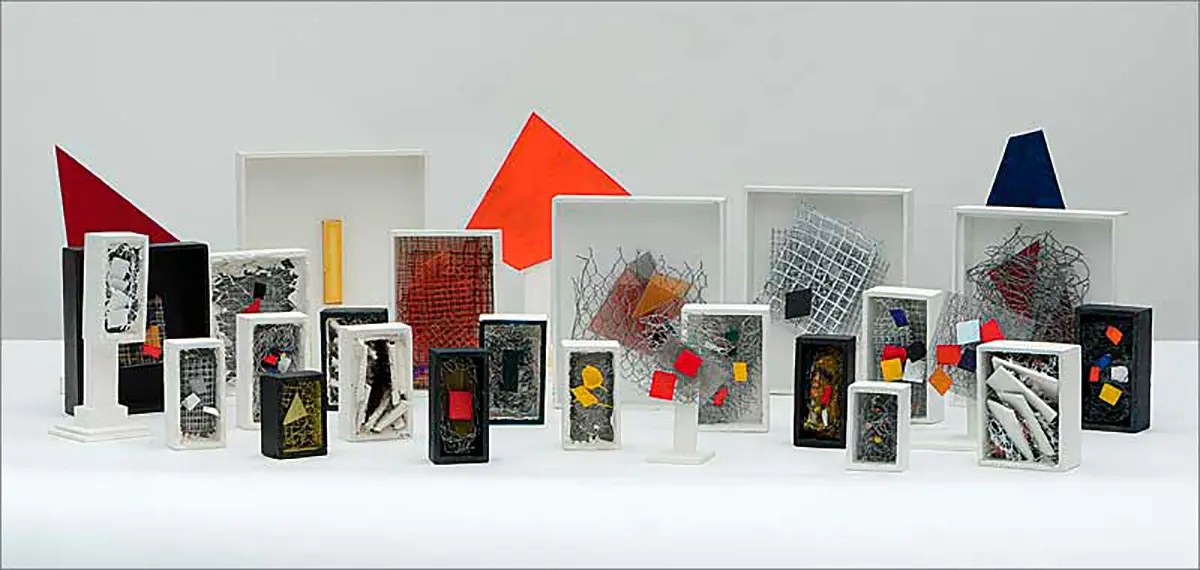
This dense exhibition includes small boxes—wood, painting, and assorted materials—several groups of screens of various sizes hung on the walls or displayed on baseboards, and sculptures created with new materials like upholstery springs. Jean-François Jaeger, the curator of the gallery, chose to showcase a large number of works, perhaps to create the impression of saturation of the space. Nonetheless, it is precisely this profusion that materializes the obsessive variations of a technique approached infinitum; one responsible for allowing us to easily access the essence of the spatial and pictorial explorations by Piza. The logic of an artistic trajectory in constant search of proposals thus becomes intelligible, allowing us to appreciate the experimental mastery of gestures, expressed through the enjoyment of limitless freedom.
What can we observe from this exhibition? Several groups of sculptures of varying sizes called Weaves that combine mesh, painting, and metal, were designed like open “books” in which the interaction between the meshes produces a visual vibration, while the colored plaques inserted in the metal meshes suggest a flotation effect. Three works constructed with springs underscore the central role of the materials in Piza’s work. He explores possibilities by relying on reliefs, thickness, density, and their opposing “immateriality,” either by affixing them on a wall or by placing them on a base. Created in 2012, L’attrape-Rêves N° IV (“Hunter of Dreams Nº 4,) is the work that the exhibition is named after. Designed as a sort of “tower,” the sculpture titled Babel (2008-2012) is one of the most beautiful pieces in the exhibition. Unstably balanced within its translucency, the superimposition of gratings opens the eyes to a “liquid” dimension. On the other hand, the gesture of complicity with Malevich in Le Noir (2012) and Le Rouge (Red, idem) resumes that notion of visual and actual instability that is one of the fictitious driving forces in Piza’s work. Two display cases constitute the focal points of the exhibition: one of them contains a large number of small boxes (10 x 5 cm approx.) that echoed the surrealist experiments, from “Arte Povera” and constructive art. Here, the artist places minuscule wooden strips and meshes painted black and white, as he turns objects in a sort of abstract reliquaries that he calls escondidinhos—glimpse, seeing or not seeing, to play with the hidden and the visible, etc. Titled Présages (Presages, small sculptures between 5 to 15 cm, 2012), the second display case consists of a group of boxes and “totems” that are like recreational and preliminary exercises that, according to Piza, are guided through the material.
Mexican painter and muralist David Alfaro Siqueiros coined his monumental painted and sculpted works as “sculpt-paintings.” These were designed for the moving viewer. It is a term that could just as well be applied to the most recent works by Arthur-Luiz Piza, in spite of the smaller dimensions in the Brazilian’s work. Profoundly marked by its constructive energy, the small and large formats in this exhibition communicate—aside from its creative vitality—a poetic feeling in which musical and aquatic dimensions, they create an opposition between movement and stagnation.
NOTE
1. The two previous shows were presented in 1999 and 2005 respectively.
CHRISTINE FRÈROT