
At the epicenter of Houston’s Museum District sits Renzo Piano’s demure wood-and-steel building that houses the Menil Collection. Under a canopy of live oak trees the art aficionado can walk just a few yards from the museum to the equally understated Cy Twombly Gallery, and the Rothko Chapel—guarded by Barnet Newman’s Broken Obelisk, standing in the middle of a reflecting pool. The Byzantine Fresco Chapel is around the corner and a block away, the Houston Center for Photography. Sculptures by Mark di Suvero, Jim Love, Tony Smith, and others, are strewn all around the green lawns of the neighborhood and of the adjacent University of Saint Thomas campus, designed by Philip Johnson. Since last June there is a new neighbor in the district: Sicardi Gallery, designed by architect Fernando Brave.
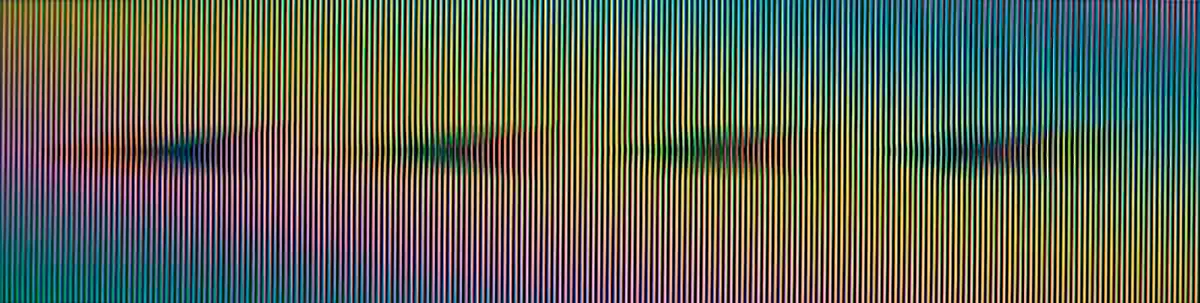
The first exhibit in this new state-of-the-art space was given to Colombian artist Oscar Muñoz. The second and current exhibit features on the ground floor recent work by the 89-year-old master of Kinetic Op art Carlos Cruz-Diez. The high ceilings of this new building and its spacious rooms give the viewer the chance to experience works like the twenty-six feet long Physiochromie Panam 94 (2011) the way they were meant to be. The viewer stands at one end of the work and sees blue/white stripes; he/she moves to the other end, and the stripes are red and black, whereas a frontal approach shows green, yellow, orange, and blue stripes. Cruz Diez’s playfulness at nearly ninety has not diminished, quite the contrary, it has increased—as evidenced in the ephemeral chromography-on-vinyl work Inducción Cromática a Doble Frecuencia (2012). It may very well be anathema for the non-figurative commitment of Cruz-Diez’s aesthetic tradition to say so, but this viewer sees in this work shapes flying across the color stripes that cannot be accidental.
On the second level of Sicardi Gallery, the viewer can tour Not Space Nor Time, the first U.S. solo show of Uruguayan artist Pedro Tyler. The unifying motif in this exhibit was the support of the works: wooden or metal rulers joined as if they were parquet flooring. One might have imagined Tyler to be alluding with those simple measuring instruments to Protagoras famous dictum “Man is the measure of all things”—as Fernando Casas did in 1979. But Tyler’s allusion lies rather at the beginning of modern science; in Galileo Galilei’s phrase, “Measure what can be measured and make measurable what cannot be measured.” Followed to its logical consequences, that prescription could be devastating to art; say for example, if someone attempted to measure beauty or imagination. However, Tyler is less concerned with its logic than with the materiality of the tools of measurement. Using a technique akin to woodcuts, Tyler carves onto the surface of the ruler's bas-relief faces of notable people in the arts and literature. Darkening the Light (2012), the main piece of this exhibit is a 6x15 grid that shows a set of 90 portraits of artists who committed suicide (although in some cases it is a moot point whether they did). Tyler states, “In 2008, I started working around the concepts of creation and destruction, the ability we have for both, and how their coexistence can be reasoned.”
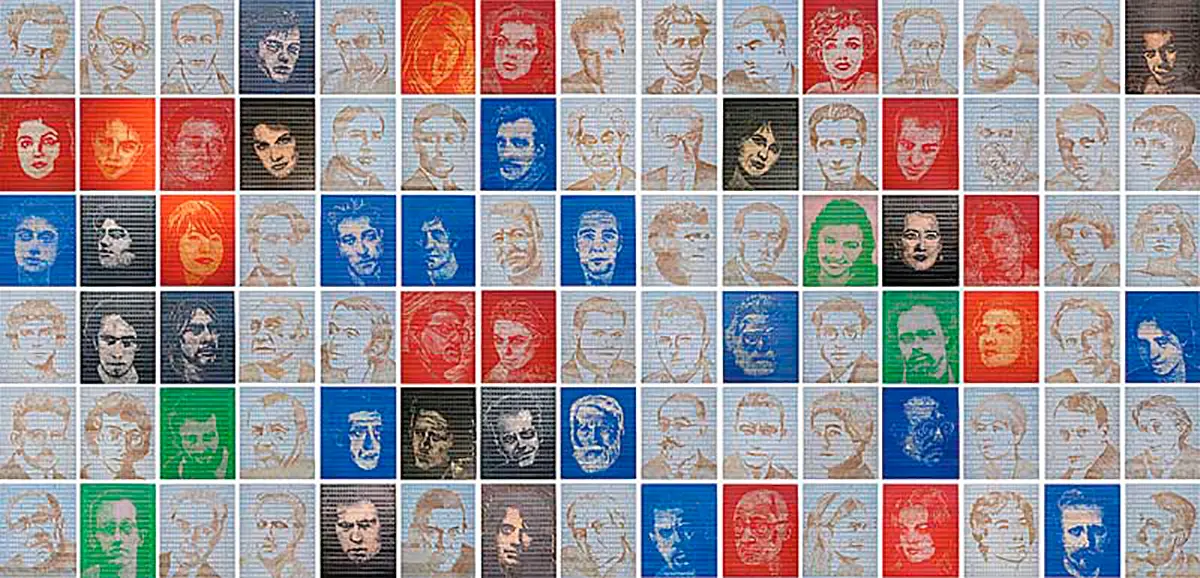
The frames made up of connected rulers in Darkening the Light come in five colors; each color standing for a different artistic practice. Philosophers and writers like Socrates and Yukio Mishima are drawn out of the white background so that the shadows are the carved sections. Musicians like Paul Hester are drawn on black under the supposition that music has no color; their highlights are the carved part of the wood. Painters and photographers like Vincent Van Gogh and Diane Arbus are on blue wood. Actors and directors like Marilyn Monroe and Rainer Fassbinder are on red; and those who belong to two clubs, like Violeta Parra and Daniel Gabriel Rossetti, are green. Is it telling that for all the background colors, except white, the carved portion becomes the highlights of the face rather than the shadows? Perhaps it is because writers and philosophers work with written language: ink on paper, dark on the light; or because the cerebral hemisphere that processes language is different from the one that processes images, but they both complement each other.
Another Tyler piece that stands out is Bloom (2012). It is a piece made of yellow rulers that resemble flowers (like Van Gogh’s sunflowers). As light shines on the rulers and through the carved letters that spell the phrase “WE MUST PUT COLOR IN SHADOWS,” the words are projected onto the wall where they hang. Light and shadow become materials of the work, thus fulfilling the command in the phrase. The phrase itself is mutatis mutandis what Vincent Van Gogh wrote to his brother Theo in a letter dated October 10th, 1885, referring to the Dutch painter Jozef Israëls (1824-1911): “When Israëls says that one must not paint black, he certainly never means what they now make of it, he means that there must be color in the shadows, but that excludes neither a single color scheme, however dark it may be nor of course that of the blacks and browns and deep blues.”
Carlos Cruz-Diez and Pedro Tyler represent two paradigms of art; the first one, non-figurative, atemporal, mathematical, and sensorial; the other, conceptual, figurative, and consciously historical. Sicardi Gallery houses both.
FERNANDO CASTRO R.