
I was unaware of the work of Carlos Herrera, winner of the Petrobras Award at ARTEBA in 2011 until I saw his show Un gesto de cansancio, curated by Santiago Rueda and presented in Bogotá courtesy of Ruth Benzacar, the gallery that represents him in Buenos Aires. I was intrigued both by the title and by the emotional payload carried by each one of Herrera’s sculptures and the way they are arranged in space.
Upon entering the gallery, we encountered a poem by Slovene author Peter Semolic, which I will transcribe in its entirety because of its importance for the artist. The poem alludes to one of Doris Lessing’s most heart-rending stories, Memoirs of a Survivor, where a middle-aged woman sees how a young girl who has mysteriously been left under her care gradually enters adolescence and becomes associated with a group of youths who destroy the city. The woman, attempting a gesture of survival, writes a diary in order to survive the terror that announces a future of desolation:
Les casseurs
Doris Lessing says that the end will begin in the suburbs. The kids will lose their enthusiasm for motorcycles and will take up arms. Armed and in groups they will move towards the center of town, bridging barbwire barricades, chevaux de Frise, dead police across houses, shops, parks… They will come loaded for bear, their gaze savage and drunk, their walkmans muting down the cries of their victims. They will come hungry for the center, the neon signs, the bright shop windows, the five-star restaurants, and their clean tablecloths. They will come unemployed, displaced to the moldy chalets that crumble in the suburbs, to the concrete hives of a project’s high-rise. They will come to take what is theirs, to destroy what they have been denied.
Peter Semolic, Fuzine, July 12, 1999.
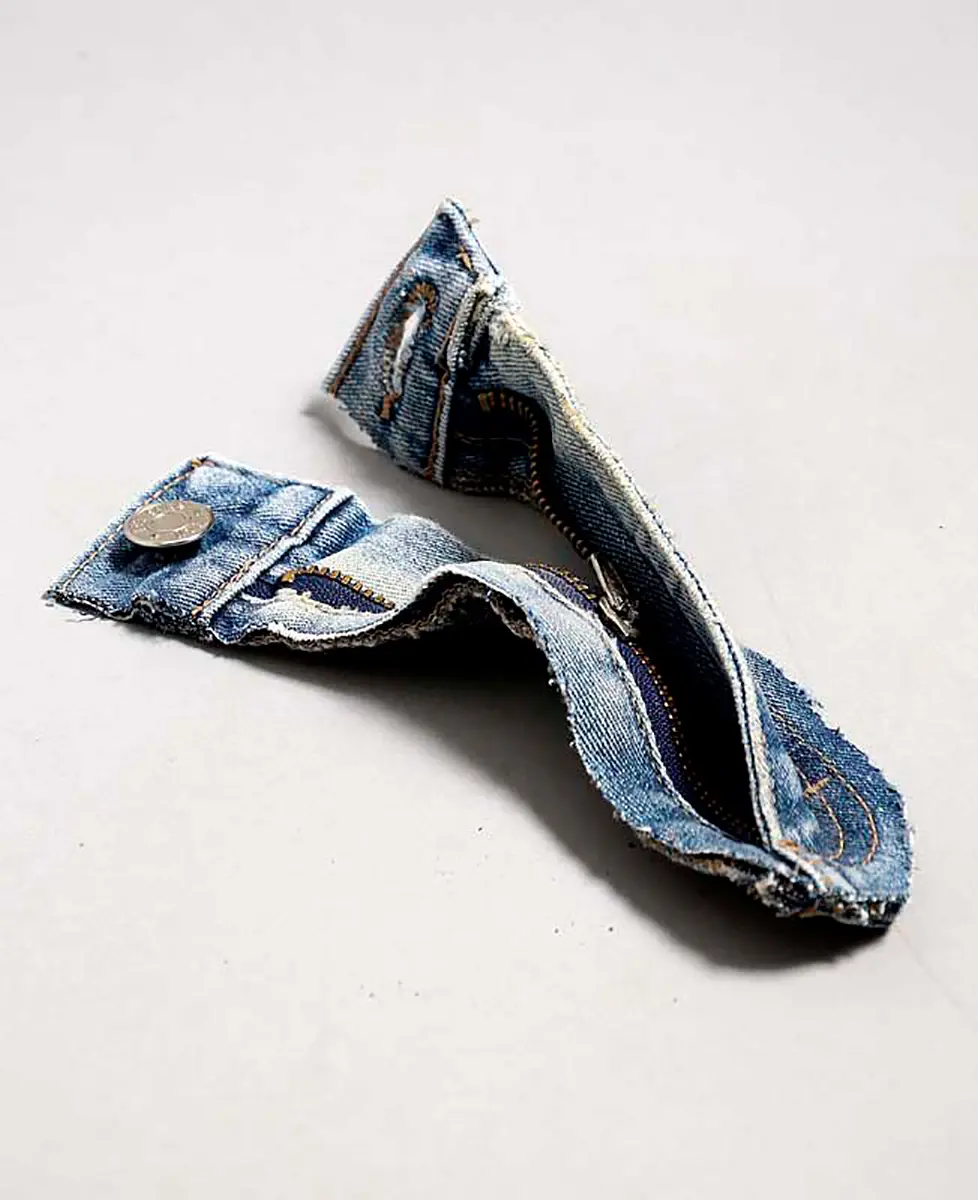
The gallery space appeared almost empty. On the white walls and also of the floor we saw some objects that, in their arrangement, evoked the aesthetic of minimalism, but we soon realized that rather than a minimalist sobriety, what they evoked was a moving gesture of tiredness and abandon.
Approaching Herrera’s sculptures, part of his series Autorretrato, one could be put in mind of those juvenile throngs Lessing alludes to. But soon, as we apprehend the care employed in cutting out a piece of jeans, a pocket, a zipper, a belt, a crotch protector on which a cross rests, the candy wrappers strewn about the floor as in the previous work, the act of destruction is forgotten. Instead, they evoke the presence of a young man’s body (given the kind of outfit). The visibly used fabric suggests the body’s smell, and they seemed to preserve the touch of its skin. A ripped pants pocket spoke of a certain intimacy, letting us see inside it the lids of preserves jars, as indicated in the technical card. Other sculptures were more enigmatic, such as a bee pinned to the wall by a sewing needle from which a line of thread hangs, or a wooden box with a hole on one end, suggesting a private world of more difficult access.
Santiago Rueda Fajardo, the curator, notes that “the works that comprise Un gesto de cansancio refer both to the brief, sudden death in the moment of sexual climax, and the final instants of the struggle for life as we pass away. Thus, a gesture of tiredness is an affirmation of life within life, which is what is happening to us.”
What happened as we left the gallery, having observed the languor and tenderness emanating from those objects extracted from other people’s intimate worlds, and having read both Semolic’s and Rueda’s words, was similar to what occurred to Lessing’s protagonist: as she observes, with tenderness and growing fear, the shift operated on her young protégé, she also begins to notice beyond the walls of her apartment the existence of a surprising world that deeply touches her heart and brings her back to the years of her own childhood. Through the traces of his clothes, the viewer imagines that young man beyond the gallery wall, watches him coming and going in his jeans, nonchalantly eating some candy, his shoes on the gray pavement of any city, asserting with each step and each gesture the everyday actions that ultimately comprise “the life that is happening to us.” Carlos Herrera’s sculptures are profoundly intimate, urban, and unsettling.
MARTA RODRÍGUEZ