
“Christ the redeemer, arms open over Guanabara,”1 sings Tom Jobim in his Samba of the Airplane, composed in 1962. Mount Corcovado, where the statue of Christ the Redeemer is situated, is a typical postcard image of Rio de Janeiro and one of Brazil’s most iconic landscapes. Atop the exuberant, tropical mountain, highlighted in many different ways throughout the history of Brazil-related imagery, this Christian figure contrasts starkly with its vivacious surroundings. The vertical posture of Christ refers to the biblical episode of the crucifixion. Death and landscape, thus, are side to side. Tom Jobim’s “open arms,” a symbol of the city’s welcoming nature, are the same open arms of religious martyrology.
At the foot of the mountain, next to the sea, in the neighborhood of Ipanema, Laura Marsiaj Gallery is presenting Sobre humano, an exhibition of works by Carlos Meló. In an exhibition space known as Anexo, devoted to small exhibitions, the artist shares two new works with his audience. One of them, a large scale drawing, cites Rio de Janeiro’s sacred monument. Rather than representing the concrete column supporting the figure, Meló opts for revealing a primordial structure: the vertebral column. The architectural support gives way to that which maintains erect or bodies. The base on which a sculpture is installed is, in this drawing, surrounded by dispersing human bones.
What place does Jesus’ shroud occupy in contemporary culture? Meló substitutes for it a man’s suit and makes sacred what appears to be the figure of a business executive. Indeed, what could be more sacred today than the equally iconic image of those who manage financial movements? Similar to an allegory of death, Christ is clad in black. The schematic traces of Art Deco are suppressed and a doubt-inducing sfumatto acquires greater presence. As in previous works by Meló, there is here an investigation centered on the veiling of faces. Who is the man with open arms? Furthermore, can we establish the figure’s male gender? Instead of the sacred face, we could see mine, yours, or the eyes of any third person.
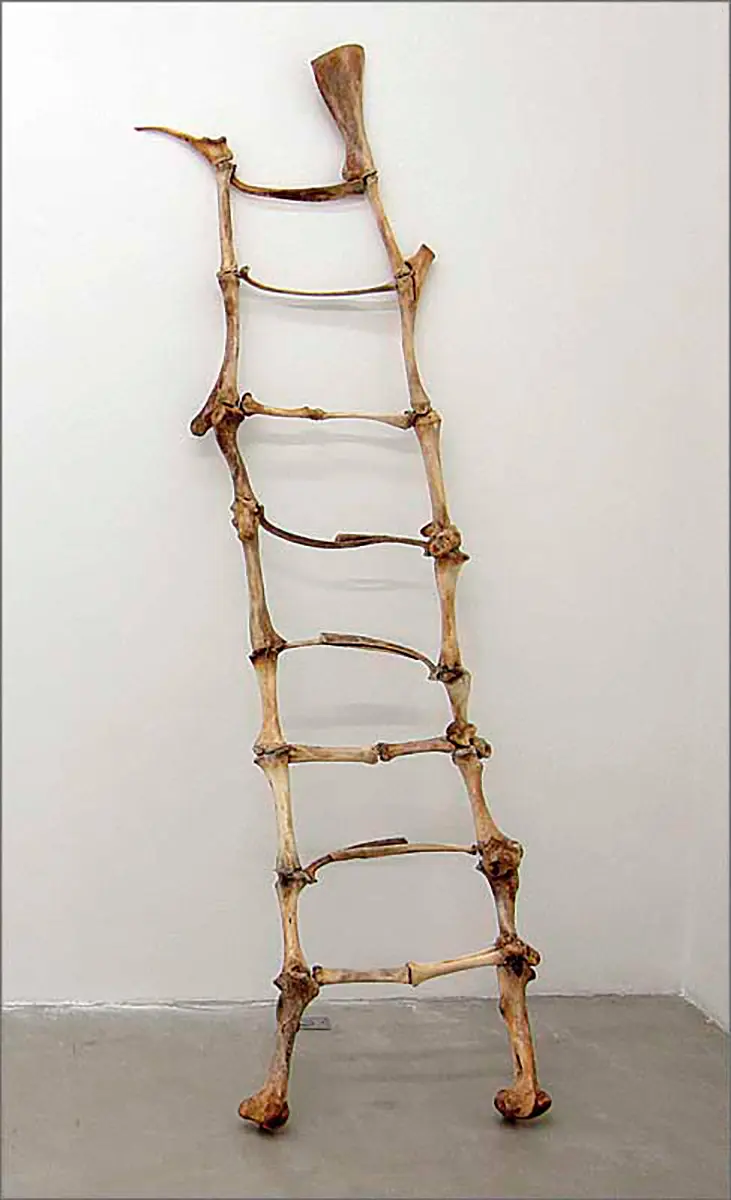
Next to this drawing, we see a ladder. On close inspection, the sculptural material grabs our attention: bones and wire. This work can be interpreted through the same Christian iconography. According to the biblical story, after his crucifixion, the body of Christ was taken down from the cross (John 19: 38-42). In pictorial representations of this event, a ladder is often included as an auxiliary tool in the moments prior to de deposition of Christ. If the apostles used it to move the body, the artist promotes the poetic act of bringing down the same man, but from Mount Corcovado to the field of contemporary art.
The bones that form this object emphasize the element of death latent in the exhibition space. In the absence of a corpse, nothing is more accurate than for the composition to be made of that which remains as indicia of the passage of time. But let viewers be not fooled: these are not human bones, but the bones of cows. In that sense, the artist places man and beast side to side, leveling them into the same existential condition. What was safely underground was excavated and brought to the surface for a second time, giving continuity to the anti-monumentalization of public sculpture.
Let’s go back to the exhibition’s title: Sobre humano. At first glance, those two words can be interpreted as referring to the show’s central theme, the human body, be it transformed into a drawing or public sculpture, be it when it is dismembered and reflected ironically in objects used by humans but made of animal bones. The word sobre, however, does not only mean "about of" (one of its possible translations) but refers also to a specific spatial configuration: sobre humano can also mean “above human.” From this perspective, how can we avoid the reference to Christ the Redeemer, located “above Guanabara”?
In a third interpretation, these works by Carlos Meló seem to speak of a different above: no longer a geographical or spatial one, but a confrontation with transcendence, which precedes the very configuration of space. More than a reference to Christianity, these works seem to turn on that which is intrinsic to any existence: the end. With two images, the artist is able to present an exhibition that is both visually precise and filled with interpretative possibilities. Ultimately, viewers are presented with an example of contemporary work that avoids cheap conceptualism and place us in a more ancestral—and, why not, more “human”—relationship with the visual.
NOTE
1. Translator’s Note: Guanabara is the geographical name of Rio de Janeiro’s bay.
RAPHAEL FONSECA