
Indications (July-September 2012) is the second exhibition presented by David Lamelas at the Ignacio Liprandi Arte Contemporáneo in a little more than 18 months. A previous one titled Buenos Aires Time as Activity (February 2011), occurred after many years of being absent from the galleries of this city. The artist that left Argentina at the end of the Sixties lives today in Los Angeles. While an anthological exhibition of his work had been organized in 2006 at MALBA with curatorship by Inés Katzenstein and co-produced with the Museo Tamayo in Mexico—where it was also shown—and, in 2010 the artist appeared in the video by Leopoldo Maler about Menesunda, 1965, when Lamelas collaborated in the historic work by Marta Minujín and Rubén Santantonín, during the retrospective titled Minujín (2010-2011) at the same museum. Lamelas has lived a nomad life outside of his country for more than forty years. Katzenstein takes this into consideration when analyzing his work. But this biographical detail was not particularly anecdotic back then, because the 2011 version of Time as Activity was the seventh from a series that began in Dusseldorf in 1969, and continued in Berlin, LA, New York, Saint Gallen, and Friburgo. With that first version, Lamelas would become one of the actors from the first generation of conceptual artists in the western art scene, as he became part of a current that answered tradition by becoming advocates of the dematerialization of the artistic object.
For the reediting of Time as Activity, the artist, as the title indicates, addressed the subject of time. In Indications he addressed the theme of the space, something more aligned with philosophy or scientific thought than with art. Nonetheless, beginning with the conceptualism of the 1970s, these became preoccupations and occupations also adopted by artists. Indications, like other works from that movement, is centered more in the function of the work than of its morphology, such was the legacy of Marcel Duchamp. At play in this proposal is a mental and a reflexive exercise about the construction of the work and the definition of art; as well as a reflection on the theme of perception, not solely in art, but also on the perceptive acts that occur every day. Lamelas has questioned the extreme mediatization of reality in contemporary life. Gianni Vattimo has called “transparent society” the phenomenon of a global environment eroded by the mass media. As result, perception is contaminated and there is a loss of insight and depth in the act of discerning.
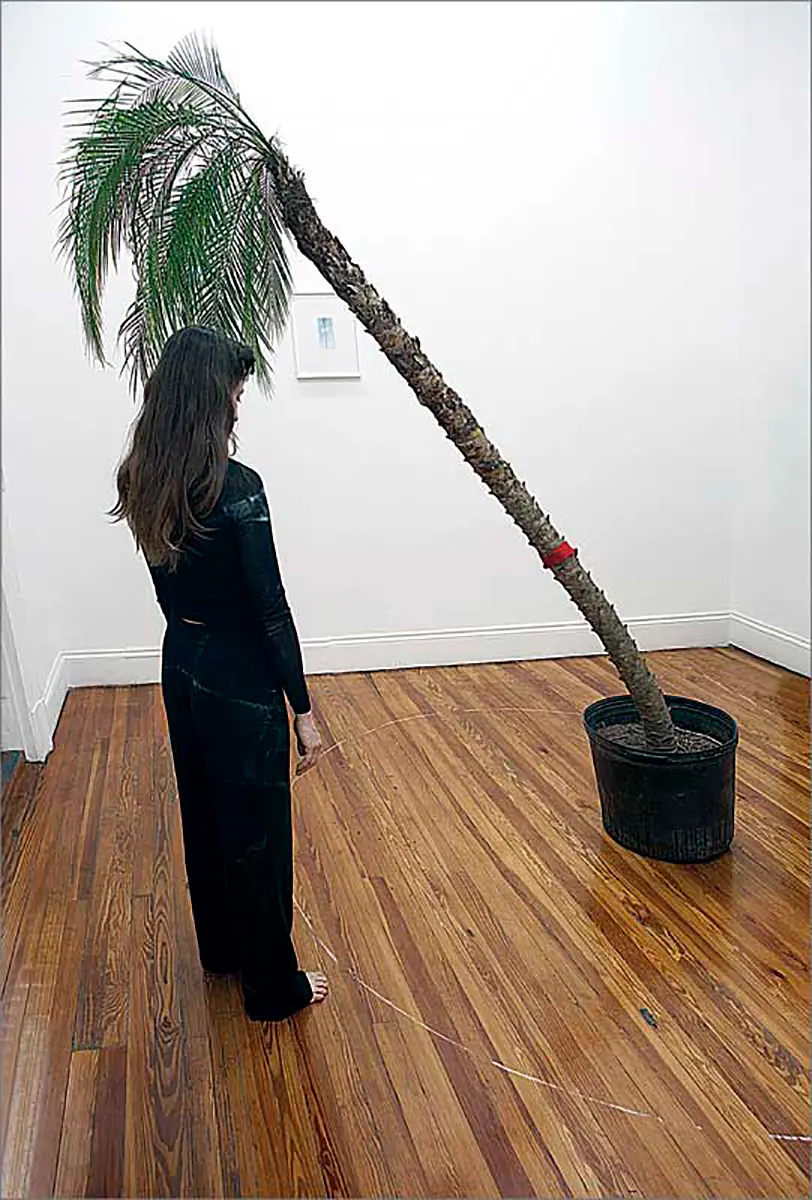
Lamelas has worked with the most diverse mediums throughout his career—film, photography, sculpture, site-specific installations. With this opportunity, the artist presented drawings and installations of two palm trees planted on their respective pots in two exhibition rooms symmetrically arranged at the sides of the main hall in a corner, and performances carried out by dancers—a man and a woman—around each of the palm trees.
At the center of the exhibition, there is the palm tree that the artist confers an almost symbolic status. He presents it in a group of watercolor drawings realistically rendered. The sketches created on the pages of a notebook Lamelas used when he lived in Belgium offer the mediation of the traditional artistic approach, given that drawing has been a practice the artist has not abandoned through the years. A selection of them covers the perimeter of the main hall of the gallery. Then, each tree, outlined with a circle drawn with chalk, has been placed to describe an eccentric inclination, each looking away from the other. Lamelas observed not solely the varied and unusual shapes of the tree but has also focused on the relationship of the tree with gravity. It is an observation that also implicitly refers to the human figure and to our existence on this planet. In this manner, he appealed to a quote from the story Averroes’ Search by Jorge Luis Borges: “You also are, Oh palm! In this soil foreigner…” In using the word ‘also’ the writer offered an analogy between palm and person. Being foreigner represents to both the palm and the person a reference to a place of origin that is not solely faraway but also of a mysterious nature. Thus, the ability to feel a foreigner in something as concrete as the soil.
By the gallery’s entrance, visitors found the record of earlier work. In Señalamiento de Tres Objetos (Indication of Three Objects, 1968) the artist had marked in Hyde Park, London, the space of two trees and a chair. Both works had the implicit virtue of pointing to and including the spectators’ space.
MERCEDES CASANEGRA