
The incorporation of mechanical movement in works of art is one of the aspects explored by Enrique Moreno-Dbeiss (Lebanon, 1971) an artist who blurs the line between art and technology. He has found a way of elucidating a poetic that transcends the threshold of functionality in order to delve into the imagination; a subject that, to a certain extent, responds to the desire to unite art and life through creation. Moreno is a trained automobile repair mechanic (1999) and also studied sculpture at the Instituto Universitaro de Estudios Superiores de Artes Plásticas Armando Reverón, in Caracas (2000). His discourse draws from these two disciplines he practices in both his professional and artistic pursuits. During the presentation of his recent production—from 2009 and 2012—exhibited at the Museo de Arte Contemporáneo in Caracas from July 8 through August 28 of this year, Moreno addresses those relationships that connect us to the electro-mechanical world. Titled Volumen. Robóticas de Enrique Moreno, the artist presents nine pieces that interact with each other, scaling the surrounding space and expanding from the white walls that constitute the Sala 11 of the exhibition space.
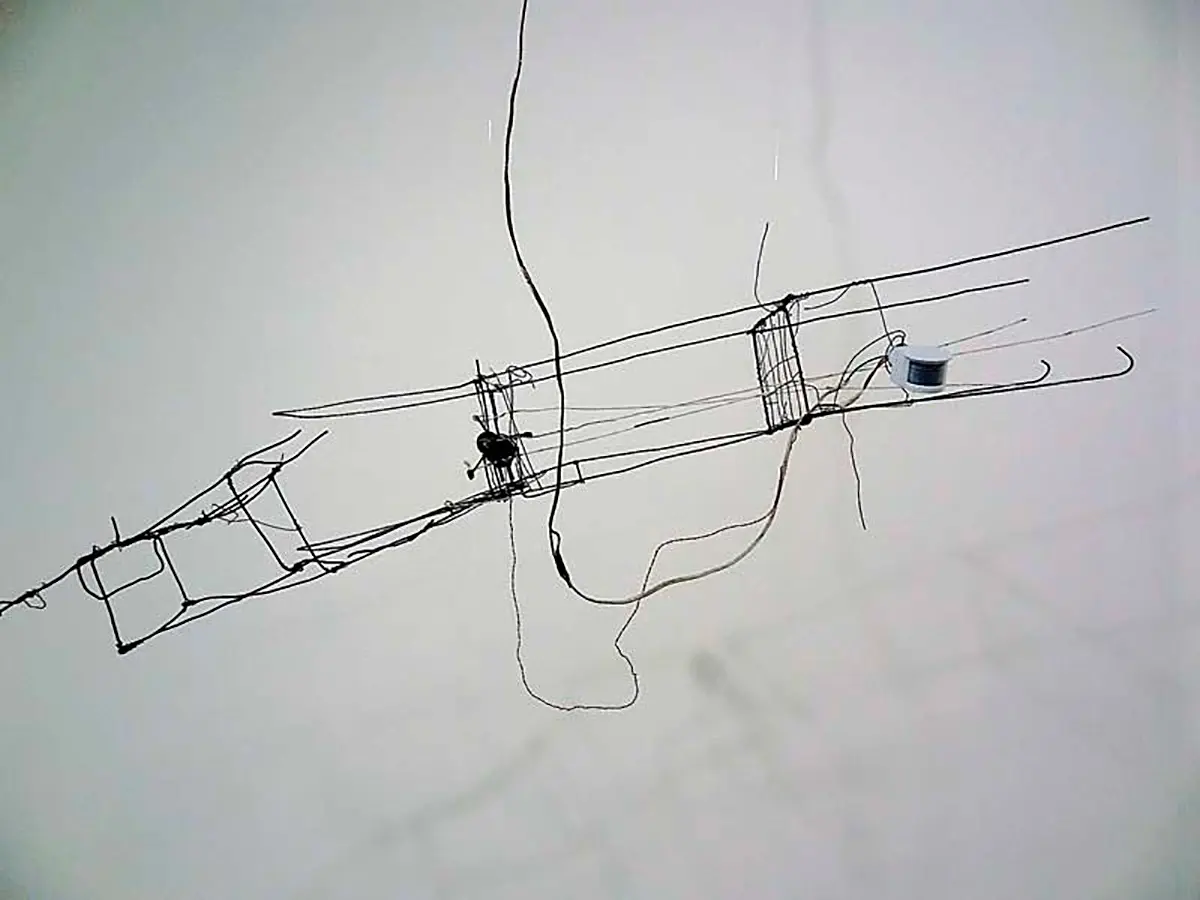
Enrique Moreno’s compositions—a sort of sculptures-ensembles-installation—are pieces created with wire woven like skeletal frames that reveal a dismembered or unfinished appearance. To this group of metallic filaments the artist adds engines that generate vibrating movements, These movements are sometimes spasmodic, or linear, or even rotatory. These “machines-mobiles” acquire a new significance that replaces the original usefulness of their engines, as it combines plastic bottles, pendulums, tires, and cables, among many other articles that accentuate the ludic, handmade and fragile of these post-industrial residues or fossils turned into emblems of everyday life. From a historic perspective, these pieces contain references to the broken-reliefs by Marcel Duchamp, the unusual machineries by Jean Tinguely, the wire drawings by Alexander Calder; they even show a certain likeness to the knots, coils, and grids by Gego. On the other hand, Moreno’s compositions are manifested as irregular bodies that border on the absurd, the incoherent, or the unexpected; some works like Synchronous Motor, WRO, or Chaca-chaca—created with gearmotors, electric cable and rods—describe that ironic quality that characterizes his visual work. In 4 x 2, for instance, Moreno includes a folkloric note by inserting string instruments: small four-stringed guitar souvenirs that surprisingly contrast with the compositional narrative. According to Albeley Rodríguez, curator of the exhibition, “Moreno transforms pieces of electrical appliances in poetic takes on wearing down, as he rescues those mechanisms from their obsoleteness in order to transform them into a precarious robotic charged with evocations…”
Beyond the curiosity and astonishment that the contemplation of these images arouses in us, the proposal by Moreno makes us reflect on the paradoxes, surreptitious or evident, brought about the Industrial Revolution and its technological advances. In spite of the great benefits technological applications have had in our everyday life, they have also contributed to a progressive sedentary life; our physical activities have been absorbed by the energetic vortex that accelerates our way of life by reducing our actions to minimal efforts: the electric toothbrush, the electric knife, the remote control, kitchen appliances, etc. On the other hand, society demands that we exercise in order to recover the physical mobility to stay mentally and physically healthy.
But Moreno’s discourse does more than just activating the movement generated by these artifacts, as he also takes advantage of the sounds that provoke them to work, and that confer them a vitality that energizes the entire group. Sound and noise are other elements that have contaminated our reality; that which once was the sound of birds, thunder, waves, etc., are now replaced by auditory resonances that emanate from airplane turbines, valves, batteries, sensors, welding torches, and transformers, among many other devices that invade the environment on a daily basis; but ones we ignore because we have become accustomed to coexisting with their invisible presence. So it is no surprise then that music and performance are other disciplines in which this creator has been cultivating his talent since 1995, or that his work can be placed in the mixed media art genre. According to Moreno “It is not solely about observing the work but also about touching it and listening to it. These combinations of elements result in a ludic experience with space because it involves other spectators connecting to the work even if they are not directly turning it on…”
GLADYS YUNES