
With a total of 15 works, the exhibition titled Washes by Colombian artist Esteban Peña showcases the issues the world faces because of the great winter wave in recent years.
Washes are a project that Peña began by experimenting with the technique, namely by playing with the amounts of acrylic paint and water to achieve different results. He would create ink patches on paper that became portraits of popular heroes and antiheroes, as he layered the veils of color on the wrinkled paper. At the same time, in Colombia and in some other places around the world the phenomenon called the great winter wave led Peña to use photographs taken from newspapers that depicted the catastrophic effects of excessive water in areas in The Philippines, Pakistan, the US, and Colombia.
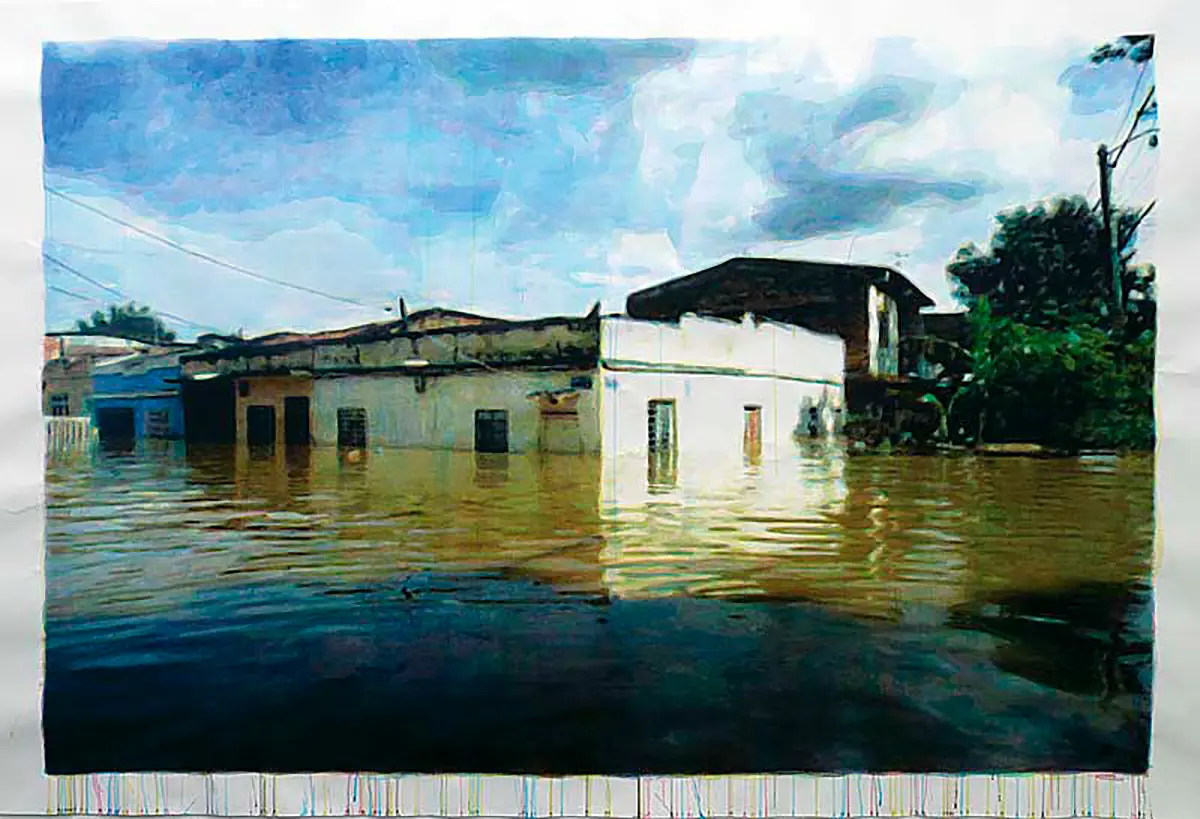
With these washes, Peña uses decomposition to compose a new landscape rendered with what some call a “bad technique.” The idea is to underscore the theme of destruction from all perspectives. He literally inundates the paper with acrylic to wash the image, as he uses the material as a tool to reveal the transformations of the landscape and, therefore, society. The resulting disseminated effect reveals the traces of intervention through the drip that emerges from the landscape. Just as the acrylic washes the image, the winter wave washes and transforms not solely the landscape, but also the social structures and dynamics.
Likewise, the exhibition by Peña invites viewers to reflect on the concept of the landscape, broadly understood in a classic sense as an idyllic and natural environment that only serves as an image for ideal contemplation. Peña encourages us to view the landscape with critical contemporary—and realistic—eyes, within a social context of cause and effect, where it is possible to move beyond the poetic image.
Thus, as we transversally move across the boundaries of the landscape, Washes becomes a representation of a phenomenon that grows like a large snowball, in a vicious cycle in which our relationship with nature becomes a factor. In other words, the works evoke in a concealed manner the abuses by humanity against the planet that have resulted in the cause of the great climatic changes and natural disasters that modify the landscape and our way of life.
Washes is an emotionally charged show where Peña subtly—ironically and sometimes even humorously—sheds light on an emotional relationship with the natural events that affect mankind. Through these washed landscapes—destroyed roads, houses, schools, or even entire towns underwater—societies appear vulnerable and powerless in the face of contingencies caused by nature.
Washes is an exhibition with two sides. On one hand, it shows the sad and terrible image of the real landscape; on the other, there is the pictorial and poetic image of the inverted photograph. And although it may sound ironic, in some cases, there it is also heavenly as a result of the attractive and pictorial touch with which the image is resolved. In other words, it is as if water that washes the color and destroys the natural geographic landscape—as it leaves on its path only remnants and loss—worked on the paper in a completely opposite manner, as a creative element that transforms the landscape into a work of art to casually contemplate those things interpreted as ruins and disasters.
DIANA MARCELA CÁRDENAS