
Under the title 1989-2012 Fotografías de Juan Carlos Alom, BuzzArt, the newest addition to the Wynwood Art District roster of galleries, offers an excellent retrospective of works by this towering figure in Cuban and Latin American photography.
Juan Carlos Alom (Havana, 1964) is known for his unique approach to photography, which allowed him to explore the psychological world of his portrait subjects. Selected by Time magazine as one of Latin America’s most relevant photographers of the millennium, Carlos Alom’s work is populated by characters typical of everyday life in Cuba, presented as the sine qua nonexpression of ontological issues.
Alom’s portraits, be it documentary in character or recreated inside the study, possess a high symbolic payload. His work transcends the epidermis of the portrait and brings us closer to the complex inner world that animates these individuals, their motivations, desires, tribulations, and dreams.
1989-2012 Fotografías de Juan Carlos Alom, includes 77 photographs covering more than twenty years of a prolonged career. With the exception of the ten color photographs in the series Los bañistas o Nacidos para ser libres (2012), all the works in this exhibition are in black and white.
In the series Los bañistas o Nacidos para ser libres, Alom revisits the topic of bathers and swimmers, so dear to the history of art, and pursues the singular light of the tropics, where colors shine in exuberant abundance.
The exhibition emphasizes Alom’s early work. One highlight of that period is his iconic portrait Libia y José de la Caridad, which depicts a biracial couple who, submerged waist-deep in the sea, holds the viewer’s gaze. Outfitted with shell necklaces, beads, and amulets, they seem to have been captured in the middle of a private river, possibly associated with Oshun or Yemanya.
Somewhat surrealistic in character, Preocupaciones sobre la mesa de comer (1992) depicts a couple trapped inside a dinner table stripped of its horizontal board. The work, created during the critical years of the so-called Special Period in Cuba, expresses a recurring concern of the Cuban people: the travails involved in securing daily sustenance while retaining, against such basic constraints, the ability to dream, invent, and create.
The show includes a symptomatic photograph: Laura o el Nuevo desnudo (1989), an iconic work that not only marks the beginning of the artist’s career with the spiritual aura that characterizes him but offers a rare author proof, for which Alom retained no negatives.
The enigmatic nude, holding a white robe that covers the upper part of the body, including the face, has a certain metaphysical halo. The powerful entity seduces us with its rare beauty, its identity halfway between the terrestrial anchor of the body and the ineffable spiritual aspect that crowns it. Devoid of any spatial or temporal reference, the environment reasserts the limbo state of this person, who, regrettably, died years later in an automobile accident, accentuating the ominous feeling that permeates the work.
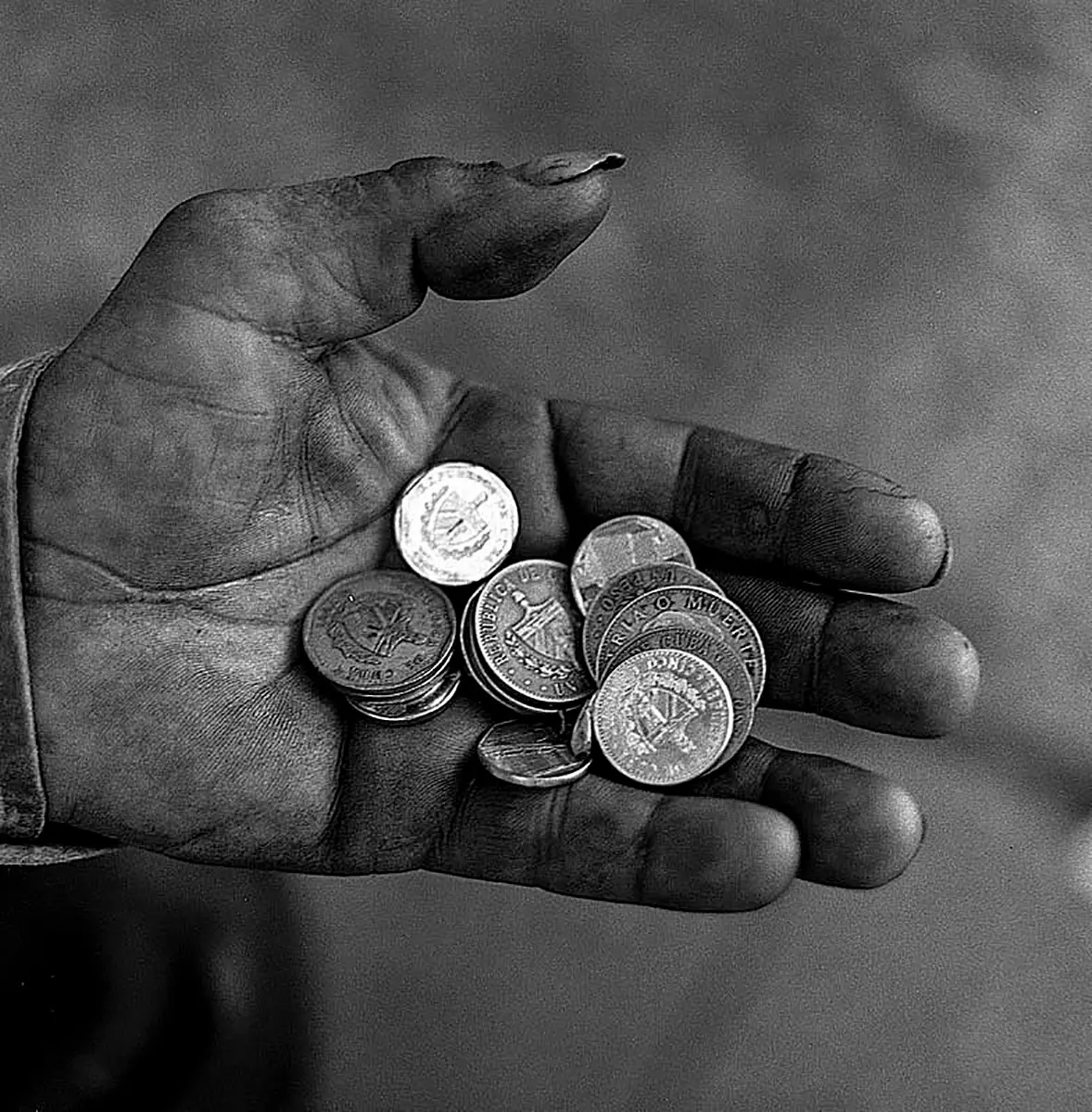
Other works included in the exhibition tend to deploy the detail shot as the epitome of the whole. The highlights here are Puño de tigre (2010) and República de Cuba (2012). In both cases, the hand becomes an archetype that offers itself openly or closes into a fist as a symbol of strength.
Puño de tigre is a symbiosis between the human and the animal realm. Between its closed fingers, the hand arms itself with the tiger’s paw, a symbol of power. There is a legend associated with the yorye ritual,1 whereby Tiger had no defense and was constantly mocked by the rest of the animals. Fed up, Tiger went to Nzambi,2 who gave him paws and fangs. Thus armed, Tiger felt invincible, which Nzambi punished with the stripes that today’s tigers carry in their backs.
República de Cuba presents an open hand with some Cuban coins, one of them displaying the National Seal. The rough, clearly hard-working hand contrasts with the coin of very low exchange value; together, they emerge as a controversial talisman of the socio-political system they embody.
NOTES
1. In the Palo Monte religion of Cuba (also known as Palo Mayombe, Palo Congo, Brillumba, and Kimbisa), the yorye involves the marking of initiates with crossed cayenne branches in their backs, in order to cleanse them of the osorbo—negative charge—that all individuals carry with them, associated with terrestrial life.
2. The creator of the universe in Bantu religions such as Palo Monte, Nzambi is the equivalent of Santeria’s Olofi and of Regla de Oshá in Yoruba belief systems.
JANET BATET