
Judith Lauand returned to Berenice Arvani Gallery from September 25th through October 26th with previously unseen works from the 1950s for a show titled Judith Lauand: Gouaches, Drawings, and Collages, The 1950s.
Nearing 90, Judith Lauand, the Grand Dame of Concrete Art remains as current as ever. After her show at the Museu de Arte Moderna in São Paulo early last year (Judith Lauand: Experiments), the artist presents never before exhibited works at Berenice Arvani Gallery, in the Jardins neighborhood of São Paulo. The same gallery hosted the artist back in 2007 in a broader context, revisiting her 50-year career (Judith Lauand, 50 Years in Painting). Judith Lauand: Gouaches, Drawings, and Collages, The 1950s was curated by Celso Fioravante, a critic who has studied Lauand’s work for a long time. Most of the 70 works exhibited were new to the public. They are projects for paintings, drawings, collages, and gouaches, all on paper, and came from private collections held by the artist and her family. It is important to note that the public now has access to Lauand’s sketches and projects for the first time, thanks to Fioravante’s insistence and curiosity. He had access to the artist’s portfolios and, after studying this archive, convinced her to present it to a wider audience.
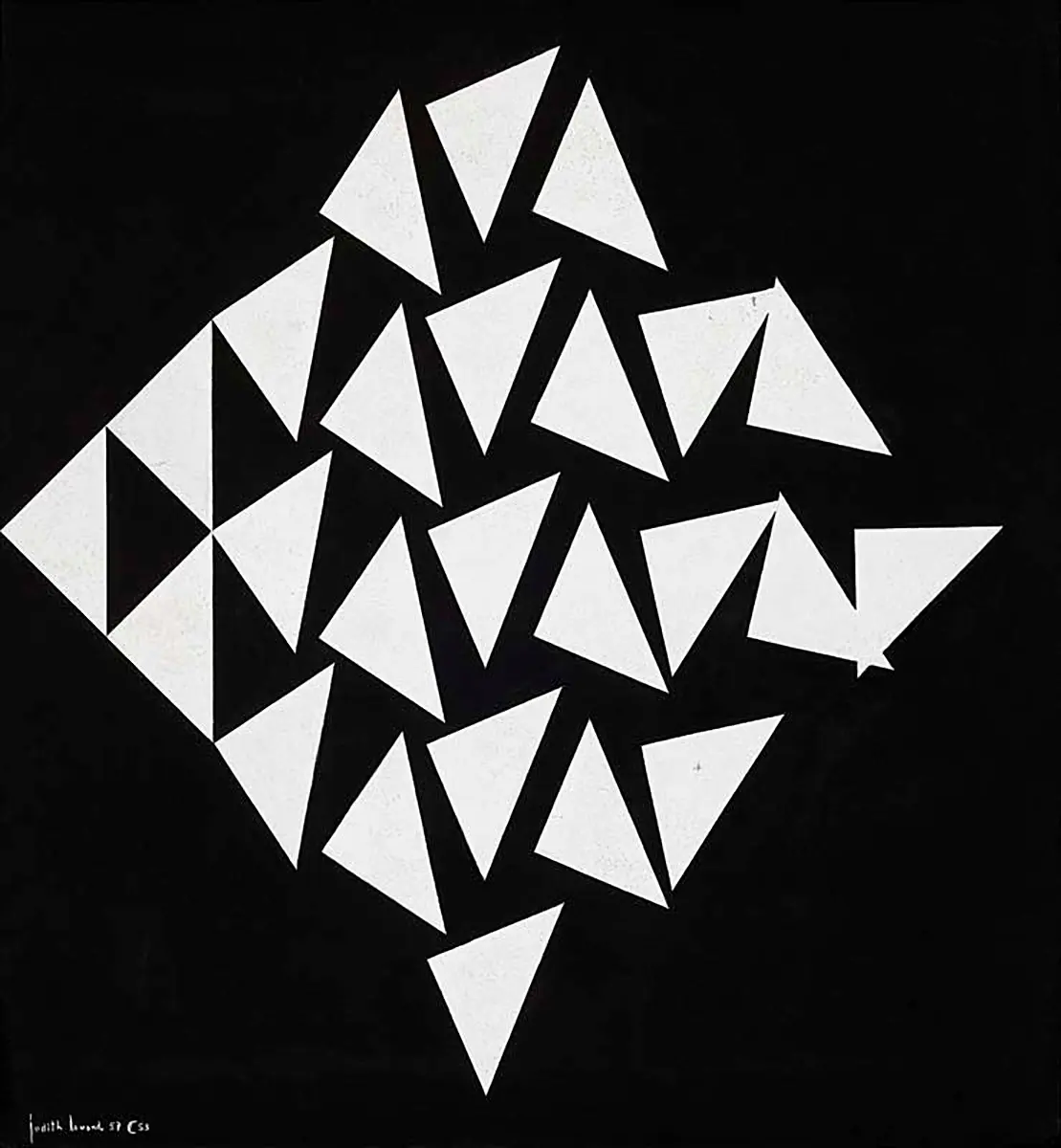
In a well-lit environment devoid of any interference, the gallery is entirely devoted to Lauand at the point in her young career when she entered the orbit of Concretism. The curator explains that the works on display reveal Lauand’s rigorous process of production, cataloging, and conservation of her oeuvre. Each work is stamped with a small “C” (for Concrete) and “A” (for Archive), as well as numbers that make it possible to establish their chronology.
The works on exhibit were created between 1954 and 1959. 1954 was key in Judith Lauand’s development as an artist: it was the year, she says, when she encountered Concrete art.
Concretismo soon permeated her entire production, even as she flirted with Pop Art in the 1970s. Lauand never entirely abandoned her mathematical thinking. It is possible to start the characterization of her work in the following decades—when she also gained recognition for her xylographs, tapestries, embroideries, and sculptures—with the earliest Concrete period. Lauand is often remembered as a feminist artist, perhaps because she was the only female in the Ruptura group (which included such renowned artists as Waldemar Cordeiro and Geraldo de Barros), but mainly for her Pop period, when her figurative paintings featured images of women in positions of command, proud, smoking and confronting the viewer’s gaze.
The selection of drawings was a highlight in the exhibition at Berenice Arvani Gallery. In them, Lauand explored geometric shapes using China Ink, color pencil, and gouache. They are in some instances studies for larger works (such as her murals for the SESC in Araraquara). Her handiwork in those drawings is characterized by its lightness of touch, rhythm, and gentleness. The artist transforms geometry and the concrete elements into poetry. Color is used to fill the drawing, or only to outline it.
The works selected for this exhibition paint a clear profile of the artist, as defined by critic Paulo Herkenhoff: "Judith Lauand seeks a mathematical reason, but also, and above all, many poetic licenses. Thus we can say that she produces an art of small concrete delicacies.”
Judith Lauand devoted her entire life to art. Born in Pontal (State of São Paulo, Brazil), she began her career in Araraquara, where she studied at the Fine Arts School. Since the 1950s she has lived in São Paulo, and to this day she spends every afternoon working on her art. Lauand played a significant role in Brazilian art since the 1950s, with a constant presence in the local scene ever since then. Her work is widely recognized; she has held eleven solo exhibitions, two of them at the University of São Paulo’s Museu de Arte Contemporanea (MAC-USP). She has participated in five editions of the São Paulo Biennial and in many group shows in Brazil and abroad. Her work is included in the collections of important institutions such as the Houston Fine Arts Museum, the Grenoble Modern Art Museum (France), the Museu de Arte Moderna de São Paulo, the Pinacoteca do Estado de São Paulo, and the Museu de Arte Moderna de Rio de Janeiro. In 2011 she was the subject of homage by the Brazilian Art Critics Association.
MARÍA ZMITROWICZ LOPES