
Redonda is the word that best defines Leandro Katz’s exhibition in this New York gallery. And if that didn’t suffice, it could also be said to be… notably linked together. With these works and thanks to their conceptual/documentary selection, we encounter an institutional-level presentation. This criterion prevails even if it were the gallerist himself who selected the works and acted as a curator. It is important to highlight a line of work that responds to commercial requirements by guiding collectors towards solid, documentary acquisitions that provoke reflection. This is not an exhibition based on the artist’s prestige—which Katz, unostentatiously, does possess—but on the intrinsic reach of the works and the consideration of landmarks in the trans-disciplinary territory of the 1970s, to which Faria has been devoting his efforts. Viewers enter an art show that is not in the least reduced in terms of a number of works, impeccably arranged, motivating in its museography, and all-enveloping. Depending on our starting point, we could see this as a retrospective. Which to a degree it is, although it hasn’t been conceived as such. The dates cover the period between 1972 and 2012, with the caveat that Leandro Katz’s oeuvre is characterized by his recycling of finished works many years later, with technological, aesthetic, and archeological-filmic objectives. The exhibition—in black and white and also in other colors—integrates time, chance, records of movements.
As we begin to explore the exhibition, it is necessary to keep in mind some information about an artist who has carved out his own geographical aesthetic, archeological, and research avenues in Latin America and New York, from his native Buenos Aires to his many years of residence in “the Big Apple” and his return to Argentina. It should also be noted that Leandro Katz is a prime example of what I call the “nomadic race.” In his case—as in the case of the Moon—the light that illuminates an area obscures the other side of the globe. The artist, meanwhile, records it all in photographs, super 8, 16mm, or digital video (modern and technological media); this is to say, he encompasses two eras of the reproduced image in a labyrinthine grid of seeing and seeing again further down the road. As though he were an archaeologist, he has analyzed the natural, urban, political, and human Latin America in his fieldwork. Years later—with scant references—he recycles his own hieroglyphs. This is why may works have very distant dates, for example, Lunar Alphabet 1978/2012, lambda print, 27 lambda photographs; and 12 Moons (and 365 Sunsets) 1976/2012.
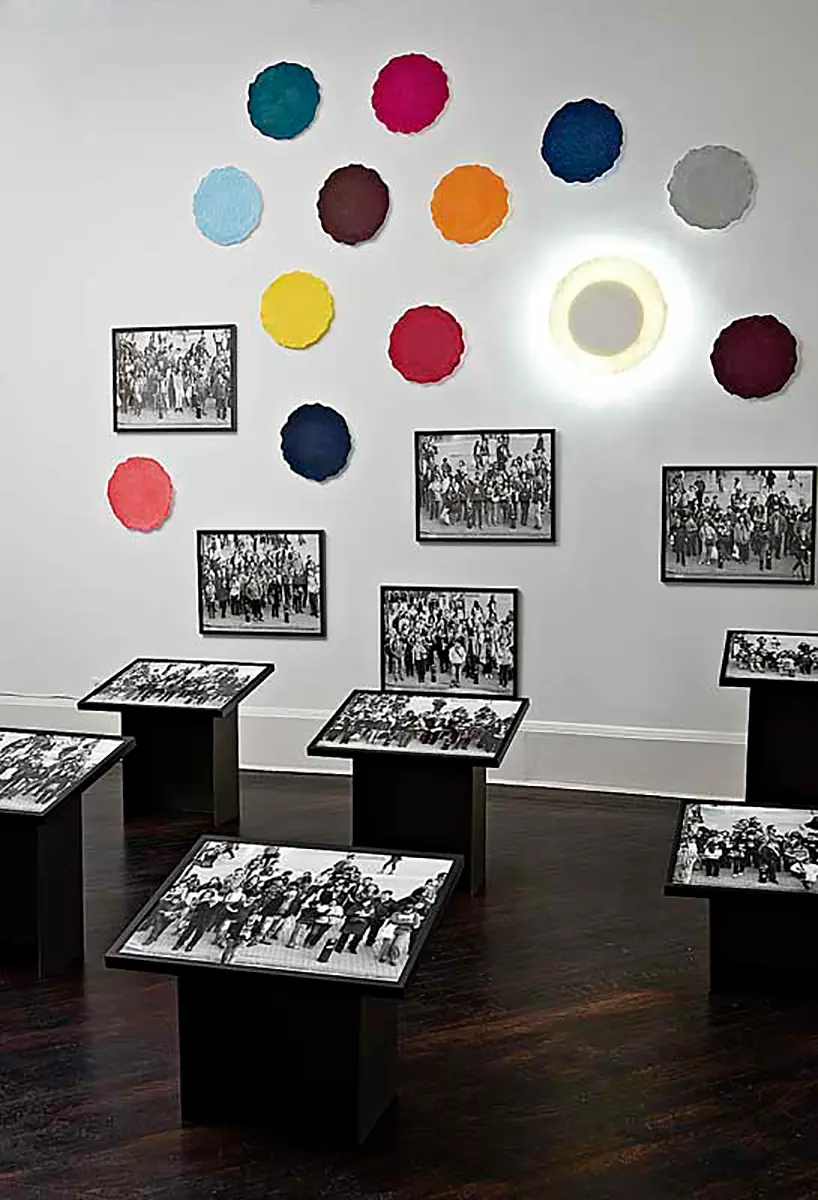
I was interested in knowing the provenance of his concern with the Moon, and Katz responded: “It comes from my interest in ancient cultures and the emergence of language. Especially from my study of and admiration for pre-Columbian cultures, the Maya in particular, and their hieroglyphs. For years, I followed very closely the research that attempted to decipher them.” With regard to language, we should remember that Katz is also a poet. And if we move on to his observations of “bodies and gazes,” the shots of “…that small multitude waiting to cross the street that I shot one afternoon in Santiago de Chile…” integrated into his installation Las Horas, the exhibition once again takes the viewer into the pre-Columbian labyrinth that the artist attempts repeatedly to decipher. Las Horas is a multi-disciplinary installation—photography, dry pastel on paper, LED light, supports, and clippings. As we stand in front of the installation, our relationship with days and hours, with the multifarious passage of time is reasserted. And we perceive two combined labyrinths that approach each other and separate as the viewer moves around the work.
The thin thread of tragedy that is present throughout Katz’s oeuvre is also perceived in Las horas. It couldn’t be otherwise for someone born in Argentina (this is to say, in Latin America): no further explanation is necessary than a recollection of the region’s national histories. An analysis of the artist’s constant self-recycling could also start, at least partially, there, on those tragedies whose mementos, once found, he wants to salvage, reread, revise. As if salvaging them helped recovered lost lives… These reincarnations of time and materials interact throughout the entire exhibition. There is in the show’s arrangement a significant articulation of contiguities, a number of paired works that can be summarized in an analysis of industrial and human motion, or in the freedom of the use of video as a highly solemn letter is read that deals with a banal matter.
Sequence, serialization, contiguity, all function as a detective following clues and traces. In these works, the idea of a module takes its value not from form and repetition in themselves, but rather as a humanistic conception. S(h)elf Portrait, 1972, fifty silver gelatin photographic prints, is an installation as much as it is a library recording the passage of time. From there emerge several vectors of Katz’s work. The use of language and the application to it of the game-investigation. The uncertain time of the work, as in all of Katz’s: to look, to see, to move in order to cover, for instance, 50 photographs, all imply time. And a connection to that period in David Hockney’s oeuvre in the late 1970s when, besides his work in painting and set design, the artist used photography to explore how Cubism could still expand as a movement yet to be exhausted.
GRACIELA KARTOFEL