
The work of Colombian sculptor Lydia Azout (Bogota, 1942) was shown concurrently at two venues in Miami: at the Frost Art Museum, Florida International University; and at Dot Fiftyone Gallery, in the Wynwood Art District. Out of the Ordinary Geometry, the exhibition at the Frost Museum is the perfect introduction for those unfamiliar with Azout’s sculptures. The exhibition checklist includes eight monumental sculptures, a wall projection, and a sound piece. On the other hand, Language of Silence, at Dot Fiftyone, offers a more intimate view of her work with pieces of a minor scale but of great variety, showing more than one phase of her work. Consequently, these two solo exhibitions complement each other, offering a comprehensive view of the artist’s oeuvre.
Azout’s successful career started in the decade of the 1970s when she exhibited for the first time. Her monumental sculptures, back then clearly inspired by Pre-Columbian civilizations, made an impact on the art scene. She was specially connected to the archeological site of San Agustin, in her native Colombia, a place that the artist visited often and that served as an inspiration to many of her pieces, especially to a series titled Augustinian Forces, which can be seen as her homage to that civilization. In this series, she explores the connection of art and sacred spaces, an interest that unifies all her work from different periods.
Stylistically, most of her earlier pieces were typically related to totemic forms. Later on, these gave way to sculptures with more distinct contours and stylized lines. Simultaneously, she started to be more interested in exploring the possibilities that iron offered as a material. For her, it was an invitation to create and experiment, and consequently, she tested the possibilities by creating different textures: from the sleek look of a very polished surface, or to the rough finish of the oxidized metal. These surfaces allowed her to communicate different moods and messages, from the classical suggestion of time passing associated with the tarnished metal to the immaculate finish linked to ceremonial or sacred objects. The malleability of the iron, and its sturdiness, allowed her to create exceptional pieces. There is something hedonistic in her work, an appeal to the visual and tactile senses, first an invitation to enjoy the textures and surfaces, and then to reflect on the possible interpretations.
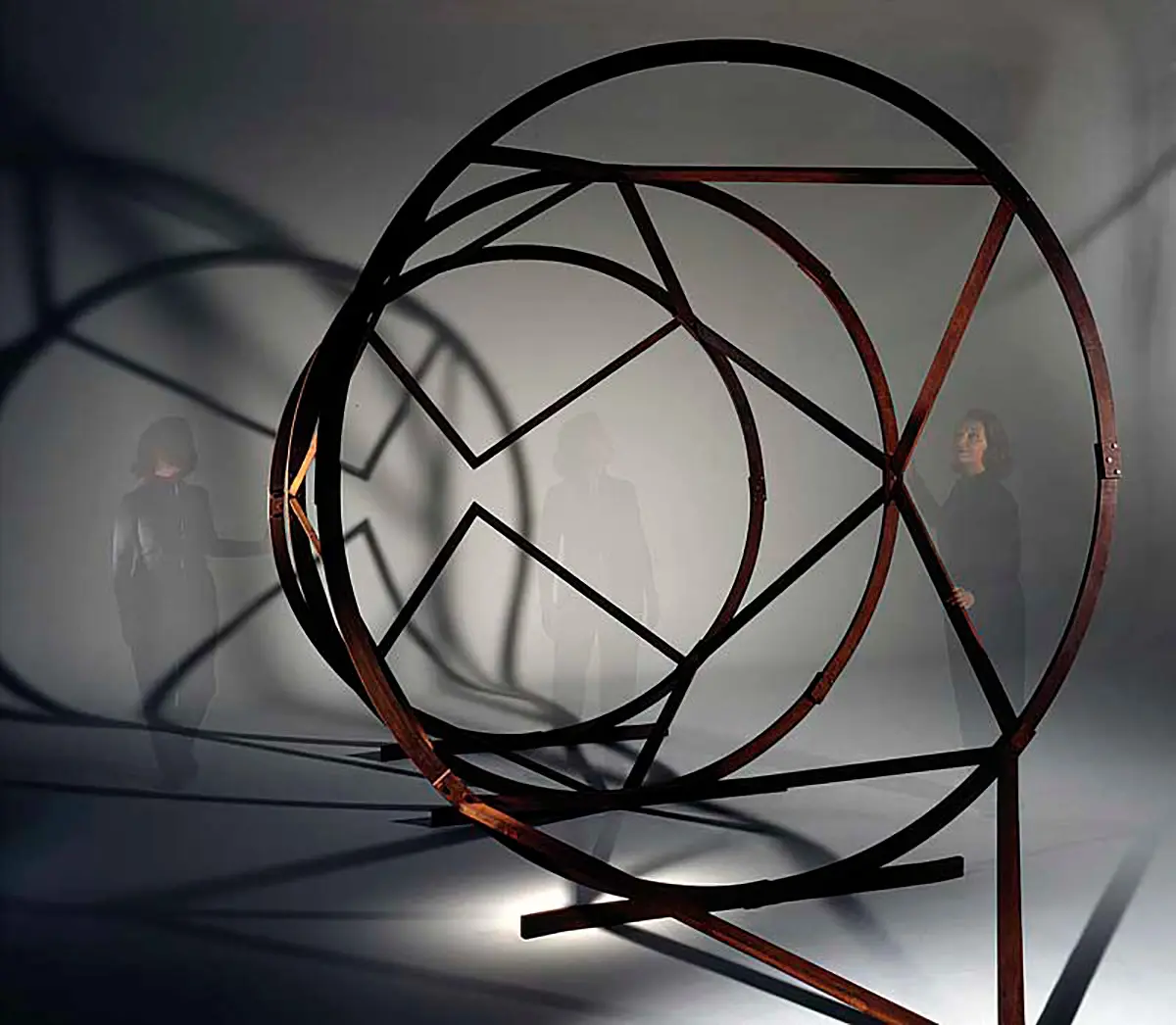
She is interested in spatial constructions and the relationship between her pieces and the environment. Her penetrable sculptures are in a way an answer to this concept. These pieces have a dual function: they could be seen as individual sculptures, and appreciated for its form in itself, but could also acquire a new reading in the context of a performance. This is how some of these pieces were presented, in collaboration with dancers, who created performances especially for her works, bringing alive the telluric forces that inspired her initially. A good example of these interactive sculptures is Fuerzas Femeninas (Feminine Forces), included in Out of the Ordinary Geometry. This is the oldest piece in this exhibition, from 1997, and was meant to be used as penetrable, establishing a physical dialogue between artist and spectator. This interaction became an integral part of the work. The piece is constructed with basic geometric forms: circles and triangles. Circles are the ideal symbols to represent the continuousness of the cycle of life, where there is no beginning and no end. On the other hand, triangles are the oldest symbols of stability, used to build pyramids, and the perfect form to represent spirit, mind, and body. At the front of the piece, she included the feminine sign. This sculpture is her personal way of representing femininity, and the plurality of forms and functions that women carry within.
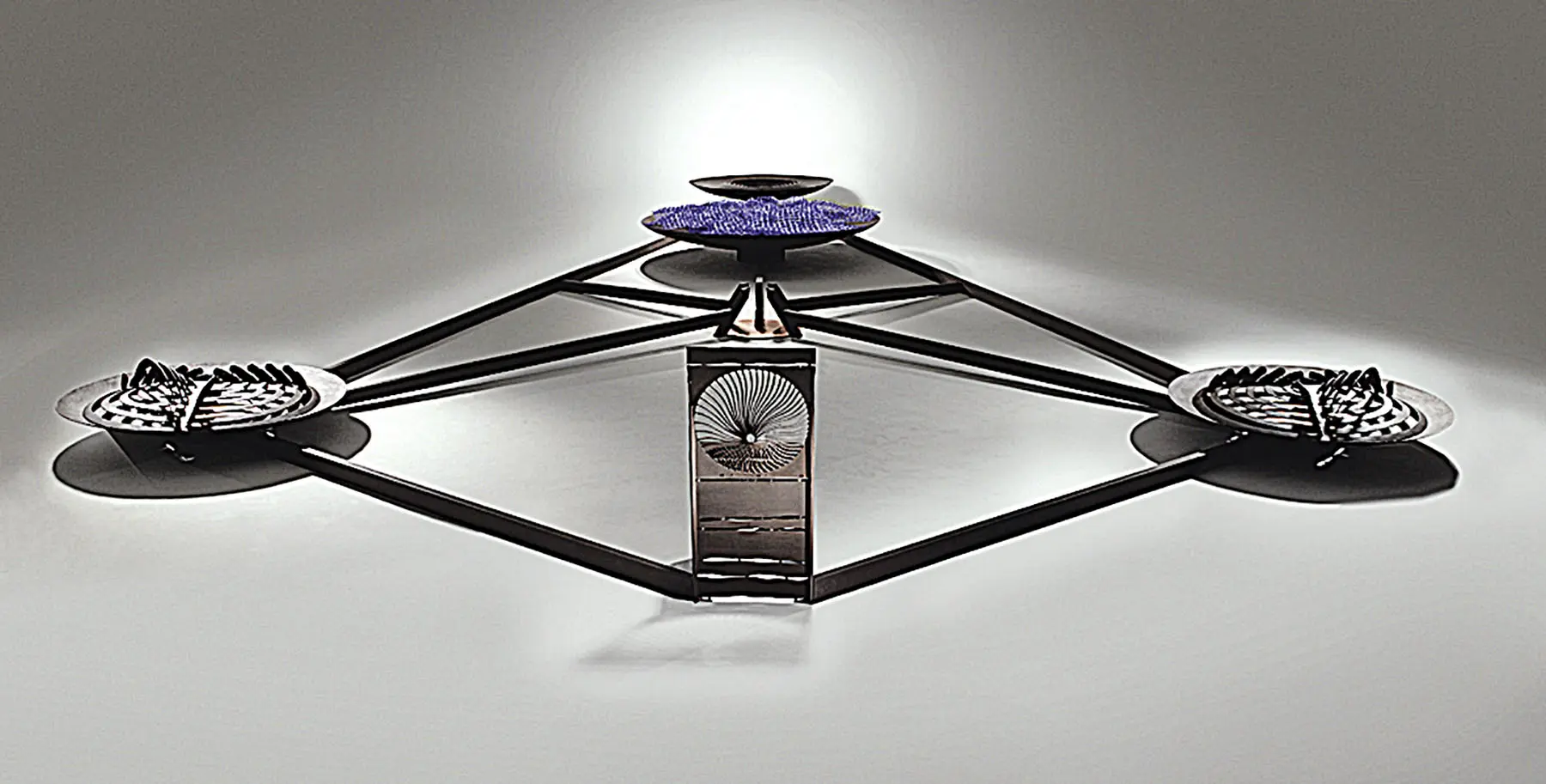
Templo Mayor (Major Temple) (2006), another installation at the Frost Museum, shows an intriguing use of the space and distribution of its components, similar to the plan of a building. It reminds us of some of the Nazca drawings, with their lines connected to each other in a ritualistic manner. Four circular forms, similar to receptacles, are connected to each other, imitating a ceremonial site. Two of the containers are placed in a mirroring position facing each other, and they seem to hold a similar “matter” inside. The other two are different, which suggests they contain correspondingly the elements: earth, water, and fire. The peculiarity of this piece is the use of color, something Azout doesn’t do very often. In this instance, the central vessel is occupied by a purple mesh, a color traditionally associated with royalty. Here, by placing it as a mantle in the center of the installation, the artist is conveying a sense of offering.
Her art is related to primal emotions such as spirituality, something that is reflected in the majesty of the artworks and the titles she selected for them. They function as an open window to her emotions and to what she is trying to evoke. For example, the title of her exhibition, Language of Silence, is a clear indication of how she sees it. The geometric forms become an excuse to portray her inner thoughts. The apparently simple forms are the repositories of a rich cosmogony that inspire the artist, an innermost world connected to hidden forces where the silence is protagonist, an essential element like in the Japanese Noh theater.
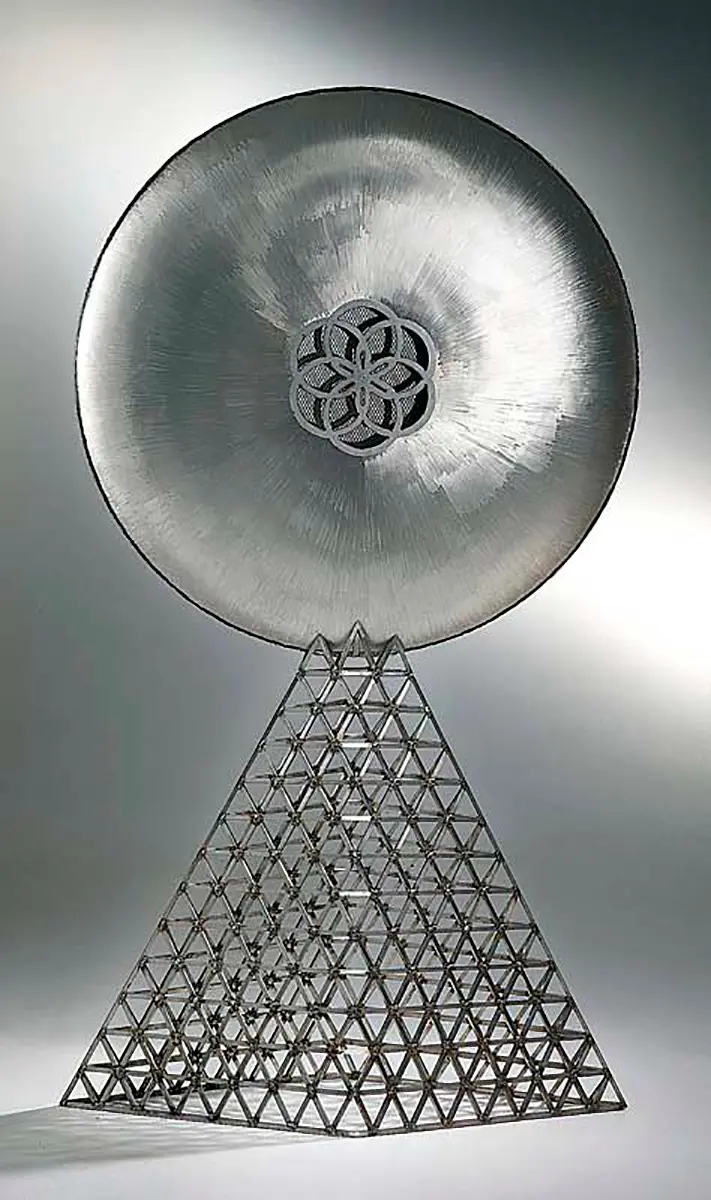
The poetic of her work is undoubtedly connected to the visual elegance of the pieces, emphasized by the seeming minimalism of the forms. This is evident in works like Language of Silence I and II, in which she combines again spheres and triangles.
Her depiction of textiles as metal meshes is also an allusion to sacred objects, and some of them can be interpreted as mimicking cloths. One of these pieces is Spatial Fabric, which may possibly simulate a ceremonial mantle. Another one is Feminine Grid, which follows a similar pattern of interlocked elements, creating a striking metal lattice.
All her work suggests concepts such as the ephemeral side of life, and yet again its endless cycle. However, from all the pieces included in this exhibition, Origin of Life V is perhaps the one that would define these ideas in a clear ritualistic manner. The piece consists of a circular basin, in which she combined metal and water. The association of ablution as a ritual passage is implicit since water is the symbol of purity and fertility. It is also the symbol of transformation and metamorphosis.
Azout’s oeuvre has the imposing magnificence associated with sacred spaces and rituality. Her pieces have the mystical sense of conveying the communion between spirituality and nature. This is essentially a sensorial type of art, where forces of spirituality and logic walk side by side. In an introductory text to her exhibition Out of the Geometry, Azout gives us a hint of what her work is about: “the unknown, the mysterious and the magical,” warning us that an open and uninhibited perception is one of the main tools to approach and understand her creations.
IRINA LEYVA
Curator and Art Critic.