
Urgencias, by María Elvira Escallón and Por el camino corto, by Miguel Ángel Rojas, two shows presented simultaneously at the Museo de Arte of the Universidad Nacional and conceived specifically for that location, signal an important development in the themes that these artists have been exploring in recent years. Each from their own perspective, they point out social circumstances that are part of Colombian reality: bureaucracy and healthcare, in the case of Escallón, and drugs and drug trafficking, in the case of Rojas.
The title of Miguel Ángel Rojas’ exhibition, Por el camino corto, refers to the “easy road,” the briefest and most expedite for the acquisition of great wealth, such as the path followed by drug traffickers and by those who seek happiness and fame using drugs, which only lead to death. Since the mid-1990s, Miguel Ángel Rojas has been working on a series of drawings based on dots, small circles, that are minutely clipped from dry coca leaves; he has also used these materials to paraphrase the titles of artworks mostly from the Pop tradition, deploying a strategy that was already present in his series of the Faenza Theater and returns in this show.
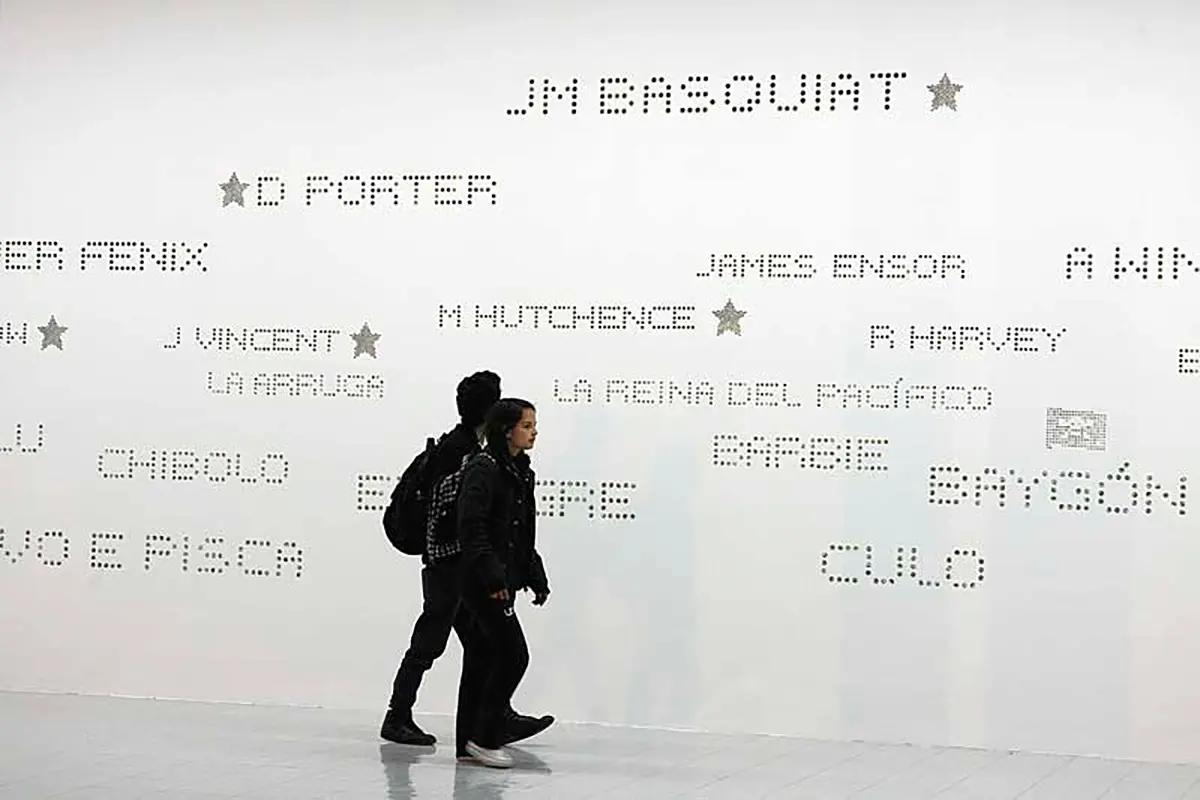
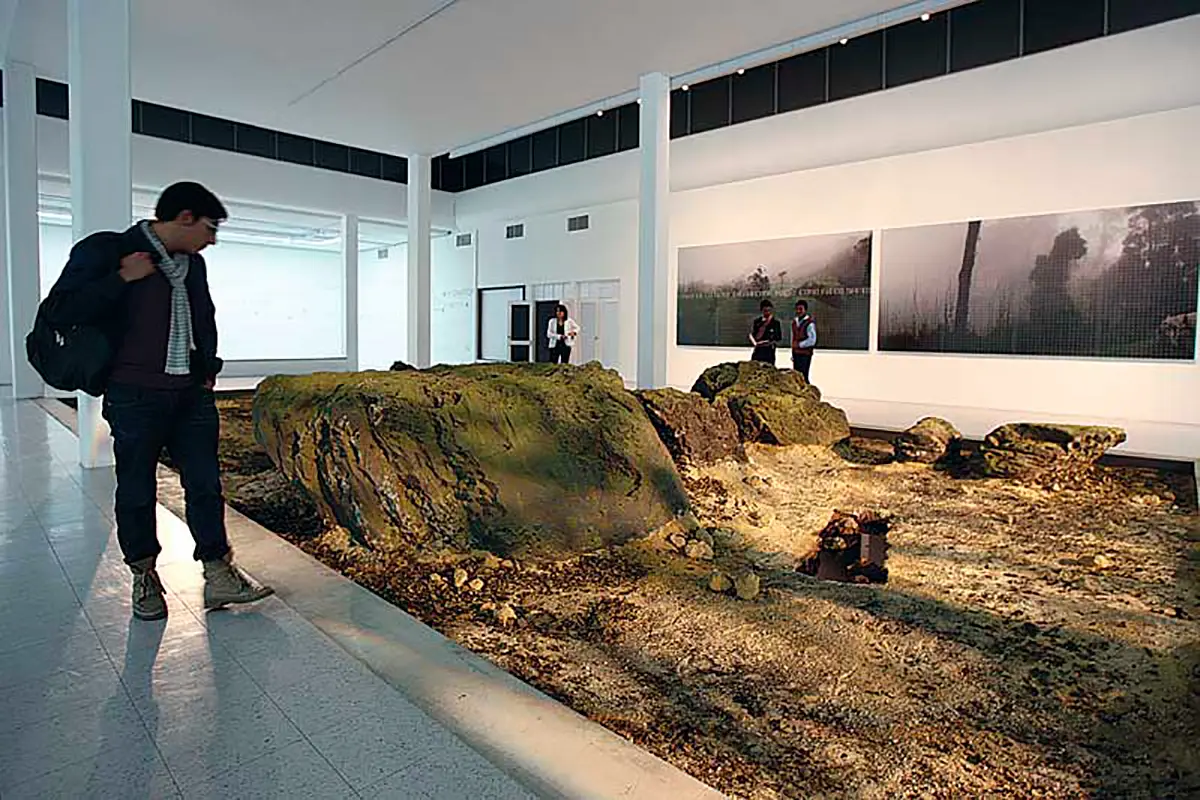
The museum’s ample main gallery contains two large installations. In the central section, a vast lifeless landscape, where only the rustle of some frogs alludes to the vital rhythms of life. It is a desolate landscape covered by the dust of dry coca leaves, which also produces an intense odor. On the walls around the gallery we read the fearsome nicknames given to traffickers, written with small circles cut from dollar bills, and next to them the names, written in coca dots, of celebrities like Janis Joplin and Jimi Hendrix, who were consumers. Besides them, there is a small star signaling death as a consequence of consumption. As curator María Belén Sáez de Ibarra says, these installations contain “two sacred entities: coca leaves and dollar bills, money. These installations take us inside the tension generated by the clash between two cultures and ways of inhabiting the world [...] which generates a clash that mobilizes ambiguous modes of relationship, resulting in violence, suffering, the destruction of the environment and of ways of life, and the destruction of life itself. "
On exhibit along with these two installations were two photographs alluding to the ravages of fumigation that, although intended to eradicate drugs, causes great social and ecological disasters. Traced on the floor in the main gallery with a gilded outline, there were some stars resembling a kind of hall of fame. In another room, a silent video was projected where the wind turns the pages of a phone directory for a nameless US city while coca leaves fall between them. In yet another room, there was a display case containing a number of small pre-Columbian heads, coca chewers with their mouths covered by bile. This truly poignant work brings into the show an emblematic figure in Rojas’ oeuvre. As the artist notes, this exhibition synthesizes the work he has been developing in recent years.
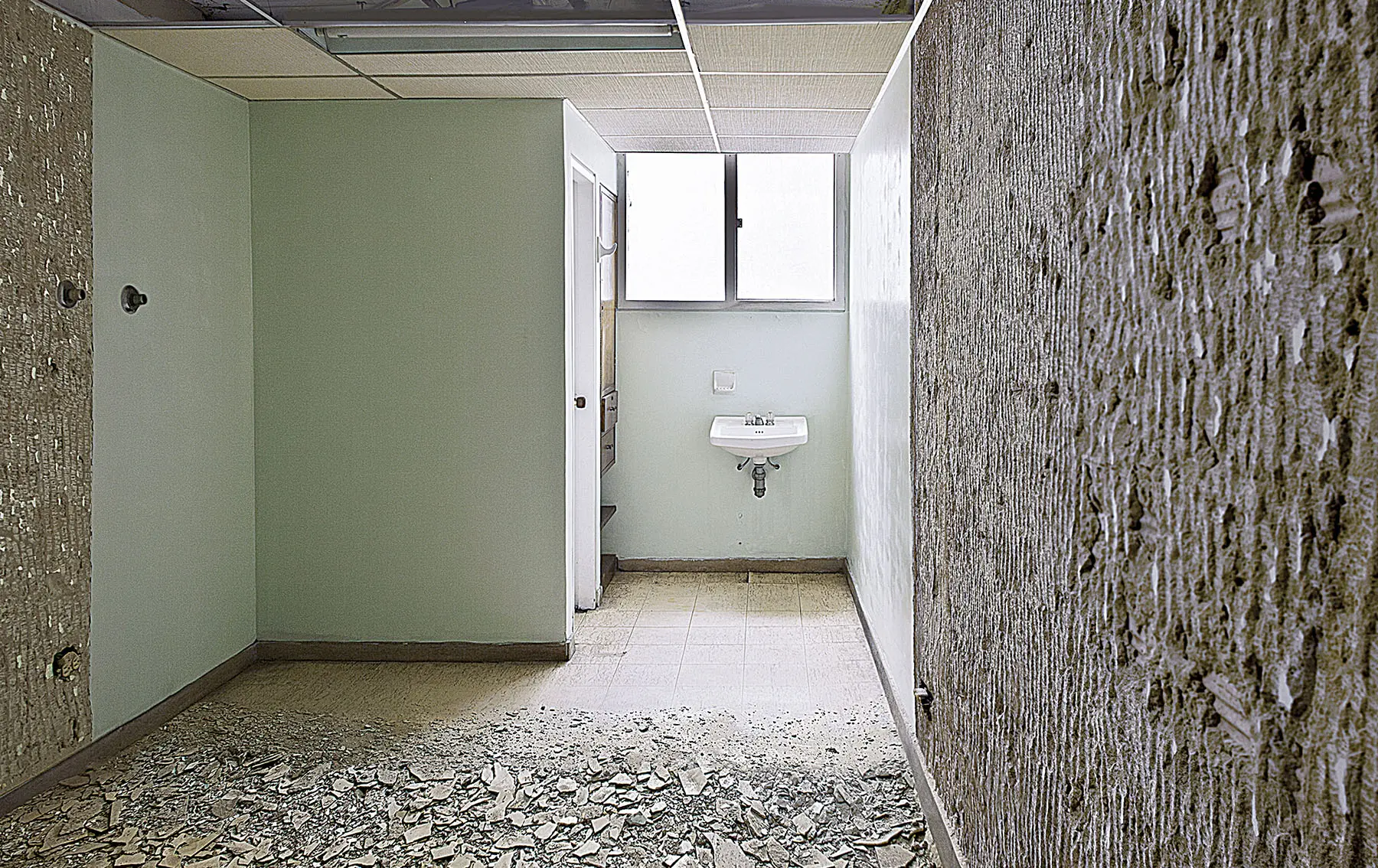
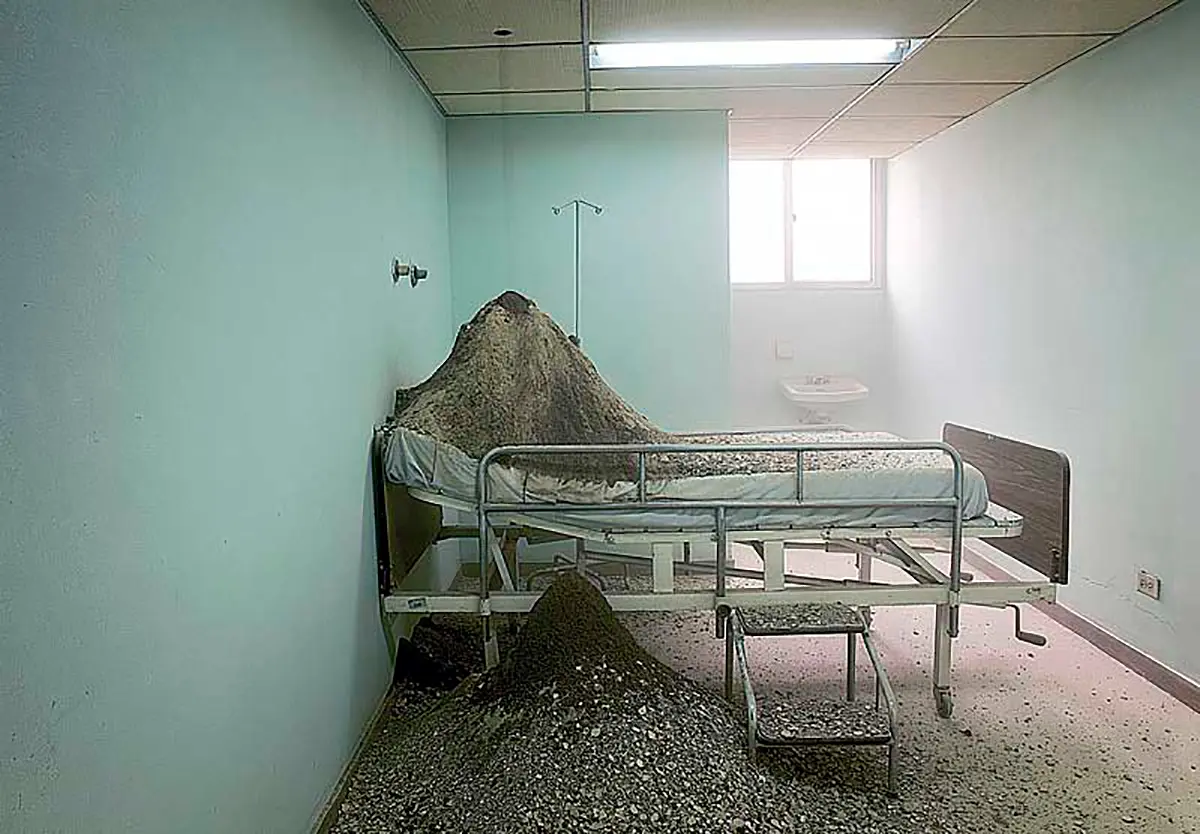
Several years ago, María Elvira Escallón encapsulated, at Estación de la Sabana, with its glass door, a forgotten, dust-filled, garbage-strewn space. This work, titled In Vitro, was one of the most memorable in the history of Colombian art. Her gesture was intended to point out the building’s state of neglect, extensive to the country’s entire railroad network. Years later, she created Estado de coma, an installation that, using photographs and items such as a grass-covered hospital bed, alluded to the situation of San Juan de Dios Hospital, one of Colombia’s most important research and patient care centers that had been abandoned due to healthcare privatization policies. With Urgencias, her new exhibition, Escallón revisits the issue, underscoring official indolence and bureaucracy, this time in reference to Santa Rosa de Lima Hospital, acquired by Universidad Nacional with the intention of transforming it into a university hospital. Escallón had already worked in these facilities, using a strategy similar to In Vitro. For Urgencias, she developed an action based on painstakingly scraping paint and stucco from the emergency room walls and leaving them in an unfinished state. The stucco was then ground, carefully selected for its chromatic quality and thickness, and mixed with dust gathered from the same hospital, dirt from the garden, and sand. Finally, this material was slowly poured on a hospital bed. The action was exhibited by means of a projection achieved through complex recording processes, montage, editing, and long recording hours, systematically articulating a series of captures frame by frame, and using metaphorically animation methods such as pixilation -in the Czech language it means ghost- and stop-motion, as Andrés García La Rota, the show’s curator, notes.
This striking projection was accompanied by a video showing the destruction of the walls while in another room, the words “POLVO ERES” (“you are dust”) were written on a wall using the same procedure.
Using the residue of equally “toxic” materials, coca and official neglect, these two undoubtedly forceful exhibitions are landmarks in the respective careers of two renowned artists.
MARTA RODRÍGUEZ
Reseacher and art critic.