
A blue plaque with Avenida Primavera written on it appears at the entrance of the gallery. The plaque is hard to see; one must be an acute observer to notice its presence. It is an imaginary address and the sign that introduces us to the house that contains the exploit by Mateo López: the idea that a house can become a book and that each intervened space is a chapter of such a book. The binding of this object-book are the gallery walls and each of the installations represents a section of the narrative. It is a narrative play that displaces the nature of textual storytelling, its order, and codices.
The exhibition project by Mateo López included a visitor’s guide. It is not a guide in the strict sense, but rather an invitation to be carried along by the series of objects and spaces that the viewer gradually finds on its walk through the exhibition. Its pages contain drawings, brief texts, and enunciations of various types. The exhibition is a stage of fiction in which the imagination can run free. There are objects that appear to be drawn on the guide-book that are not in the space. The observer must be daring enough to discover the visual and/or narrative traps that the artist places in the scenes. A between-the-lines connected to specific experiences are transformed by López into fiction as he takes a conscious risk since it is very possible that the “invisible” cannot be perceived because the “visible” maintains a weight of signification that triggers interpretations of a different order.
Mateo López is well known for his explorations with the language of drawing. His project emerges from lines outlined on paper; a foundational two-dimensional state that the artist leaves behind as the creative process moves ahead and three-dimensional forms begin to be constructed. In his installation proposal titled Avenida Primavera Casa No. 2 (Spring Avenue. House No. 2) the space itself became in support or container for a “drawn idea” in which the stroke reaches the dimensions of sound or smell; an abstract cartography of places and environments where memory—in its fragmented nature—becomes matter that gives origin to the works. There are twelve moments numbered in the guide. But once the visit through the gallery ends, the sharp observer realizes that some episodes could only occur in his/her mind, because they are nowhere to be found in the exhibition space. Such is the case of Chapter 5, titled The Divan. This is the manner in which stories are assembled and dismantled while the chapters of the book invented by López are populated.
In the drawing titled Nota de autor (Author’s Note), which could be categorized as piece number zero of the exhibition, the artist breaks with the pagination of the texts. According to the reference for this work in the guide: “The numerical order of this 200-page book was removed to allow readers to move about freely among the pages without perceiving its distance from beginning to end. The numbers were transcribed separately and were reorganized in alphabetical order.” With this subtle move—as if it were a chess match—López proposed a “dismantling” act. He warns us that not everything is what it seems and asks of viewers to become observant, but also careful once they enter the “play area,” because the rules are not unique and he, the artist, is entrusted to construct his own imaginary from experience.
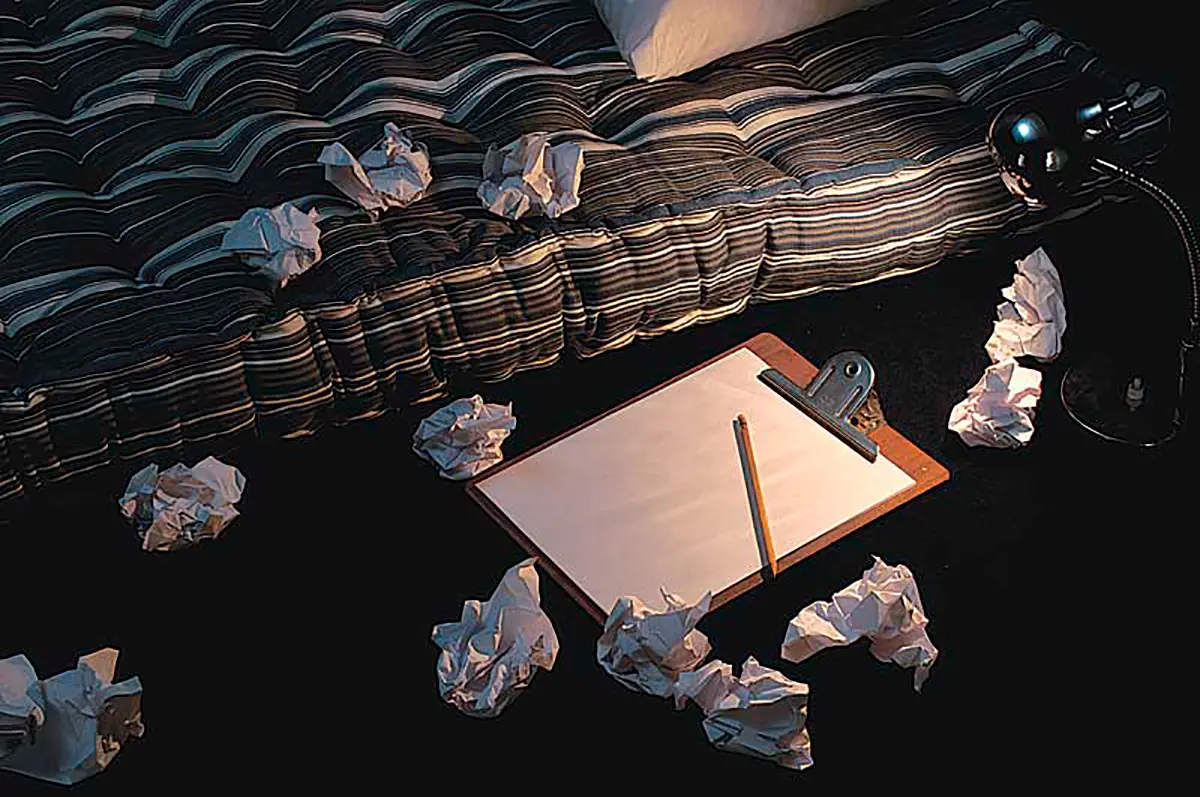
Titled Archive, Chapter 2 is an installation where the artist has mounted some modular shelves made with green painted cardboard designed and assembled by the artist himself. They contain nothing on it. Nonetheless, it is one of those proposals where the visible becomes even more present than the things that are. In La Caja Negra, another installation, Mateo López constructs a room with basic elements: a curtain, a mattress, a lamp, a pencil, a table with white sheets of paper ready to be used and crumpled ones thrown at random. In the background, there is a sound landscape that alludes to the rooms where López has drawn one of the leading audios: the pencil making traces on a sheet of paper. This action increases with the juxtaposition of other sound layers that enables viewers to mentally draw images from specific situations.
The Cabinet (Chapter 11) is the installation that somehow “closes” the exhibition. One idea of the "Cabinet of Curiosities" by Mateo López is there. Objects constructed by the artist that exhibits “his universe.” Once again the archive appears and, along with it, the multiple presences of the montage; a great story constructed from micro-stories. Could it be perhaps like a three- dimensional storyboard that did not make it into a movie? Or, the stage design of a play that was never played? The work by Mateo López appears to be experiencing a transition. Drawing is being transferred to other levels of representation. The artist inhabits the present of this passage, and it is from this temporality that he presents us with his Avenida Primavera Casa No. 2.
NOTES
1. These are the names that Mateo López assigned to the twelve chapters that form the exhibition Avenida Primavera Casa No. 2: 1. Between-the-lines, 2. Archive, 3. Abandoned Room, 4. Untitled, 5. From the Divan, 6. The Black Box, 7. Ephemerides, Today, 22 Years Ago, 8. History of Survival, 9. R/, 10. Removed Piano, 11. Cabinet, 12. Discontinued Piece.
2. It is important to note that the first idea of collecting maintained an obsession to contain “the universal” in the places where exotic and singular objects were accumulated. Mateo López exhibits “his universe” but not in the literal sense, as he continues to open cracks or to generate inquiries on representation and drawing as a boundless visual language.
ERIKA MARTÍNEZ CUERVO