
Visiting the space of the Fundación Teatro Odeón in Bogota—which I knew several decades ago when it housed the Teatro Popular in Bogota, reformed at the height of the so-called postmodernism with all of its formal tics, its historicism and its misunderstood contextualism—the only thing I was able to think was: ruins dignify everything. Years of neglect and deterioration have conferred this space a certain air of greatness; its character of historic pastiche and grandiloquent pretentiousness in vogue during the 1980s, fell along with the plaster moldings and the pastel color stuccoes, leaving behind a concrete shell that possesses the pathetic magnificence of a whale stranded on land. This is the magnificent stage for the most recent exhibition by Colombian artist Miler Lagos titled Breaking of Gloria. The works presented by Lagos are the result of a residency in one of the places least visited by art: the Arctic. The residency was organized by Astrid Bastin, Colombian curator and cultural promoter and director at AB Projects in Toronto, Canada.
Lagos stayed for almost one month near Coppermine town, and from there he made several excursions to specific points of this inhospitable and solitary territory. During one such trip, while he was returning to base camp by hydroplane, Lagos flew over the coast past the arctic polar circle and further north. Before taking off, Lagos affixed a video camera to one of the plane’s pontoons. The camera recorded for almost half an hour, from the time the plane took off until halfway through the flight, when the extreme weather froze and disabled the camera. The result is a 15-minute long video, without any editing or cuts.
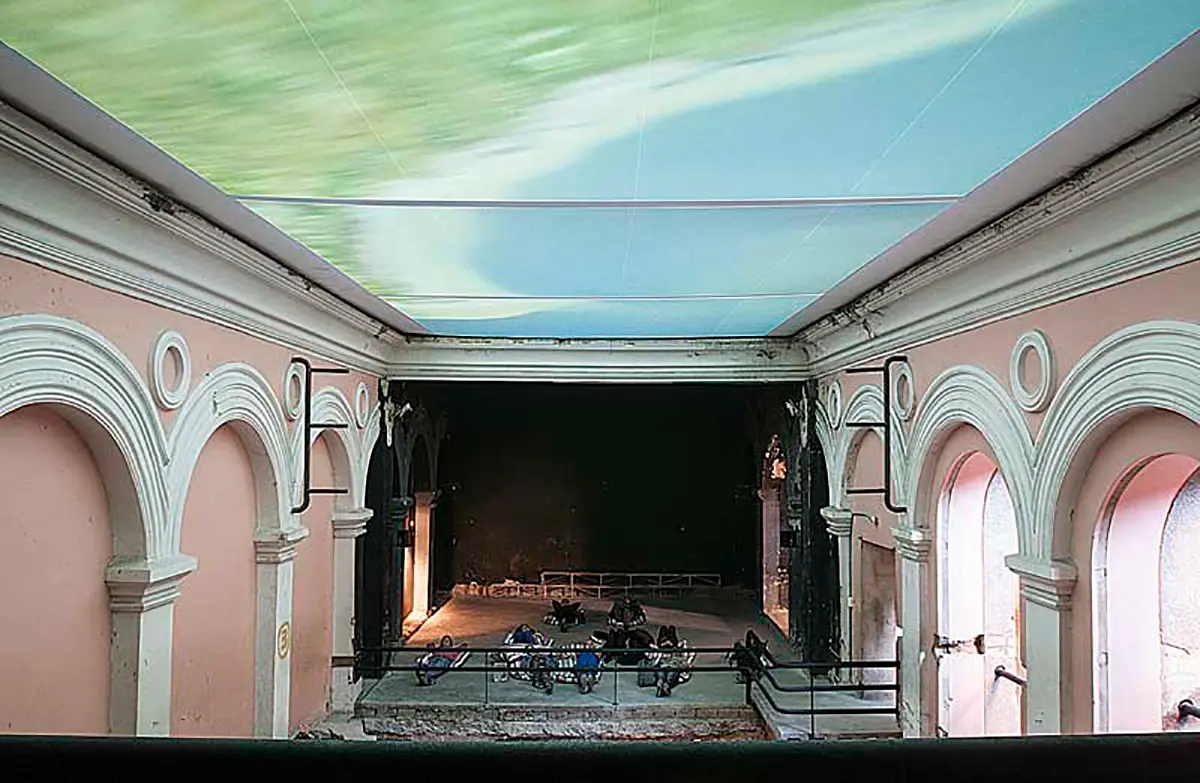
It should be pointed out that such a sublime landscape can be both a blessing and a curse for an artist. Beauty that perfect, that serene and present, makes it difficult to find a new point of view that avoids the cliché. Above all, Lagos is a sculptor, and this is palpable in the way he approached the problem. The photographic series and video about the man-caribou, one of the foundational folktales of the Inuit people, show a cairn decorated with antlers from those enormous cervids. These monuments are called Inuksuit (similar to a human), points of reference, reverence, and pilgrimage for the Inuit. Lagos shows the sculptural form in front of the changing landscape, as a way to contrast myth against territory, while suggesting that even the most desolated places in the world have someone living there and that someone has found ways to signify it. One of the most beautiful works in the exhibition, the video titled Skipping Stones, shows a large lake in complete calm and minutes before dawn. The wind is the only thing disrupting the calm of this unpolluted dark mirror. At times, it sends a ripple through the surface now bestowed a terse texture. And then successive patches of water begin disrupting the calm in random intervals as they generate concentric waves. This is periodically repeated and in different areas of the body of water. Since the video is silent, it takes us a moment to understand that someone (the artists) is throwing stones to the river from the shore, in such a way that it bounces off the surface of the water. This game in Colombia is known as pan y quesito (bread and cheese) or haciendo sapitos (making frogs). Lagos breaks the sublime through evoking childhood and play, but the result is not funny, it is rather grave and moving. When he arrived in Odeón to mount the exhibition, Lagos searched for the right place for each one of the projections and photographic series. When the time came to decide where to place the video taken from the airplane, he realized that the main hall of what used to be the theater, now in ruins, lacked any chairs or a stage and that the cornices ended at the point where once was the clear sky, letting the gaze wander off to the depths of the fly system. Lagos remembered the painted skies on the roofs of many Baroque buildings. There, the fake perspective and the trompe l’oeil suggest an opening to infinity, toward a metaphysical space. This pictorial device was called “breaking the glory.” Laos replaced the clear sky with a translucent cloth and projected the video from the floor looking up. The effect is surprising. The piece can be experienced from different angles, given that it is possible to lay on what was once the stage or to go up several floors and watch from the balcony. There is even the possibility of going further up and staying on the loading bridge to watch the video from there as if one was watching it from an airplane. Lagos creates an exhibition that is at once subtle and powerful, and one that masterfully interacts with the place that houses it.
JOSÉ ROCA