
This is Moris’ first solo exhibition, at Arróniz Gallery. The artist, whose real name is Israel Meza Moreno, presents a series of objects that, staged as a whole, offer a harmonious reading of difficult topics in contemporary Mexican life: violence and suffering.
Perhaps the most representative work on exhibit is A media asta (found tires and wood, concrete, leather jacket), an assemblage whose effectiveness is announced from the start in the title’s reference to a national flag that is raised only halfway on the mast in periods of grief or for the commemoration of collective tragedies.
Moris’ proposal is, evidently, the suggestion of a flag that should permanently be sending that tragedy-related signal. The everyday constant of grief has become entrenched in the spirit of a collective that can only rarely decide when the country’s greatest emblem should “officially” announce national mourning. Moris has left it like that precisely so that mourning will continue.
This work includes a cardboard sign that also gives the entire show its title. The obvious reference is to birds of prey that have detected their victim, but the obviousness does not detract from the effectiveness to the assertion that above us, above everyone looking at this work, a flock of large birds circles and patiently waits for our demise.
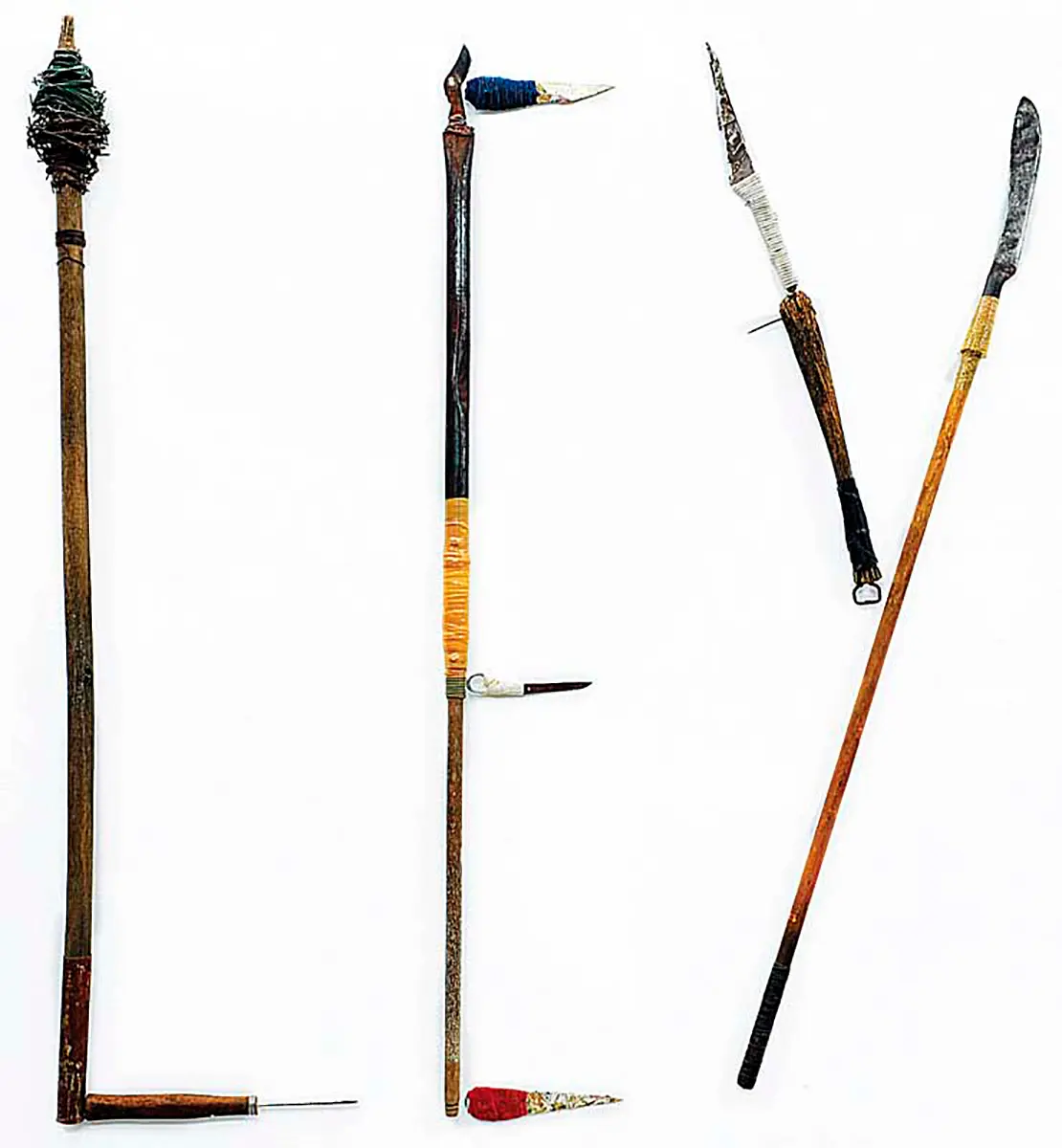
A series of signs have been written using stabbing instruments: razors, penknives, screwdrivers, pikes, fragments of scissors… They all remind us of those made clandestinely by gang members in prison in order to maintain their areas of power and control. Teresa Margolles also made a forceful series using similar objects, in her case used in the commission of a crime.
Now, these weapons from the phrases “DEATH TO COWARDS”, “SOMETIMES COWARDS SURVIVE”, “LAW”. The texts’ geometric structure, given by the primordial shape of the weapons, provides an element of aggression for words that, evoked in this context, appear rather as directives for survival in adverse spaces, perhaps the streets or some high-danger areas of the Mexican republic.
A two-dimensional work captures the gaze of two characters we are on the verge of recognizing. Captured in some kind of public event and stripped of any identifying feature (as in a different time guerilla fighters used ski masks, or as military commandos shield their identities behind masks and dark glasses), they glare threateningly at their audience.
This kind of revelation of evil as a “big brother” of officialdom, appears before us in an especially forceful work of art. It is dominated by a funereal shade of black that, despite its strength and preeminence, lets us see the eyes of those who are hiding behind it to survey it all.
Moris’ studded belts tying objects (as Thomas Glassford did in his historical series of bottle gourds tied with similar objects and metals) speak of the well-informed trajectory of an artist whose works possess great objectual and volumetric effectiveness.
Moris’ art becomes expressive not only due to its themes but essentially for the selection of materials and the assemblages he creates by mixing supports and subverting them in the construction of a discourse that is inescapably current.
SANTIAGO ESPINOSA DE LOS MONTEROS