
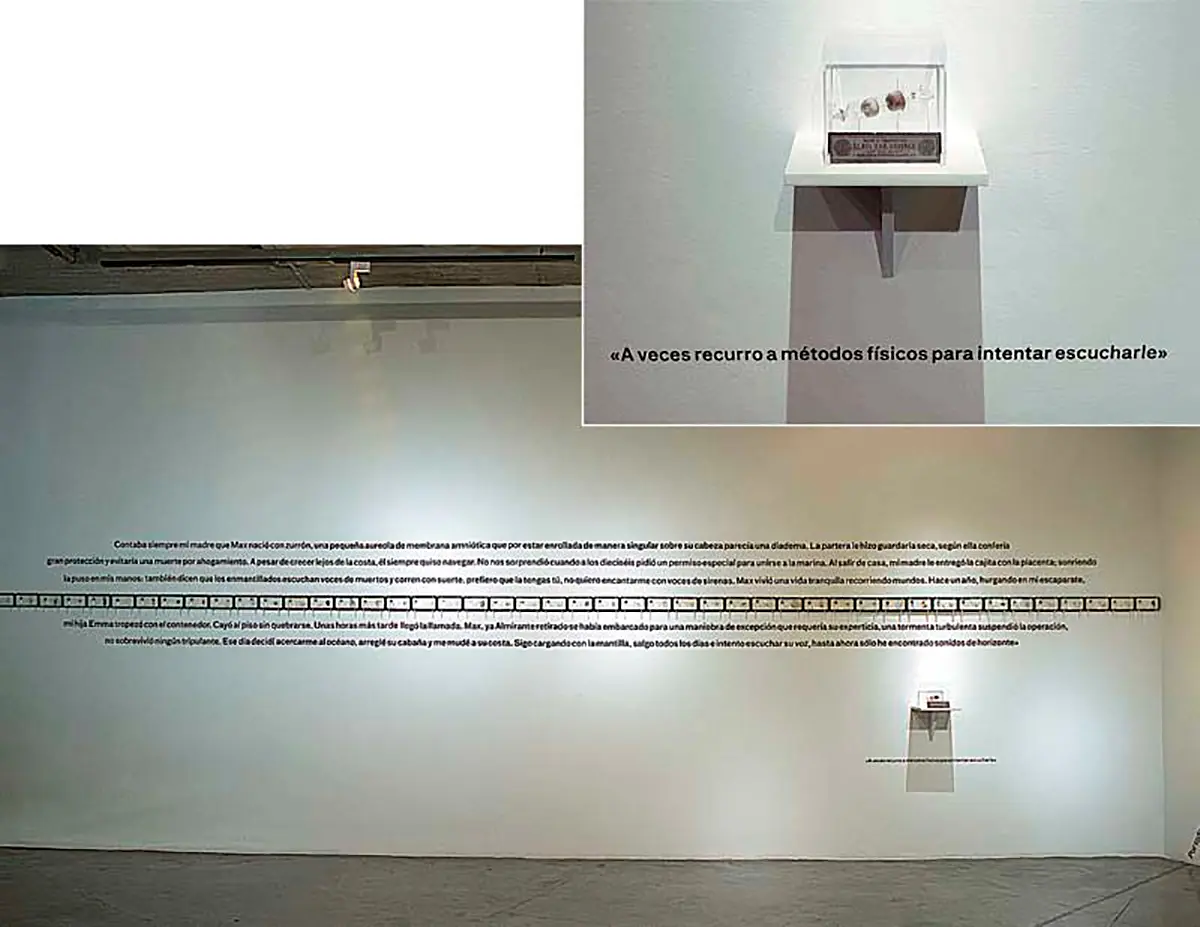
Experience and memory reconstructed as careful and yet unsteadily assembled narrations defined the five installations in the exhibition titled Sonorous Epigrams by Venezuelan artist Nayarí Castillo (the US, 1977). The works Horizontes para Amar (Horizons to Love), Confesiones de un Pirómano (Confessions of a Pyromaniac), Sobre el Estremecimiento (On Quivering), Veinticinco Trampas (Twenty-Five Traps), and Anotaciones tras la Sacudida (Notes After the Tremor) were constructed with materials that are prevalent in Castillo’s work: video fragments, texts, photographs, old and found objects, jars, and photocopies, among others; objects Castillo relies on in order to build a museography that required a dynamic and active movement across the exhibition space.
Printed texts on the floor and on the walls were prevalent in the installations. They described various sound encounters, anecdotes that Castillo collected from several people and then rewrote for the exhibition. To strengthen the central role of words, handwritten signs were also present on walls or labels that alluded to the recollection, cataloging, reorganization, and re-semantization; all operations that influence Castillo’s exploration and practice.
Sound Epigrams represents the consolidation of a methodology that was already becoming evident in the last show by Castillo in Caracas in 2009. On that occasion, the artist created an exhibition-installation based on his research about the missing hippopotamus that belonged to drug lord Pablo Escobar. This research methodology materialized in works where the strategies employed are not based on formal considerations but rather on communicational needs. It opens the seams that are often hidden in the polished appearance of the finished work while suggesting the elongated temporality inherent to the research process.
In the case of Sonorous Epigrams, this methodology also operated on the installations; fragments made from fragments. Threaded across space, the dialog between them created intimate interstices that confronted the work, as it also allowed one to think about the record and archive mechanisms used to collect and re-present the sound events that each installation represented. These mechanisms included listening, the insurrection of narrative, data collection, and field research as facets of an artistic—and archeological—practice. This archeological gaze by Castillo—unearthing and exposing the past—generates temporalities and interpretations that are not limited to addressing the curious elements from the various sound anecdotes of his exhibition. On the contrary, he also succeeded in establishing a dialog with the largest theme in the history of representation technologies in order to hint at other inquiries. How is the occurrence captured? How is the occurrence marked? Which format will more faithfully capture the occurrence? What is the role of the object as a bearer of the occurrence?
According to Walter Benjamin, the authenticity within something represents “the sum of all that is transmissible since its origin, from its material duration to its historical testimony.” Castillo masterfully plays with this concept and sometimes auscultates the traces of objects to suggest its past, and other times invents records of the supposedly real through found objects, fragments from other lives that have a connection to the fictionalizations weaved by the artist.
In Veinticinco Trampas (Twenty-Five Traps), for example, Castillo enumerated paranormal voices that were part of the story that jolted the installation. He used glass bottles to submit several materials—bright wool, insects, and other natural relics—to an operation re-semantization. The labels placed on each one and the text placed on the floor turned them into metaphors that suggested the voices that the protagonist listened to. Likewise, when translating the experience of the object and muting sound, the installation pushed the boundaries of the presentation by imposing a loss in translation—or poetic license—between the experienced/sound and that which is represented.
This gap between the occurrence and its account mark the determined but delicate form of the installations in Sonorous Epigrams. They contributed different processes of translation—images, texts, objects—without looking for a faithful or objective recount. The diversity offered by the installation acquired conceptual and communicational gravitas in this exhibition by Castillo, who employed the medium to build pieces according to the prevailing logic of fragmentation. This exhibition allowed Castillo to construct the distinctive distance that her works inspire: marked by the sensation of loss and displacement; thus suggesting the gap—perhaps tragic, nostalgic, or melancholic—between experience and memory.
Despite their diversity, these five installations were articulated through a double and successful dynamic. On one hand, the insisting collection and organization of data—objectual, photographic, visual, textual—and on the other, the materialization of something previously lost in translation: an interference turned into text, image, and object; the product of the appropriation of the sonorous anecdotes. In this respect, the multifaceted translations by Castillo opened spaces for a new sound experience, detonated by the objects and images that transformed viewers into listeners of the silence in Sonorous Epigrams.
LISA BLACKMORE