
Color as Structure is an exhibition project that Venezuelan artist Patricia Van Dalen presented at two cultural institutions in Caracas: the Galería GBG Arts, and the exhibition space La Caja of the Centro Cultural Chacao. Curated by Lorena González and Juan Ledezma, both exhibitions address an essential aspect in the work by Van Dalen: the behavior of color in dynamic structures to contribute to open work. The curators took into consideration the diverse supports and processes preferred by the artist; her formal and conceptual diversity and, of course, the relationship between the work and the viewer—different in each venue.
Van Dalen approaches the concept of structure from a revised perspective. Juan Ledezma points out in his curatorial text that, instead of considering the structural criteria as a rigid and unchangeable articulation of an artistic formulation, Van Dalen opts for the post-structuralist definition—based on a theoretical revision that began in 1968—in which the artistic formulation is disarticulated. Based on the premise of the destructuring of the structure, this allows her work to expand its field of interrelations, both perceptual and discursive.
Under these criteria, the meaning of both exhibition proposals becomes perfectly visible. The first of these, inaugurated at GBG Arts, included nine collages titled Estructuras (Structures), five of which were superimposed to murals painted by Van Dalen with acrovynilic painting. Suspended by transparent nylon, these collages conveyed an interesting weightless and dynamic condition due to their oscillating movements and the effect produced by the planes (collages) superimposed on stable “fields of color.” This presupposes the presence of dynamic structures that continually change. Likewise, the chromatic compositions in the collages are also very dynamic with their prevalent asymmetric geometries, the interaction between highly saturated colors, and more muted tones. At the same time, there is an interesting play with the balance that relies on the proportionalities of the color planes and the chromatic combinations. An installation created in the Sala 2 complemented the exhibition. It consisted of a fluorescent vinyl cord in orange, green, and pink held by the needle. The articulation of each part has subtly outlined a structure made with lines of color.
In La Caja exhibition space, Van Dalen created a surprising effect in the main hall. As the name suggests, La Caja (The Box) is an enclosed space with high ceilings. So instead of intervening it directly with adhesive tapes to fill the spaces with dynamic lines of color—as she has done in other occasions—Van Dalen chose to create a pictorial installation with 120 small pieces—of various dimensions—that were clearly conceived to contrast the height of the place. The equally asymmetric distribution of these small modules is part of this challenge to proportions. "I was interested in exploring—Van Dalen affirmed to the press—small formats that allowed me to appropriate the large space and to create a piece with many parts; one that would allude to the definition of the word structure: relationships established between the various parts of a whole." But this artist also took into consideration the overwhelming feeling that this place produces in her. “I wanted to create a chapel, like the one at Ronchamp by Le Corbusier. Although I have never been there, even through photographs one can sense the reverence that exists in space for devotion.”
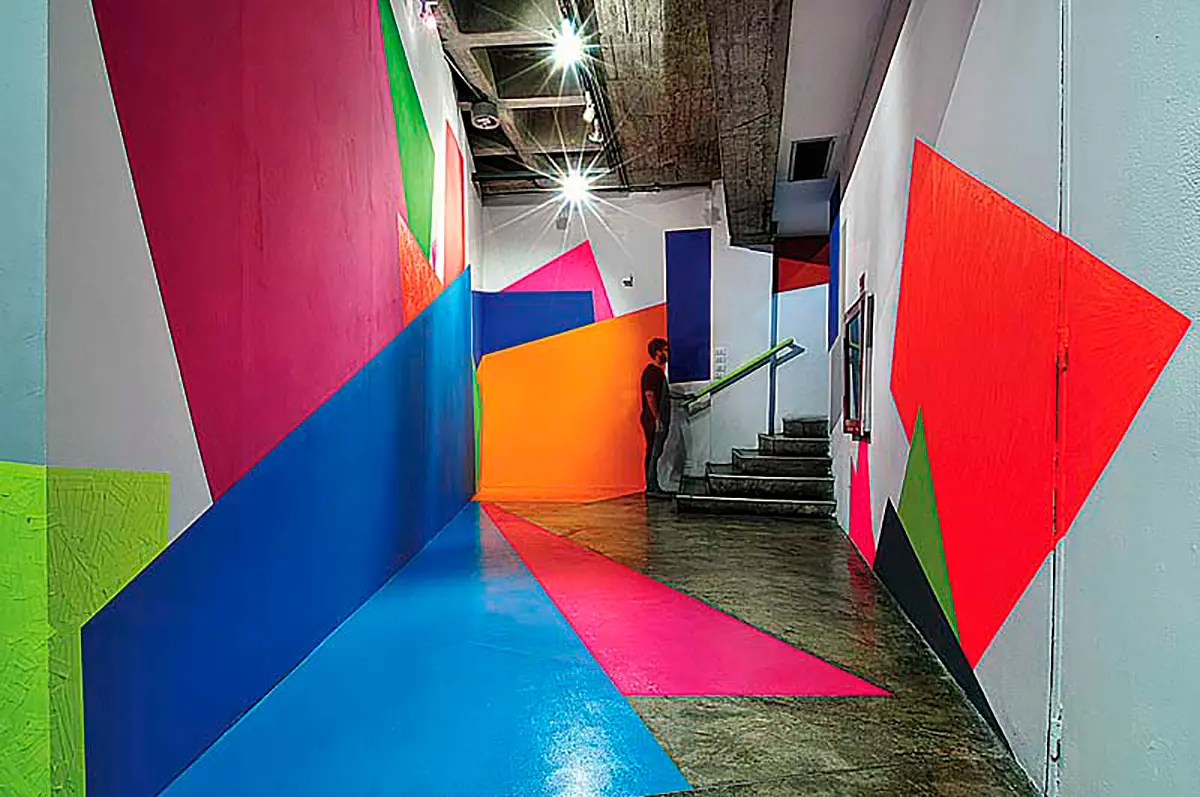
The curatorship at La Caja also underscored the mobile and transforming nature of the various structures created by Van Dalen. For the first time, the artist animated her chromatic compositions in a separated section—divided from the rest of the space by a false wall—that reproduces one of her works titled Arquitectónicas (Architectonics). In this small realm, the artist presented videos where several planes of color appear and disappear as they are replaced by new ones. It is clearly an irrefutable demonstration of the compelling nature of these mobile and flexible structures when they are explicitly set into motion. Conversely, the transition from one scale into another, from the minimum to the maximum, was also taken into account in this exhibition. One realm painted with large planes of color placed on the floor and wall invited viewers to experience being inside a chromatic composition rendered with fluorescent colors, and in some of the planes, textured with adhesive tape. This Arquitectonica Penetrable (Penetrable Architecture), as it is called, created a dissonant relationship that, at the same time, was complementary to the chromatic and spatial proposal presented in the main hall at La Caja.
Both exhibitions demonstrate the limitless possibilities in the language of color. They both will be without a doubt a future referent in the artistic trajectory of Patricia Van Dalen.
SUSANA BENKO