
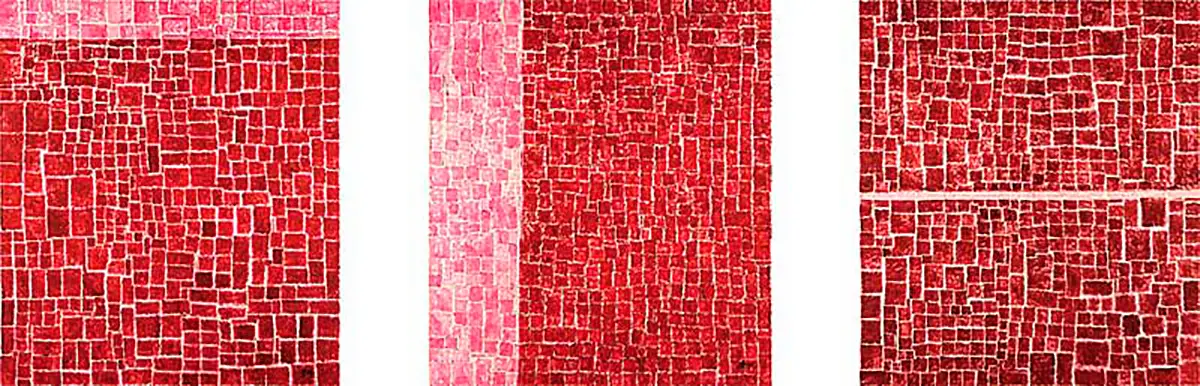
Entre líneas, Roberto Diago Durruthy’s first solo exhibition in New York City, presents viewers with several possible readings. Besides referring to the existence of lines in each of the works, at first glance it appears dominated by geometric abstraction, and it creates a sense of order and abstraction in the gallery, yet there is something in suspension that is not geometrically rigid. The works gradually generate a feeling of softness that invites us to investigate its provenance. In a total of 19 mixed-technique works, verticals dominate—1.3, 1.7, and 2 meters in height; there are only three horizontals of 1 x 1.3 meters. Large panels in white, black, red, and sand tones inhabit the gallery. What happens inside these formats outlined by right angles? As we examine the works more closely, the weave gains prominence and begins to refer to a process that cannot be perceived from afar. In some places, the fabric used by the artist in his mixed techniques is known as “blanket fabric”; in others, “non-industrial linen gauze”; in yet others, arpillera. More designations can be cited, but what is important is the fact that with this open weave the artist lets the support “shine through” to the viewer’s gaze and reveals a painstaking process that turns the cloth into a sieve for those figurative elements he no longer includes, only alluded to in works populated by a crescendo of black and red pigments.
Roberto Diago is a Cuban artist who continues to explore and contribute to this indispensable period. The island’s great visual artists already produced their works, their screams, their new modes, with installations, relieves, paintings, and so forth, where the “insular” was expressed in a novel, suffering aesthetically of an expressionistic and/or conceptual bent. As if the seascapes of the Nineteenth and Early Twentieth Centuries had escaped the canvas and entered into the ocean’s storms, to reveal the social and the political. It can’t be denied that those Cuban voices—and those from different areas of the Caribbean region—have been intensely enjoyed; their works have blazed new trails in the visual arts of the last three decades. And this is the point when a new generation—understanding “generation” as a concept, not a matter of age—brings forth new visions. Some are doing this in a context where explorations and quests prevail. Undoubtedly, it is very difficult to say something intense after José Bedia, Luis Cruz Azaceta, Ana Mendieta, Carlos Garaicoa, and Los Carpinteros, to name only Cubans.
In the case of Roberto Diago, an interest in the Afro-Cuban element offers an intrinsic vector, interpreted from the plot of lines that cross each other to reveal their structure. The artist presents a proposal that must be considered in its labor of synthesis. Before, in his work of five or ten years ago, we noticed with greater clarity the presence of more rustic mixed techniques, compositions with a compartmentalized organization, the simultaneous use of flatness and perspective, as well as the characterization of flowers that resemble ritual/indigenous feathers. In these works, there was also frequent use of small brush touches, precedents for the weave of the fabric in the current mixed techniques. The color black was always present in his semi-figurations. All of this has been gradually left behind. Now, a careful pulchritude defines works such as those seen in New York.
Diago, as the artist is often called, introduces in this exhibition a series that possesses something of the musicality inherited from his family. The show as a whole can be seen as chromatic scales from the Caribbean’s typical white, through the sand tones of geography (with some materials like bamboo canes and knots), to the black color of the oceanic night, the richness of dark skin, the Afro rhythms, without excluding the red of sacrifice. One must understand that this artist is a contemporary, matteric primitive who now resolves his work from an extra-installative and transpictorial perspective. Figurative and semi-figurative narration is absent in these impeccable, ascetic works rooted in minimalism, which hide within themselves the passions of bicultural deities. In this context of the contemporary primitive, purity—as day—and plots of black and red—as night, sacrifice, passion—present new visual alternatives. The Afro-Cuban roots, religions, and deities cited by the artist—Abakua and Shangó, among others—live together in a monochrome, bi-chrome, and three-tonal intensity. The most intense and accomplished works are the black and red-black ones. In them, the artist retains his original expressionism, for instance in the wood pieces he used years ago. In this exhibition, Diago expresses a path of tension that does not ignore two polarities: tribal decorations in stripes, and the existence of digital screens. The artist conceives several of his works with allusions to diptychs and triptychs, emphasizing the experience that everything implies a process in time.
GRACIELA KARTOFEL