
OMR presented Retrospectiva en un minuto (One-Minute Retrospective) an exhibition by artist Rubén Ortiz-Torres, almost six years after the previous solo show in his gallery. Interestingly, the 2006 show, Distancia táctica, introduced a series of paintings; his first abstract experiments with car paint which have developed in the body of work presented at OMR. Ortiz-Torres’ work is informed among other things by popular culture and subcultures. At the beginning of his career, his experiments in photography portrayed the lives of his friends and acquaintances in the eighties punk scene in Mexico City and after moving to Los Angeles, California in the nineties, he has explored the many complexities of living in a city that is a mix from various cultures (and subcultures) and which also possesses a troubled past and present histories, doing so in many mediums such as painting, photography, video, installation, sculpture (ranging from intervened everyday objects such as baseball caps to altered hydraulic cars).
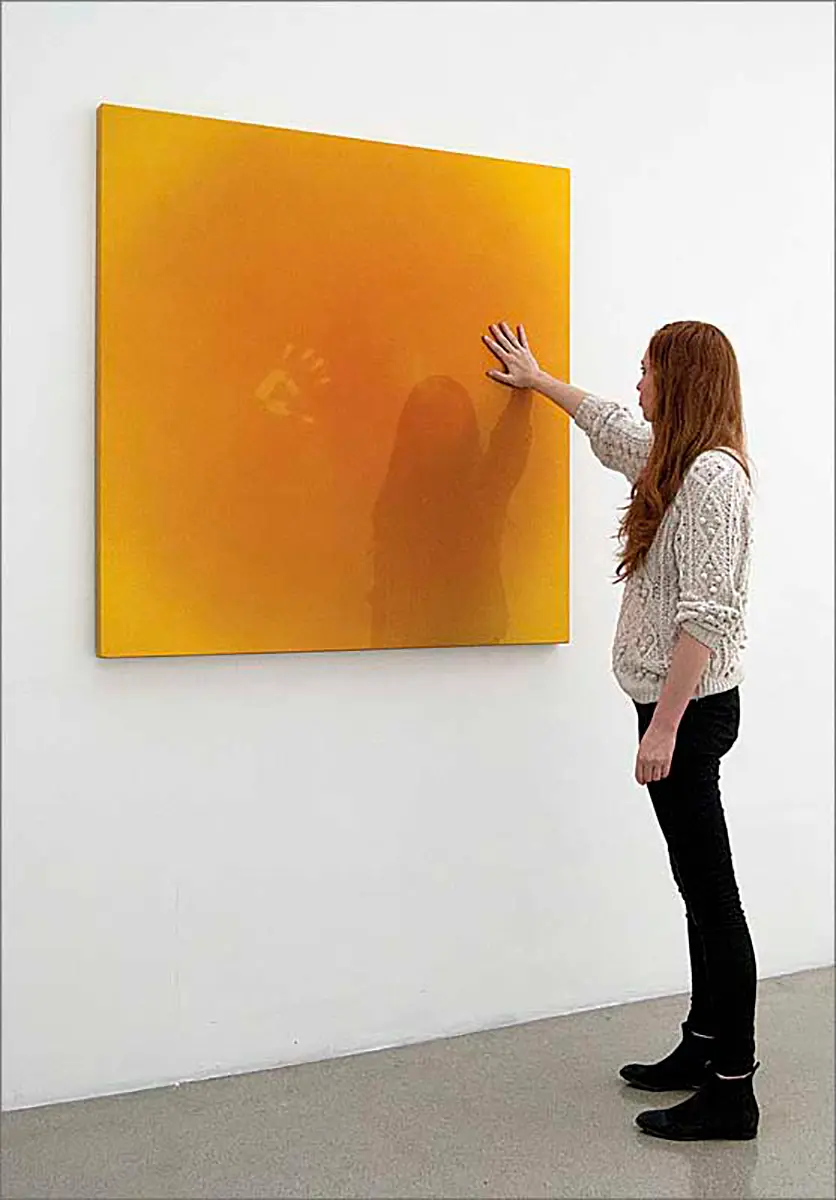
Retrospectiva en un minuto was composed of three main nuclei arranged in different sections: one about portraits, three videos, and his most recent body of work in painting. Since Ortiz-Torres’ early art training was strongly based on academic art techniques, he has explored and deconstructed the medium in the practice as well as conceptually. While producing works that stem from border policies and lowrider culture, such as the famous Alien Toy, 1997, Ortiz-Torres began to work more closely not only with hydraulics experts but also with custom car paint shops, which allowed him to realize that the car painting process is not far from a canvas painting, requiring a similar preparation of the surface or support with different coats of primer, sanding, etc. His most recent series, which includes Aurora Borealis, Pintura indéxica (Big Bang 2) and Mango Transmutation, from 2012, is the result and the continuation of an extensive investigation on the medium of painting through the experimentation of car paint techniques. Aurora Borealis and Mango Transmutation, for example, are large panels painted with “chameleon” paint in different color gradients that can be perceived based on how the light hits the surface or the position of the viewer. The surface of these paintings is not only a conscious nod to the Los Angeles Fetish Finish movement from the sixties—whose proponents, just as Ortiz-Torres, were concerned about issues of color, perception and handcrafted techniques that had a perfect-finish look as if they were machine-made—but also to ideas of participation and interaction proposed by Neo-Concretism. The painted benches Jungle Fever and Inversión térmica, both 2010, as well as the panels Pintura indéxica (Big Bang 2), and Horizonte alcanzable, both from 2012, were produced with thermochromic (thermo-sensitive) paint, and therefore involve the touch of the viewer to “complete” the painting, leaving traces of their body on the surface in the places where the painting was touched and the color transformed due to body heat. The thermo-sensitive paintings allow a reading that goes beyond experimentation with material or medium; they also represent an examination of the history of painting itself. Ortiz-Torres transgresses the idea that painting on a wall is to be observed, thus inviting interaction and completion, as the experience with the painting is meant not only to physically transform the artwork but also his/her experience with it somehow. In this attempt to “democratize” the medium of painting by activating it through the movement of light (while the spectator moves his/her own body to circulate around it) to perceive the different colors or by touch, Ortiz-Torre’s series also includes a particular diptych that goes further into this political statement. 1% y 99%, is the title of these two panels also from 2012, which complement each other (they are sensitive in 1% and 99% respectively). He plans to separate them and place them in different sociopolitical contexts to be brought together again at the end of the project.
Ortiz-Torres’ work is often, if not always, loaded with political content, in some cases more obvious than others, but challenging the ways we understand (art)history, worldwide social issues, and “high” and “low” cultures. The four videos that are part of Retrospectiva en un minuto, include Como TV, 1985, an early experiment in the medium that he collaborated with cinematographer Emmanuel Lubezki by recording news clips and movies about war and world miseries from television in Super 8mm. El sueño de la razón todavía produce monstruos (The Sleep of Reason Still Produces Monsters), 2006, is a video made with photographs from the personal archive of Siqueiros, who left his archive “available to be used by revolutionary artists,” in a direct reference to Siqueiros’ utopian view of art, but also to Francisco Goya’s famous self-portrait.
In the same way as the images in this video mutate into another, the section of small figurative paintings and drawings in the show is a simultaneous representation of the past and present as many of them include the “original” portrait of his friends (made in the 1980s-1990s) and a “current” portrait of the same person superimposed on the “old” one. Interested in portraiture since early on in his career, he has transported this branch of the beaux-arts to studies of the individual and his/her sociopolitical circumstances through every medium he works with—for example, his modified artifacts as portrayals of a culture (specific to Los Angeles), and the car paint panels and benches that could work as portraits after the viewer has activated the paint with body heat.
Lastly, the two videos which give its title to the exhibition are Retrospectiva en un minuto mexicano (Retrospective in a Mexican Minute) and Retrospectiva en un minuto neoyorquino (Retrospective in a New York Minute), entail the ironic endeavor of capturing his entire career and context in a hyper-fast stream of moving images in 2 minutes (the “Mexican Minute”) and 1 minute (the “New York Minute”), in a mix of historical events and his body of work.
SELENE PRECIADO