
Colombian artist Ruby Rumié (Cartagena) presents Getsemaní: Subject Objet 1998-2008. The exhibition includes several works that depict through several formal mediums the inhabitants from the neighborhood where she lives. Getsemaní, an emblematic and colonial neighborhood in Cartagena, is the place where Rumié gets her conceptual “material,” as she responds to the urban and touristic impact to which this area is subjected.
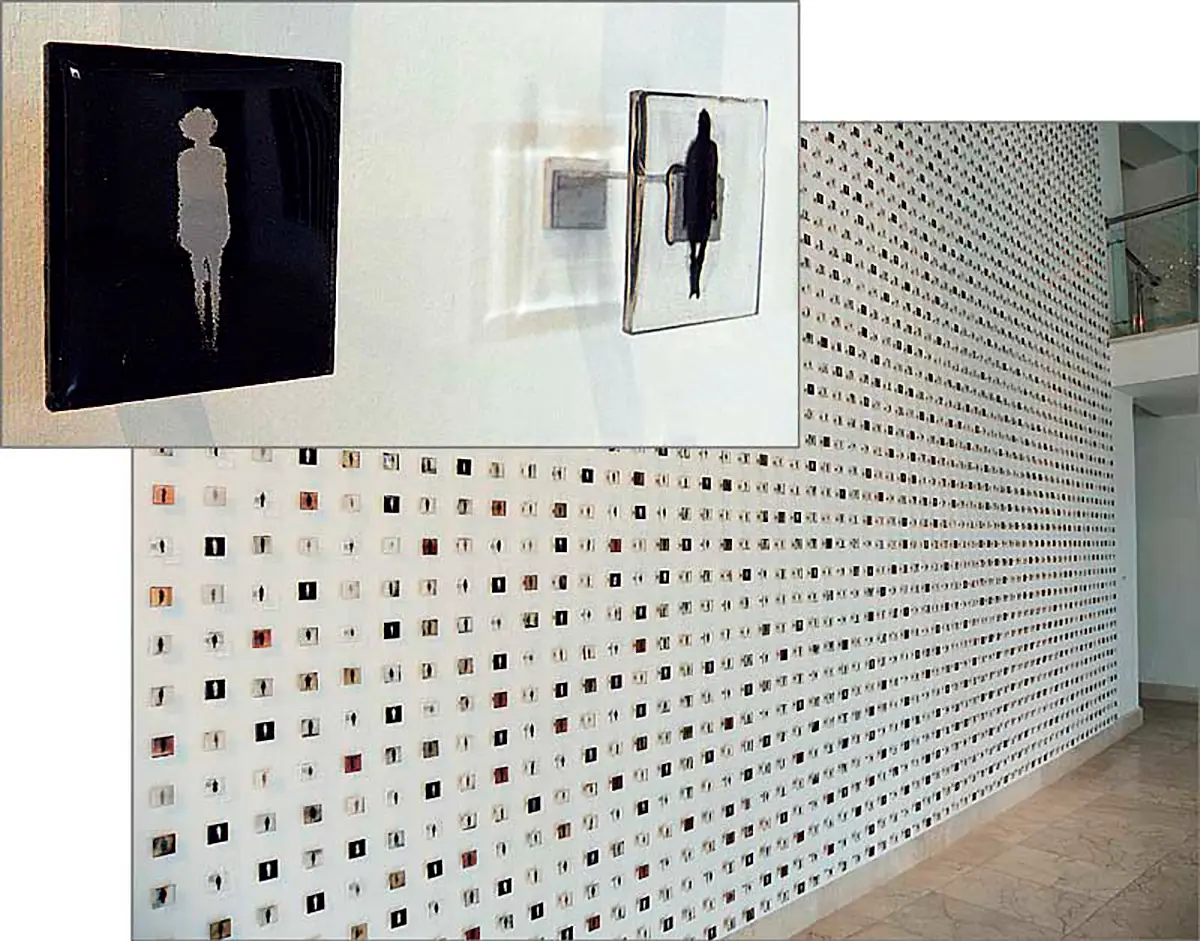
The main hall in the gallery presents 4032 Teselas Fragmento Censo Getsemaní (Tessera Fragment Census Getsemaní), a monumental mosaic that contains 4032 of the 5970 miniatures that are part of the entire work (Cincomilnovecientosetenta, 2003-2007), and a number that corresponds to the 2003 census for this neighborhood. The miniatures are paintings created in lacquer on small acrylic and resin plaques outlined in the shape of human figures. Each plaque represents one of Getsemaní’s inhabitants. Previously exhibited at the Museo de Bellas Artes in Santiago, Chile, the work pays tribute to the people of the town. Several chromatic ranges are used to paint this piece and to generate certain dynamism when the work is observed from a distance, until the miniature figures lose their individuality and become part of the whole.
The same exhibition hall contains the work titled Código del Barrio (Neighborhood Code, 2007) a polyptych created in lacquer on MDS and resin. The pieces are arranged vertically and in parallel. They recreate a group of locals into a single object that adheres to the commercial idea of a barcode and revives the social, territorial and economic inquiries formulated by Rumié. Upon getting closer to the piece, it is possible to observe the same formalism used in 4032 Teselas Fragmento Censo Getsemaní. Nonetheless, in this occasion the “subjects” are grouped in columns—28 total. Ranges of black and brown are part of the composition of the inhabitants of the piece. This treatment generates the superimpositions of figures and, at the same time, a certain degree of uniqueness among them over a clear background.
An adjoining exhibition room contains the work Caminantes, 2003-2007 (Walkers, 2003-2007), an installation that consists of rectangular boxes of varying heights, fabricated in wood and Formica. The boxes have photographs of the profiles of each of the 62 inhabitants of the neighborhood. A frontal photograph, one of the backside and several laterals, from left to right—and from above and below as well—are present on each one of the faces of the boxes. This installation makes reference to packages of products of mass consumption. Nonetheless, it also generates ambiguity between the space they occupy and the idea of evidencing, through different views, each person portrayed. This work was accompanied by a commemorative act in which Rumié gave the boxes to each of the inhabitants portrayed. The presentation of the boxes took place at the Callejón Angosto, the name of the street block where the artist lives. A second proposal in the same exhibition hall presents Proyecciones, 2003-2007 (Projections, 2003-2007), a video that shows the artist’s street address, the installation of the boxes on neighborhood streets, and locals of different ages projected on one of the walls.
Getsemaní: Sujeto Objeto 1998-2008 contains several technical resources, a sculptural installation, painting, photography, and video projection. With them, Rumié offers a clear framework of the issues affecting her neighbors, but at the same time, her posture becomes a universal theme. It becomes an artistic response to global situations of countries that suffer the same impact, even in other places across Colombia. Large companies attempt to disfigure historic centers, cultures, and societies with the goal of building tourist complexes for economic profit. During this process and until it ends, the subjects become objects.
DIEGO ERAZO FLÓREZ