
It would seem that, in a certain inevitable way, every promise is from its origin inked with the same substance that remains of the indelible in grief. It is the case that in both scenarios what remains assumes it's being destinexiled (following Derrida); exiled, reluctant even if destined; adrift, even when imprinted with remittance. What remains after a promise is received or after the onset of grief is a being in remanence of that which, not necessarily have taken place, has already occurred, entirely losing the possibility of recovering that being/state ‘before’.
In the process of her works, Teresa Margolles often stirs up such conditions of incompleteness, provoked absence, desertion, and hurt-by-default wearing out the gestures of that which we can name (ourselves) as within the social body and a part of it.
In recent years in Margolles’ insistent artistic practice, it has become evident how those very processes of verification of the irreducibility of violence as a functional and foundational condition in a widespread dynamic that knots Mexico’s socio-political fabric, have gradually transformed her own reflexive condition about the matter and consistency of her work. Constantly traversing the delicate hollow that signals the substantial and symbolic difference between the weight of the body and its trace, Margolles has carried the remains of so many raw deaths that today she resorts to deserted objects (thus doubly asserting the obligatory absence of the body) in order to constitute the always-deferred catastrophic re-placement of her installations as a besieged looking-at. As if the time-between-time she has forced herself to travel in order to achieve her own reinvention amidst the graspable forms of grief and the stench of death, were able to contain inside itself some recoverable remainder of presence in order to justify its insistence as it pushes to re-make itself visible.
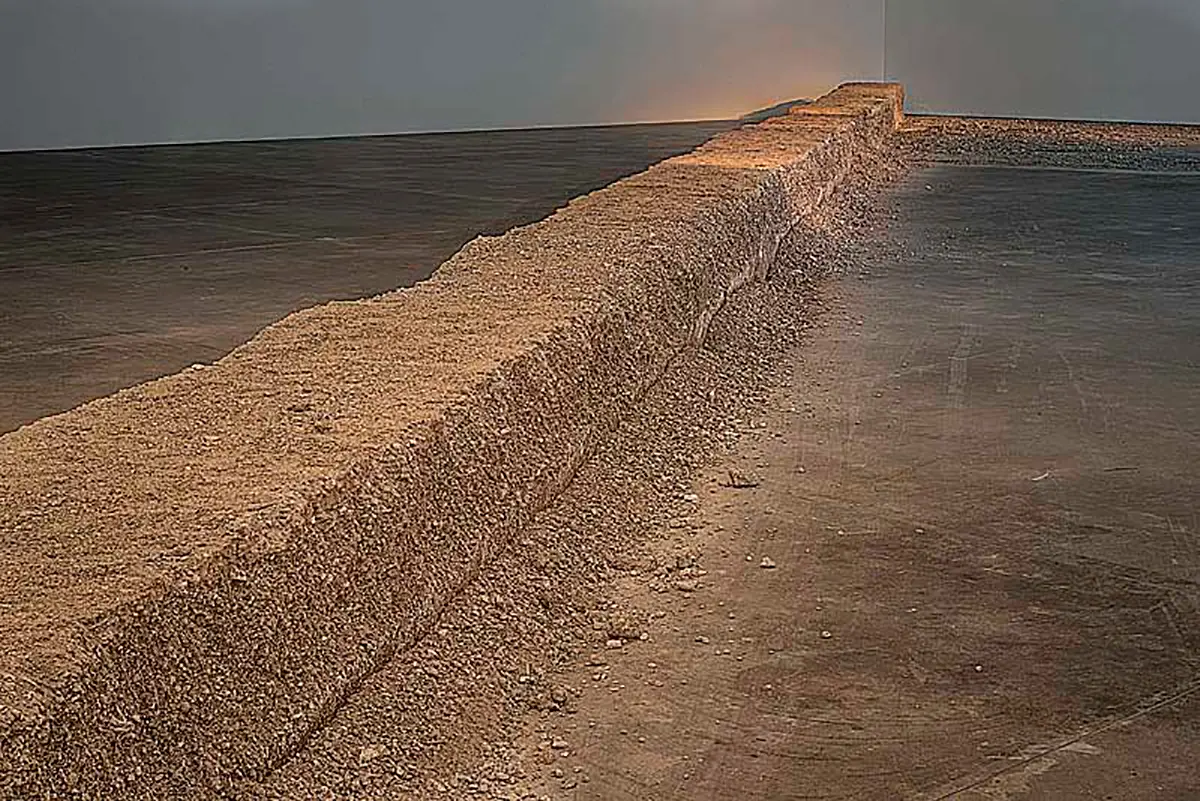
A few weeks ago, Margolles began the wait that engenders on its own destruction her most recent work, La promesa (2012), installed at the MUAC (Museo de Arte Contemporáneo de la UNAM, Mexico City). Using one of the physical and conceptual tools that at this moment most frequently support her art—displacement and the isolation by de-contextualization it generates—Margolles transported the “ruins” of one of the 115,000 houses abandoned (even before any habitation) in the social-interest housing developments with which an agonic Ciudad Juárez most recently attempted to convince it's future (remaining) denizens of its promise—no longer architectural, but of sheer habitability. Margolles thus extirpates one of those multiple 32-cubic-meter housing units from its symmetrical grid and transfers it to the museum gallery.
But the architectural remains of that which never congealed within itself the impulse to habitation were demolished and crushed into gravel, obliterating any trace of their previous shape of functionality. Pulverized in this way, the (dis)appeared rubble, now compacted, forms an elongated, small residual fence, border, or boundary that, diagonal on the floor, breaks the dark and empty room in two. Periodically, some volunteers gather around it for an hour in order to gradually break apart the inexplicable rise of that border that was a home, extending on the floor the remains of what, even though it wanted to stand in front of the irrepressible expansion of violence and insecurity, ended up evincing its errancy through its hollowing.
In the silence evoked by the reconfigured ruin we see, we assume that the linear accumulation of anodyne material must contain the foundations, walls, corners, rooms, stairs, and finishing’s of the promise referred to by the artist in her title; thus, the response of the viewer is muted, knowing that what presides over all the (im)possibilities of contemporary urban existence is a kind of grief. Reverted the matteric condition of what would be entailed in deploying construction as the constitution and safeguard of society, the rubble of one among the more than 5 million abandoned houses that extend around Mexico’s main cities, especially in its northern region, are exhibited inside the intact museum space as a paraphrase of that against which they promised to rise.
Even though the voice with which I have decided to end this brief review exists but in parallel to the tenor that often keeps Margolles’ work in step, I want to think of that other site that seems to sow the work with infertility, and to believe that her action of transporting and making evident such ruined promise or promised ruin can reflexively extend towards that which Hélene Cixous understands as the assumed destiny of writing—and, let’s also agree, art: “Who can define what to have meant? Where does living take place? (…) This is the point: when the separation doesn’t separate; when absence is revived by its rescue from silence and immobility. In love’s assault on nothingness. My voice rejects death: my death, your death. My voice is my other. I write and you are not dead. If I write, the other is safe.” 1 Because it is possible to think that if we are able to keep breaking apart the grief that the ruin brings about, we will also have the strength to reconstruct (ourselves) from the rubble.
NOTE
1. Hélène Cixous. “Coming to Writing” and Other Essays. Ithaca: Cornell University Press, 1992.
MARCELA QUIROZ LUNA