
It is a common thing for architects to delve into artistic activities, particularly into sculpture; a logical step as both disciplines welcome both imaginary spaces and the space that corresponds to the reality of mankind. Vicente Antonorsi (Venezuela, 1953) is one such hybrid; an architect by trade and a sculptor by desire, he has been guided by a sharp interest in the exploration and research of rare materials, especially those that tend to highlight subtle textures and a natural beauty with which to construct abstract works—both in form and concept—and one that can hardly be confined to one of the known “isms” of historic vanguards. Since the beginning of his work as a sculptor, Antonorsi’s three-dimensional pieces have centered on mankind and our recognition of a real-world invented, planned, and represented by the artist; a world that is always present in architecture. Thus, it is no accident when the artist, as he talks about this exhibition at the Galería La Cuadra, affirms the following: “the architectural concept is all over my work, and at this very moment there is a sensation, a sort of mixture of amalgam that positions my work on the verge of becoming architecture or a result of it.”
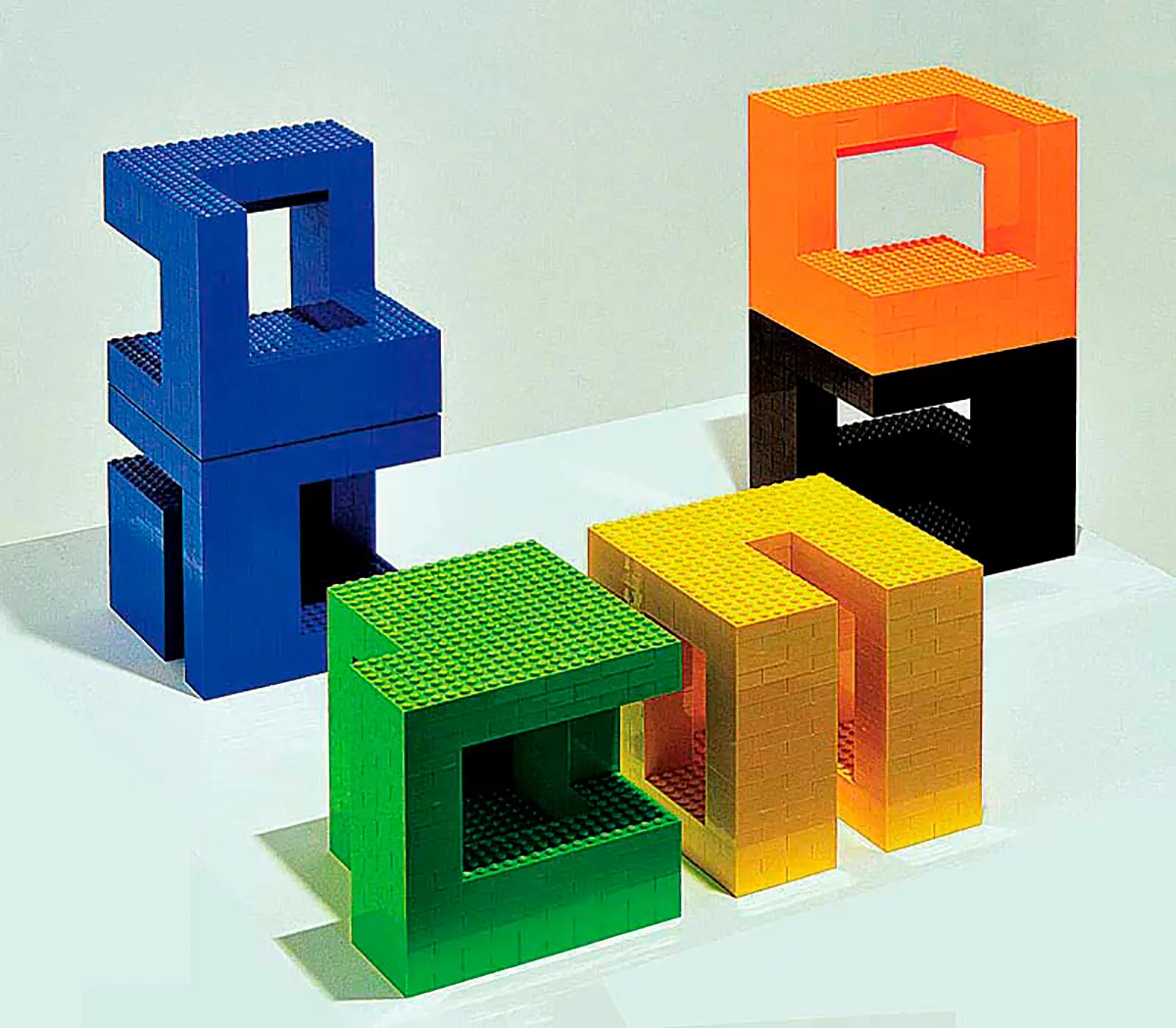
Antonioni's artistic trajectory has been a short but intense one. He began to participate in group exhibitions during the late 1990s and to present his work in solo exhibitions in 2001—eight thus far. Through his artistic career, he has presented a vast number of perfectly organized ideas, thoughts, and “mental processes.” His interest in a large variety of materials began early in his artistic career. Acumulaciones (Accumulations, 2007) an aesthetically sublime exhibition included works “constructed” through the accumulation of organic elements that generated a variety of chromatically charged and strong visual figures, based on the utilization of several types of wood, assorted seeds, and cotton cords, to produce works that could be classified as baroque because of their visible appearance. These beautiful baroque “jumbles” were eventually reduced to simplified geometric forms, to “architectures” of this 2012 exhibition, accompanied by new materials, acrylic, bakelite, marble, glass, and lego pieces. At this stage of his career, Antonorsi consolidates the minimal geometric language that had been characterizing the works from his most recent exhibitions.
In his recent work, Antonorsi focuses on the aesthetic of the simple and secretive cube and of the man-invented square. Most of his constructions are resolved with assembled pieces of superimposed plywood sheets—always perforated at an angle— that generate a variety of mysteriously crowded and hollow geometric configurations with internal and external perspectives that result in artistic complexities that oscillate from the two-dimensional and three-dimensional realms. In some cases, formalist multiplicity could mean the interaction between several glass cubes and Lego cubes. Here there is no overt meaning, as the work leans toward the cryptic and austere nature of the cube and of the square. There are no affectations or decorations that pull the gaze toward any paths other than one’s own or the one outlined by the work; paths that are discovered through contemplation and inquiries concerning the mysteries of human introspection. More a philosophical matter than a semantic one, it is resolved in the simplicity of the visible signal originated in the “architectures” that define “something” this artist is interested in. Only the radically visible textured surfaces—like wood streaks or glass imperfections—along with the asymmetry of the “arrangement” of the superimposed plywood sheets, become part of the stylistic three-dimensional rigor of an artist who glorifies the simplicity of minimalism and values intellect as a central part of the creative act deposited in an “object”—that represents universal knowledge based on the concision of two geometric forms. This work by Antonorsi reminds me of The Endless Column created in 1937 by Constantin Brancusi: work with no end that multiplies to infinity.
BELGICA RODRÍGUEZ