
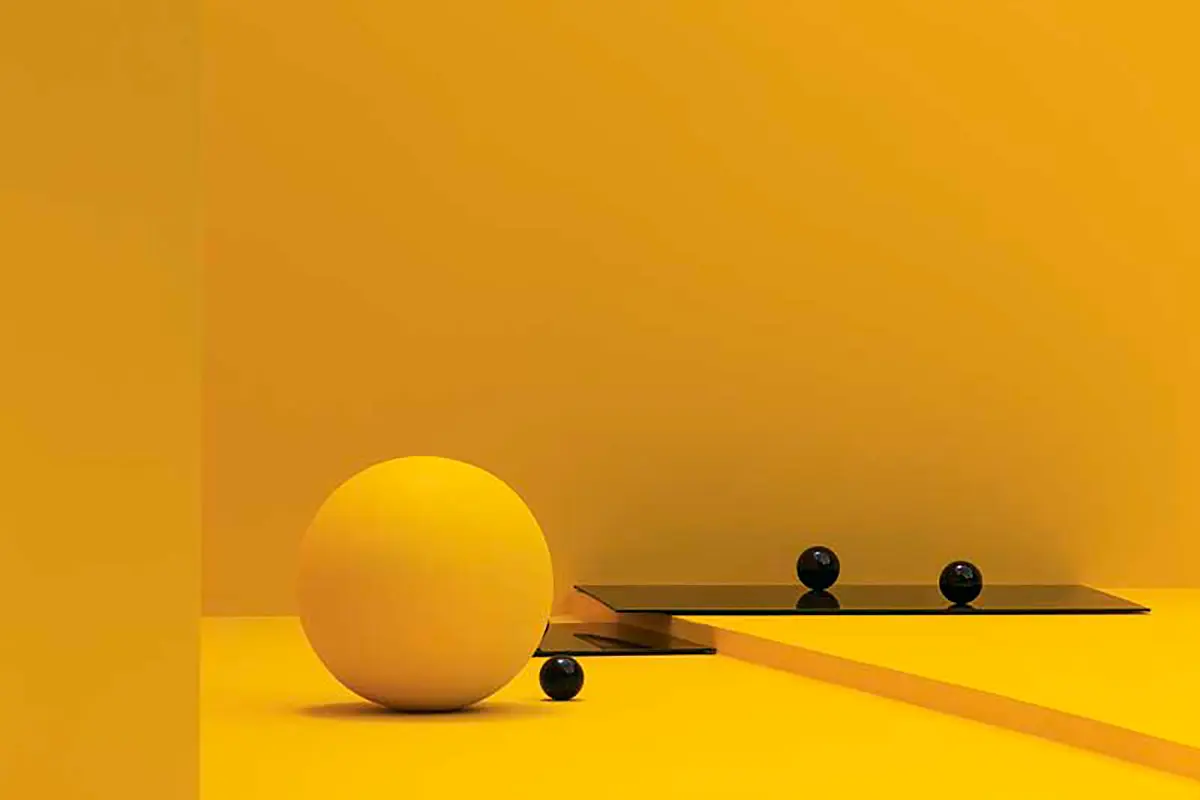
Rio de Janeiro artist Waltercio Caldas examines the boundaries of the art function and makes this tension the leitmotif of his work. In Cromática, an exhibition recently at Casa França-Brasil, in Rio de Janeiro, the artist once again focuses on the unexpected and the surprising, elements that have been present in his work of the last four decades.
To illustrate this topic, the show’s press release quotes film director Alfred Hitchcock, who supposedly placed posters at the entrance to theaters with the following warning: “Do not tell your friends how the movie ends.” This was one of the inspirations for Caldas’ show, where the artist poses questions such as: “What happens when we are confronted with a work of art? Is it possible to make explicit matters that are implicit? How can a fleeting moment be extended to the limits of the possible?”
The five works on exhibit, conceived with the building’s Nineteenth-Century architecture in mind, were large geometric structures with rectilinear volumetries, circular and in pure colors, and invited viewers to enter a highly sensorial and playful universe as if taking part in an aesthetic game where perplexity and the possibilities of imagination were the only rules. Contrasting with the building’s neo-classical style, Caldas’ large shapes reinforced the element of surprise that permeated the exhibition.
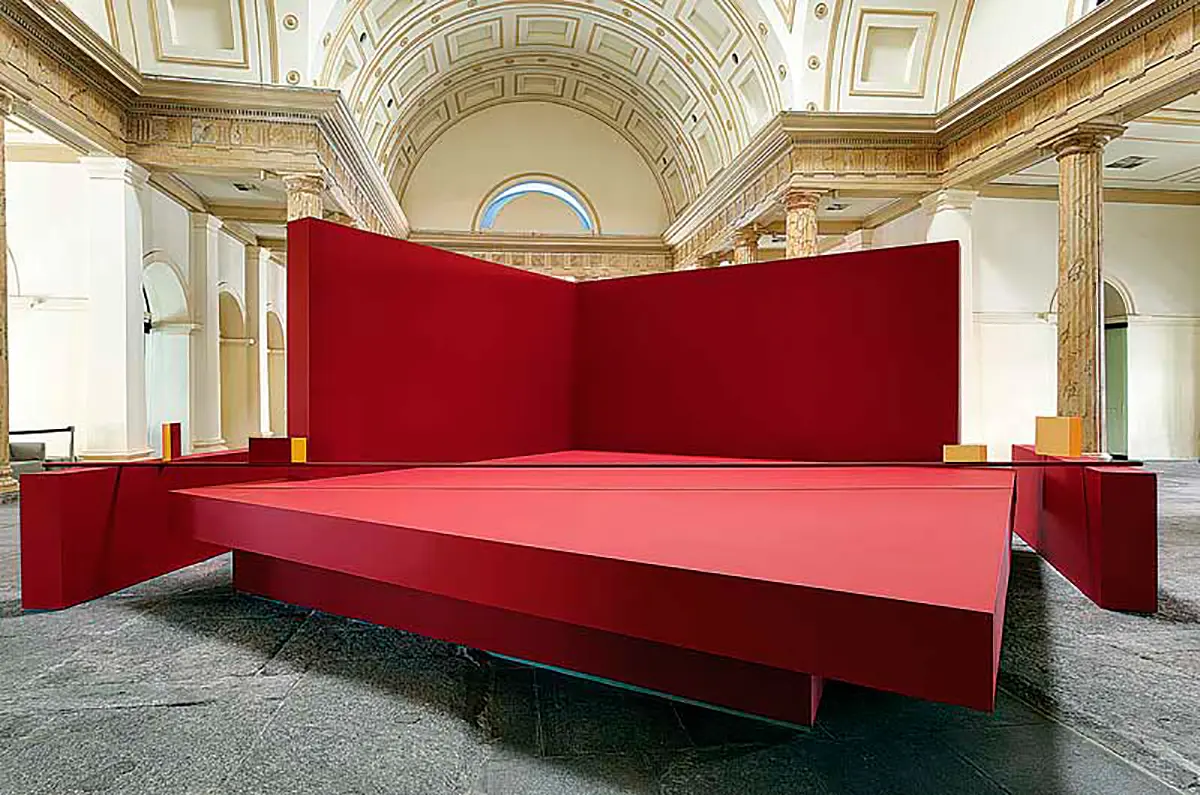
With its full-on charge against architectural empty spaces, overtaken here by striking shapes, the show as a whole was a site-specific work of art, offering viewers the feeling of being inside an abstract painting, with lines, colors, and volumes directing their bodies between unexpected spaces in order to experience the work in a continuous and vertiginous way. The effect of suspension provokes a positive unease, the work being so profusely colored.
The exhibition brings into play principles that the artist has explored throughout his career. Irony, structural rigor, meta-language, and perplexity are some of the elements found in his objects, sculptures, drawings, and installations, all created around an interrogation of the senses. Caldas’ works bring about disturbed states, starting with their technical definitions. What does “sculpture” mean in Caldas’ hands, since such basic notions as “materials” and “scale” are thoroughly reinvented?
To reach this terrain where formalism and meta-language come significantly close, Caldas went through several phases, the most important one in the late 1960s and early 1970s. That period was punctuated by works of a critical nature, an attitude that was essential for a generation of artists marked by the political tragedy of dictatorship in Brazil. For ideological reasons, Caldas even declined an invitation to participate in the Venice Biennale, holding fast in the production of politically emblematic works of art. Among them, boxes containing objects and carrying highly suggestive titles: Conductors for perception, with silver tubes; Anti-Dreams, with magnifying glasses; and Center of Primitive Reason, with gold needles.
Endlessly productive, Caldas was a co-editor of the Malasartes journal (alongside Carlos Vergara, Bernardo Vilhena, Cildo Meireles, Carlos Zílio, Ronaldo Brito, José Resende, Luiz Paulo Baravelli and Rubens Gerchman), which published three issues between 1975 and 1976. The journal was one of Brazil s most important art publications and was intended to emphasize the meaning of the work of art as an instance of cultural production and not as a commercial object. Malasartes represented an early effort by a group of artists, critics, and poets to debate politics through the arts in the country, proposing art as a mode of expression that could be debated in intellectual space.
During that period, Caldas even deployed a markedly iconoclastic attitude. His biting questioning of constructivist tenets and the libertarian romanticism of the neo-constructivists made an appearance in several of his works, such as his sculptures using unexpected combinations of materials like wood, glass, alcohol, and metal. In the 1980s, discourses about art itself and debates around the material and philosophical possibilities of the aesthetic universe intensified; Caldas became an “anti-sculptor” who tested the boundaries of art and human sensibility, for example with his series Sculptures for all non-transparent metals. His objects are “full objects,” as critic Sheila Leirner said in reference to works that promote the synthesis of sensorial and mental experiences.
When he moved into occupying large public spaces, especially in the 1990s, Caldas takes those same questions into outsized physical scales. His Sculpture for Rio, with its vertical shapes that abruptly break the pedestrian plane, is literally an ironic explosion of one of the city’s symbols, its terraces. As in other works, Caldas proposes here moments of psychological disorientation, as critic Ronaldo Brito defined them, in the 1970s. The work of art ceases to be an object of contemplation and becomes a means of transformation.
At the Venice Biennale in 1997, Caldas presented Venecia, a series comprised of four stainless-steel sculptures with inscriptions of the names of historical artists. Exerting his sense of irony on traditional historical readings, Caldas declared in an interview with critic Ligia Canongia that “order doesn’t have to be rational, there can be a poetic order.” To evoke this subjective order, the artist constantly produces optical effects, such as bottles formed with metal contours and games of mirrors.
More than questioning the parameters of artistic language and the art circuit, Caldas explores an existential dimension. While that terrain has often been reached through irony and with a complexity bordering on nonsense, in Cromática he seems to sublimate concepts and to offer an opportunity for greatly pleasurable enjoyment.
ALESSANDRA SIMÕES
Journalist, art critic, and research scholar at the Post-Graduate Program of Latin American Integration for the Universidad de São Paulo, PROLAM / USP.