
Alberto Borea seems to be a nomadic conceptualist drifting through the materialisms of everydayness with eyes fixed on global themes. The materials are varied, the claims list a long one, and the integration of the two—works and ideas—of mixed results, with successes and failures often within the same construction. Consider, for instance, one of the strongest pieces in this relatively small show of 12 works.
San Cristobal (2012) is composed of two black wooden boxes mounted on the wall. The larger box forms a fluorescent-lit shelf on which is scattered a jumble of small rectangular boxes, some with and some without roofs, and all made from wooden kitchen matches. They appear fragile and imply a potential incendiary danger. Such a narrative is reinforced by the video loop that plays in the slightly separated second box by showing a match being lit, held, then used to ignite the constructions that go up in flames. The work can stand on its own merits in terms of esthetics and a generic tension but it is useful to know that San Cristobal refers to the jumble of colorful box houses which run up the slope of the mountain at the edge of Lima (the Rimac District), which in Borea’s hometown is generally considered a slum. The physical and social implications seem clear
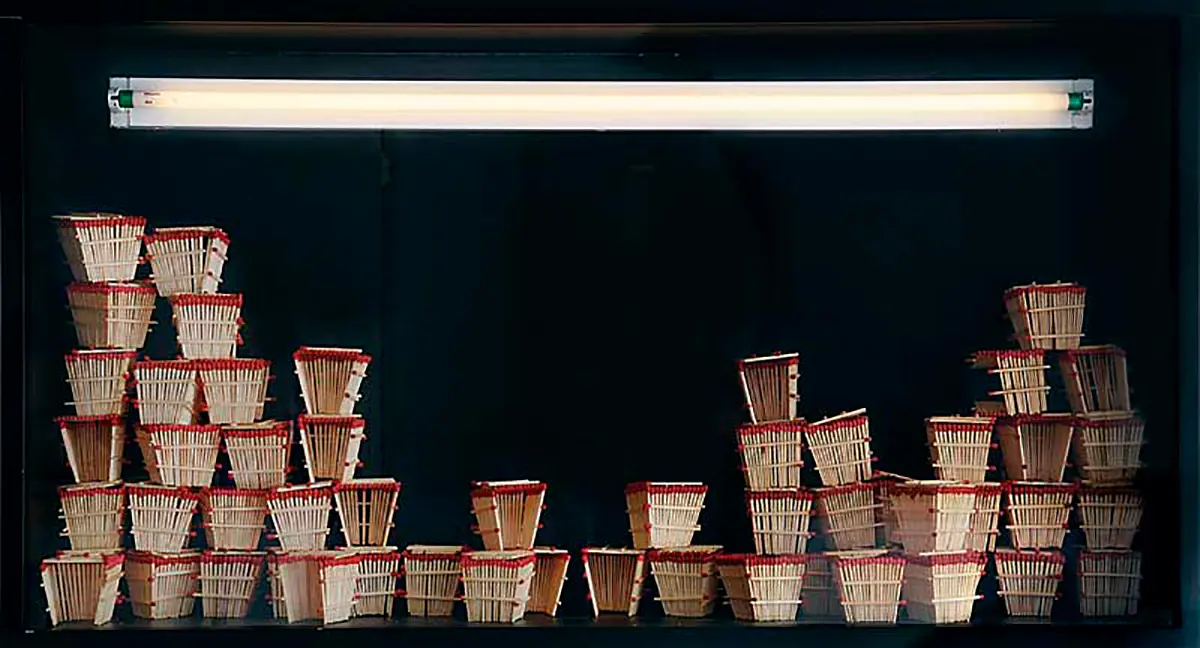
Then again maybe it refers to the burning cars and buses that crash down from that dangerous one-lane road up the hill (cerro), or to the 16th century rebellion that gave the hill its name, or the flame-like rivers of the lights of Lima visible at night from the top. Or perhaps one thinks of San Cristobal in Northern Santiago with the magnificent Metropolitan Park and its beautifully forested cerro now ablaze. My first thought was of San Cristóbal de la Casas in Chiapas, where I was located when Mexican government troops killed a number of the indigenous peoples and which helped ignite the eventual formation of the EZLN (Ejército Zapatista de Liberación Nacional). The metaphoric levels abound and one wonders and wanders about. Or, more likely, simply moves on without thinking of anything specific.
Another strong piece that I like and one which answers my concerns are the small black boxes displayed in a row on the wall with 6 of the 9 (each 15 x 14 inches) holding a crudely cut-out mask mounted on black backgrounds. On close inspection the paper used is discovered to be an immigration application form issued by the US Department of Homeland Security. That, along with the title, Immigration Line (2012), gives us a delightful open-ended concept that works well because it is sufficiently strong and specific to hold the metaphoric tensions. A viewer might interpret the masks in many ways, but this conceptual play always returns to align with the issue of immigration in various provocative directions. It was in such a frame (pun intended) that I interpreted the barely visible white marks in the three black or otherwise blank boxes to be traces of what or who could have been and traces of those removed. Blankness is not a neutral state of affairs!
But I return to the problem (at least for me) with another strong series, his collaged paper works Archeological Cycle (2012). All three are mounted on black paper and use printed pictures from gun catalogs, real estate magazines (a favorite metaphor of his in this show), and auction catalogs for Native American artifacts. That all three constructions are in the shapes of various archeological Peruvian vases, such as the well-known Moche stirrup-handled vase, not only strengthens the references—and rightfully expands the concept of American artifacts for a thoughtful US viewer—but also as a form literally attempts to bind the various concepts of the archeological (and its sales) together. But with additional references to real estate and guns…well such an expansion of tangential ideas seems too much for the literal and metaphoric container to hold together. Or does it?
My question is, do such open-ended choices mean anything in a world reportedly filled with free-floating signifiers and emancipated viewers? After all, aren’t art and meaning in the beholder’s eye? What then is success or failure, or even strong or weak works? Aren’t artists perfectly happy with any response or association based on their work? And if we are to enter the free-for-all of conceptual relativism then ultimately what need for art or artists, except for archeological and sales purposes?
RICHARD LESLIE