
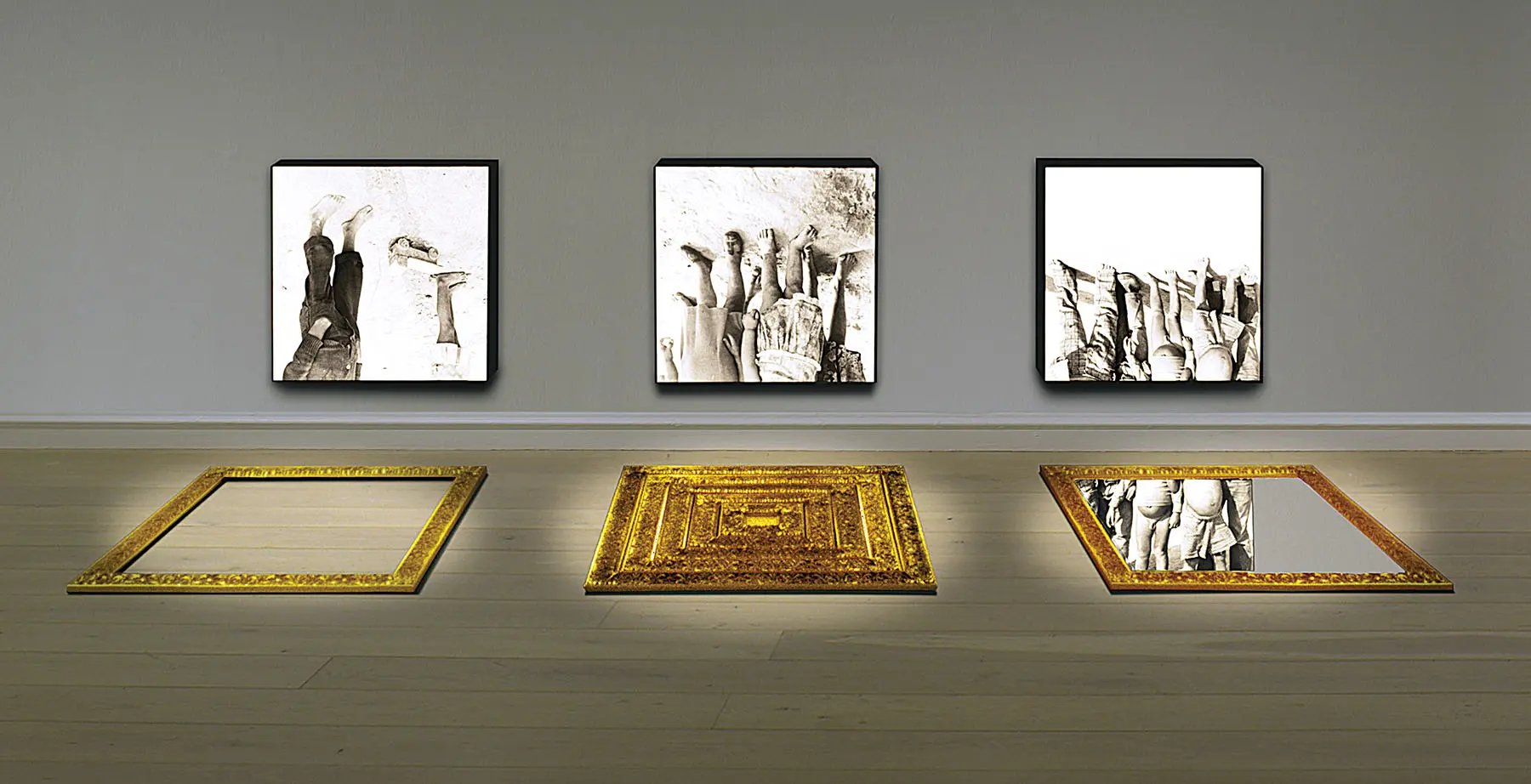
Alfredo Jaar’s triple exhibition in Berlin last summer was something of a happy reunion. Jaar reunited with Germany, which in 1987 invited him to participate for the first time in Documenta in Kassel, thus crucially contributing to a career take-off that soon had him presenting his work or carrying out artistic interventions in four of the five continents and made him the first Latin American artist of his generation to achieve such degree of internationalism. And Germany reunited with Jaar, an artist who has regularly responded to the invitation to exhibit or intervene with notable works that opened the eyes of the German public to realities that seemed alien or faraway and helped them understand that they weren’t so—that, in the end, those realities concerned them in a more acute way that they were initially willing to admit. Such was the effect of 1 + 1 + 1, the installation Jaar presented for the first time at Documenta 1987, now on exhibit at the Alte Nationalgalerie in Berlin, where it fits as though this, the palatial galleries of a museum conceived in the Nineteenth Century as a Roman temple, where it shared space with masterworks of Neo-Classicism, Romanticism, and the early German Expressionism, had always been its intended destination. The installation has three sections, and each section is double: on the wall, it is a lightbox; and on the floor, a composition of gilded frames, precisely like those found inside a Fine Arts museum. In each of the three instances, the lightbox displays the inverted photograph of barefoot, rags-clad children seen only from the waist down. The compositions of frames are more varied. The one on the left is just an empty frame leaning on the floor, while the one on the right contains a mirror reflecting the image of its observer. The composition in the center is like a Matryoshka doll: a frame inside a frame inside a frame… This work admits many possible interpretations; the simplest among them would attribute to Jaar the desire to open the most cloistered and hallowed spaces of European art to the representation of realities of penury and marginalization that should not be indefinitely ignored. But it is also possible to find in this seminal work a desire to interrogate the work of art itself from the standpoint of those defeated by the very powers that commission it in order to reassert their dominance. This is what Coppi and Heilman, the two Berlin youths featured in the opening of Peter Weiss’ modern epic The Aesthetics of Resistance, do as they debate the reach and significance of the monumental frieze on the Bergamo staircase exhibited in the museum of the same name. In 1992/93 Jaar paid explicit homage to Weiss and to Coppi’s and Heilman’s debate in an intervention on that very staircase, which among other things arranged in the steps the names of 14 German cities written in neon lights.
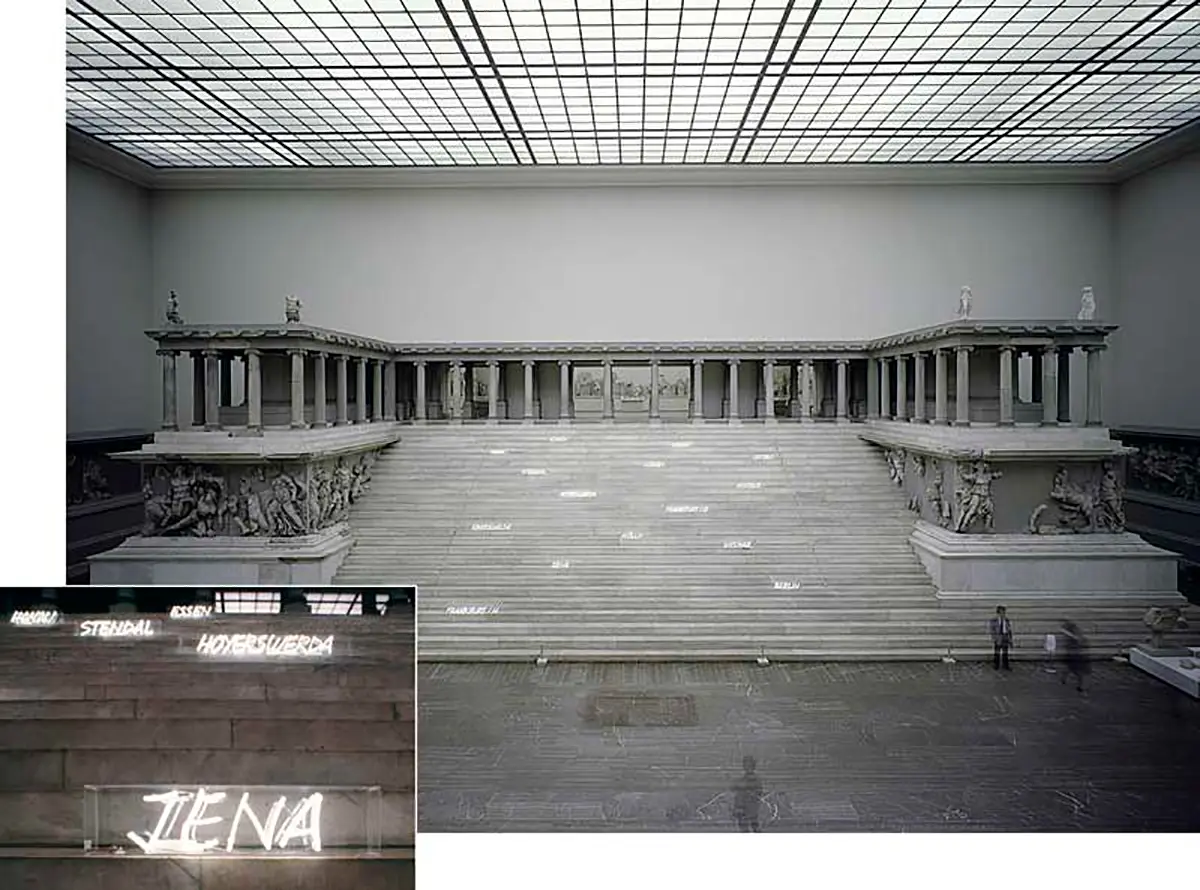
Revealingly, the intervention was titled Una estética de la Resistencia and its reconstruction was included in the selection of works exhibited at the Berlinesche Galerie, the second site for this three-fold exhibition, one of the titles for which was precisely an Aesthetics of Resistance. The other title, The Way It Is, updates the title of an intervention carried out by Jaar in 1991, when he emptied the ground floor of space as part of Heimat, a collective project organized by the Wewerka & Weiss gallery in Berlin.
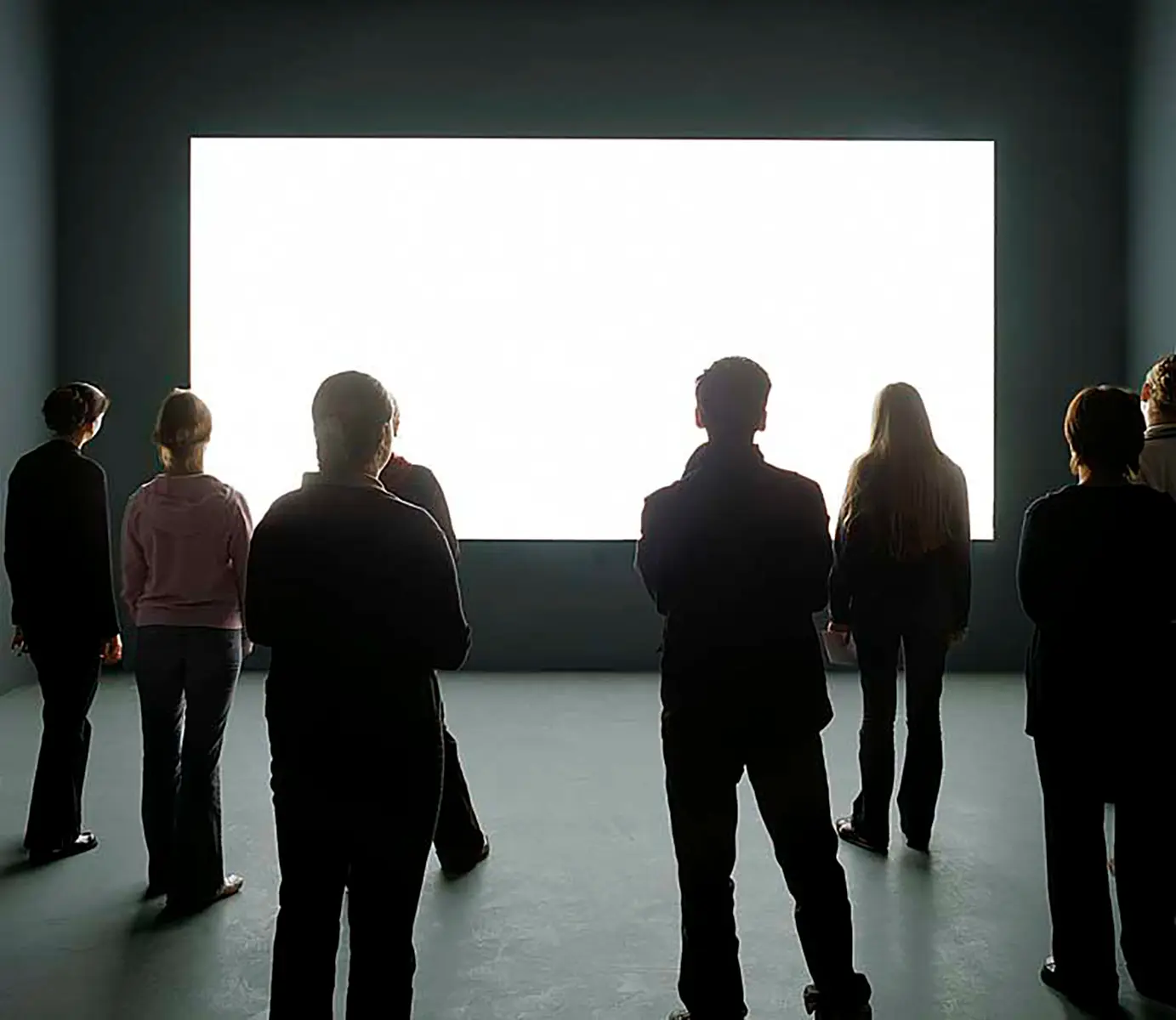
Both 1 + 1 + 1 and Persona (also from 1987 and also exhibited at the Alte National Galerie) evoke the conflict between artwork and image, certainly one of the characteristic features of the globalization of the arts that, driven by biennials and art fairs, completed the transit of the work of art valued from its cultural function to the work of art valued by its exhibition function. Yet Jaar has always refused to understand this conflict with the image as something exclusive to the realm of art, because he believes—like many others who follow Guy Debord, the theorist of the society of the spectacle— that the problem of the image is the key political problem of the time. Thus, a significant portion of his oeuvre is devoted to a critique of the image as a replacement of reality or a cauldron of indifference towards it. To corroborate this it would suffice to encounter at the Berlinesche Galerie two of Jaar’s most potent, terribly blinding works. First, El lamento de las imágenes, which evokes the harsh incarceration of Nelson Mandela and was presented at Documenta in Kassel in 2002. Second, El Sonido del silencio, from 2006, presents the human drama of South African photographer Kevin Carter, who committed suicide after winning the Pulitzer Prize with the picture of a starving Biafran girl naked on the ground as a vulture awaits her death. The shared African locale is not a coincidence; it responds to Jaar’s sustained concern for a continent with which he first connected emotionally during his childhood in Port-au-Prince, and to which he has devoted many works.
The main appeal of the works on exhibit at NGBK, the third site for this large-scale show, resided in the fact that they belong to Jaar’s earliest period, in Chile under the Pinochet dictatorship. These works anticipated the decidedly critical and committed turn of his later production.
CARLOS JIMÉNEZ
Art critic and independent curator.