
Kissing is, undoubtedly, one of our culture’s most common expressions of affection. Its origins, which remain obscure, could be connected to the early era of human development, when mothers perhaps transferred chewed, mashed-up food from their mouths to their offspring’s.
From a spiritual perspective, kissing involves in itself a transference of vital impulses from one being to another, thus implying a transfer of souls and, with that, the idea of an offering and a complete abandon into the arms of the other person.
The act of kissing involves mobilization of all our senses and symbolizes the overcoming of that bounding barrier that is the outside of our body, acting as a threshold for our inner being. El beso, a photographic installation by Amalia Caputo (Caracas, 1964) at Art@Work, is a unique reinterpretation of this act.
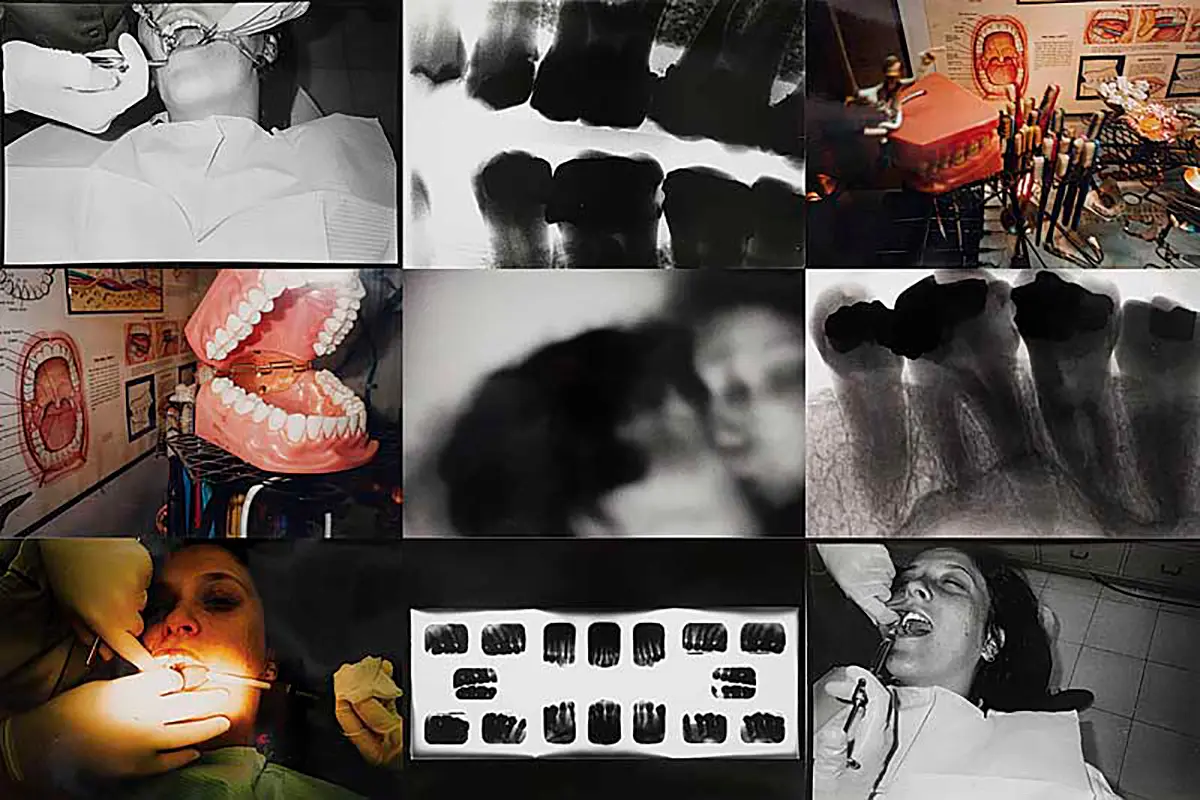
Comprised of nine photographs integrated into a single artwork, it is an unsettling approach to the buccal structure from a purely clinical standpoint. The aseptic photographs in Caputo’s El beso are set in a dentist’s office, and the final work is now punningly exhibited in an orthodontist’s practice.
Some of the shots depict molar x-rays; others, a direct intervention on a female patient; a third group, meanwhile, presents the office via a three-dimensional model of the mouth and illustrations classifying the parts of the buccal structure. At the center, blurrily, we see what could be a kiss.
Amalia Caputo’s education has followed two paths. She studied art history in her native Caracas and received a Master’s Degree in photography from the International Center for Photography, in New York City. From the start of her career, Caputo has been interested in two central axes that give shape to her proposal; the body and the history of art.
In Caputo’s work, deeply connected to a sense of the corporeal, the body acts as a container for and a reverberation of the soul. A battleground for our desires and dreams, the body is the heavy earthly burden that anchors us to the real, mercilessly reminding us of our limitations and our finite condition.
The recourse of art history allows Caputo to explore cultural patterns and trace back their changes over the course of time. On occasion, the artist introduces distortions that enliven her reflection around issues with a broader social range, such as the use of female images in the history of art. In that sense, it is important to note her engagement with motifs like the Madonna and child, the Three Graces, or the Maja.
In El beso (1994-1995), an early work in Caputo’s career, we are presented with the antinomic effect between the object and its denomination.
Caputo also appropriates here one of art history’s great themes, which we inherit in unforgettable works by such artists as Canova, Klimt, Rodin, Chagall, and Brancusi, among others. In Caputo’s work, however, all traces of sublimation have been eliminated.
Amalia Caputo’s kiss seems to focus on the mouth with the single-minded precision of a taxidermist, desperately seeking that mystical essence that cannot be captured in a portrait and in the process revealing the mouth in its denuded state, in a raw offering of its base materiality. Devoid of any eroticism, the mouth is here what it is, and only what it is: the orifice that separates me from another, the boundary between interior and exterior spaces, a vital organ whose primary function is one of nourishment and survival.
Yet the contrast between the stark, unflinching image and the sublimated title generates in the viewer a series of evocations, and these become an essential part of the work. The filial kiss, the first kiss, the abandon of passion, each one of these archetypes survives and intertwines with the photographs in El beso, reasserting the polarity—so recursive in human existence—between the spiritual and the corporeal; the eternal and the finite go hand in hand.
This is the central achievement of this seminal work by Amalia Caputo, whose production has always been guided by that opening of the body to memory and remembrance. Once the unavoidable puzzlement provoked by this photographic installation is overcome, the viewer inevitably re-inscribes in it the spiritual dimension of the intertwined tongues and the suspended breath, even if from the cold stage of a dental office, once again transcending that imponderable, enigmatic spiritual being that is man, constrained inside a body that barely contains him.
JANET BATET