
Visiting an Angelo Venosa exhibition is like entering a strange world, archaeological and ancestral. His sculptures, whose organic shapes bring to mind fossils and other animal anatomies, reveal a peculiar path where opposite concepts such as silence and noise, calm and enthusiasm, eschatology and spectacle, result in a single moment of aesthetic rapture.
His career from the 1980s has followed such a cohesive path that it is difficult to speak of periods within it. So much so that, in his recent individual exhibition at the Museu de Arte Moderna (MAM) in Rio de Janeiro, curator Ligia Canongia proposed a non-chronological reading, combining works from different dates and in different techniques to promote a global understanding where concepts and process are in dialog.
Encompassing some 40 items dating from the 1980s to the present, some of them not exhibited before, this show revealed that Venosa began his career as a painter of watery, delicate works, but soon began to seek a certain three-dimensionality even in the bi-dimensional plane, slashing through the painting’s linen and introducing in that way the element of volume. This corporeal element already revealed a sculptural inclination, which was to become the main concern of his work through the representation of bones, teeth, and skeleton fragments.
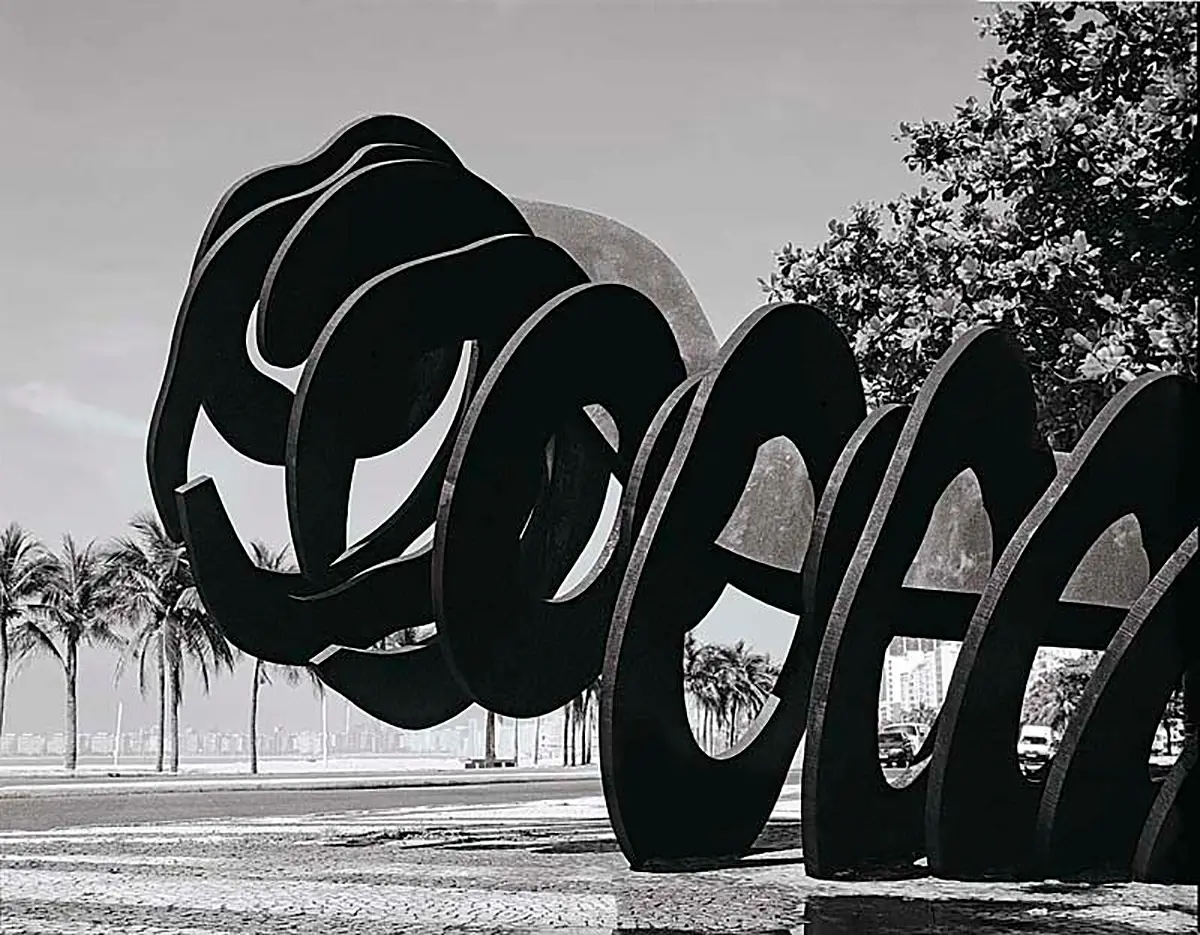
Venosa’s works of the late 1980s utilize a combination of various materials, without distinction between natural and industrial elements: tree branches, wood fragments, woven fabrics, rubber, fiberglass, tar, etc. These works combine organicity and formalism, foreshadowing the artist’s future investigations, many of them representing recognizable figures such as vertebrae and bones.
One of a small cohort of artists belonging to the "Eighties Generation" who work in the language of sculpture, Venosa became increasingly more committed to the numerous possibilities of the three-dimensional, to the point of exploring a large-scale horizontality that has seldom been used in sculpture. Born in São Paulo, Venosa opted for moving to Rio, where in the 1980s he frequented free workshops at the Parque Lage Visual Arts School (the EAV), the cradle of a generation known for its return to gesture-based painting.
It is interesting to note that Venosa didn’t participate in the famous 1984 exhibition Where Are You, Eighties Generation? at the EAV, because he wasn’t satisfied with his pictorial work. And it was around that time when, after cutting canvas and producing an object, that he started working in three dimensions and became one of the country’s best-known sculptures, with works in important collections. At the end of that decade, Venosa’s work assumed an organic character, with informal materiality.
Venosa’s work is not aligned with the concrete-art movement, yet it does evince a clear structural understanding. A certain constructivist influence can be argued, based on his education at the ESDI (School for Advanced Industrial Design), from which he graduated in 1977. The process of the creation of his works starts in a computer or in modeling clay, which he uses to manually develop the basic shapes. The artist believes that computers are mere tools, used in the past mostly in a bi-dimensional fashion and only recently used to visualize his structures in three dimensions.
The use of computers, however, does not signal a quest for perfect lines. “Even if you use all the available technology, there will always be some noise, some deficiency. I am uncomfortable with any search for perfection. It is not the real world. I like the noise and dirt. A straight line is an interpretation of the curve, it doesn’t exist in nature,” says Venosa, who since childhood has felt the fascination of organic shapes. Before graduating as a designer, he liked to visit the natural-history drawings section at the Museu Nacional de Belas Artes, in Rio de Janeiro. And as an adult, he has continued to study human and animal bones, which he collects.
Even after returning from the 1993 Venice Biennale, fascinated with British artist Damien Hirst’s cut-up cow preserved in formalin, Venosa opted for a path that diverged from Hirst’s technological and Pop language. As critic Luiz Camilo Osorio has noted, over the years that fascination pushed Venosa in the opposite direction, towards an organic, artisanal treatment of forms, with results that are more lyrical and informal.
Osorio, currently the curator at the MAM in Rio and a longtime observer of Venosa’s development, wrote about this artist in a book published by Cosac&Naïf: “His shapes carry in them the rarity of a will to express that rejects eloquence and adjectives. At the same time, there is in his poetics a selection of materials that imply a singular, unique language.” This singularity is beauty.
ALESSANDRA SIMÕES