
As we near the Museo de la Memoria a large banner welcomes us with the legend: Truth + Justice = Healing. The exhibition titled Doctor Allende’s Consultation: Amendments to the Human Intellect presented us with this banner created by the Chacón Brigade, an organization founded in the 1980s that was part of the communist party.
The building that houses the exhibition is surrounded by controversy. There are voices against and in favor of the editorial line by a Museo de la Memoria that has been entrusted with the restoration of the testimonies by victims of the Chilean dictatorship. It is a symptom that there is still plenty of work ahead to revise that period without pain or confrontation. And this is precisely the intention of Chilean artist Arturo Duclos and Argentinean photographer Marcelo Brodsky: to heal any open wounds. More than a museum, the collective memory needs tons of memantine; thus, the much-needed trangeneralization proposed by the two artists, in order to transform this cultural institution into a visit to the doctor.
Santiago is covered by smog every day. A solid fog pierced by skyscrapers, by the economic neoliberalism that crushes the great Chilean capital. An indelible cloud that was born during the nauseating bombardment of La Moneda Palace on September 11, 1973, and that resulted in the (horizontal) ousting of president Salvador Allende. Since then, every September 11, street unrest resuscitates Allende amid blackouts and tear gas that become part of that fog in which the recent history of Chile is immersed in. This year, the day before the historical event, Allende’s cause of dear was officially confirmed (39 years later). This is the extent to which the smog affects the black box of Chilean history.
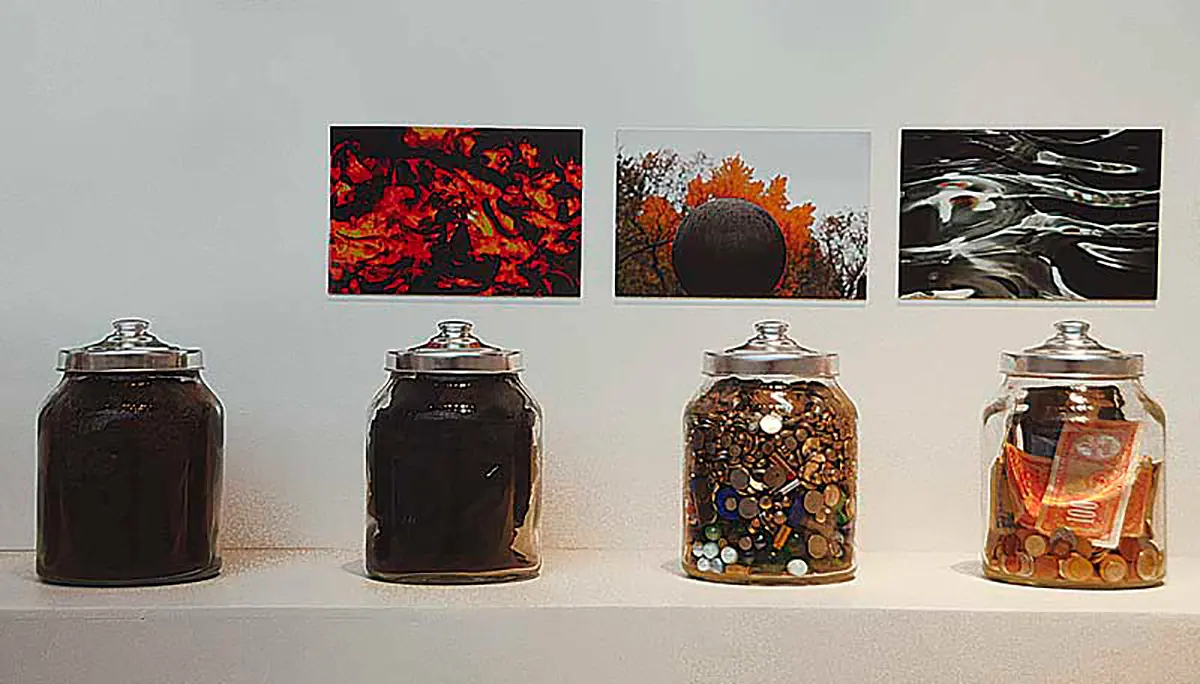
Arturo Duclos and, to a greater extent, Marcelo Brodsky, have been committed since the 1970s to showing the hidden truths through approaches that are more artistic than political. For this occasion, the two artists joined forces to conceive an exhibition aimed at a collective therapy session accomplished through dialog, participation, and a conceptual play. The lack of aesthetic or narrative unity provokes a discursive daze. The two artists collaborate like the Chilean and Argentinean dictatorships did to help each other with their mass production of kidnappings, tortures, and murders. This is pointed out by Arturo Duclos, as he indicates the 53 names of the Chilean citizens murdered in Argentina—General Prats among these. In front of the images, a projection of the Argentinean sea above a blue box shows tranquil undulating waves silencing their complicity for hiding the bodies thrown in the ocean during the dictatorship. A poetic element that connects the symbols—associated with power and religion—and the tattooed bones—associated with the disappeared—that are recurrent elements of Duclos’ imaginary. Among the conceptual and collaborative works, there was an Andy Warhol-like pop portrait of Salvador Allende that was rather unsettling.
The cornerstone of the exhibition is Salvador Allende’s own doctor’s office. Before becoming a politician, the president was a medical doctor that would see patients in his practice located in Valparaiso. Duclos and Brodsky have brought part of the furniture and original instruments from the original practice into an exhibition room of the museum. A central table reproduces the doctor-patience conversation that precedes the actual healing. The assistants leave a valuable object associated with the collective trauma and take another object left by another visitor. The power of therapy resides precisely in this exchange in a mutual understanding. Then some paperwork has to be completed—the patient’s medical history—by commenting on how the events of the dictatorship affected you. I can observe a shortcoming in the proposal: spectators that visit the Museum de la Memoria represent one side of the conflict; no followers of right-wing policies would enter this place. Perhaps a more effective curatorship could have been achieved had the office been placed somewhere else, like a real hospital.
But there is really no need to be so critical of an artistic initiative that is more ludic and discursive than it is grave. I see Marcelo Brodsky assuming the cliché role of the Argentinean psychologist, as Duclos takes on the role of the Chilean, of Jorodowski’s psychomagician—who, by the way, already offered a diagnostic for the Chilean patient: bipolar as result of the geography, the weather, and the collective unconscious. This project also includes the works and collaboration of Luis Weinstein, Erik Kirksaether, and the already mentioned Chacón Brigade. It is precisely this combination of wide-ranging works that generate the sensation of a Persian market. Nonetheless, the visit is valuable and the symbolic function of the exhibition fulfills its objective. The role of this exhibition is as necessary as the role of the Museo de la Memoria.
JUAN JOSÉ SANTOS