
An obsessive investigation is a clear characteristic in the career of Rio de Janeiro artist Carla Guagliardi, whose work was recently on view in the show Carla Guagliardi – The Sides of the Side, with eight new works at Anita Schwartz Gallery.
In recent years, her investigation has been predominantly sculptural and has focused on time as its main theme: her exercises with the proximity of different origins, such as water, plastics, iron, latex, glass, copper, steel, cotton, mud bricks, plants, wood, etc., evince the action of time on the matter and on space.
Guagliardi’s sculptures bring together elements that change by the action of tie. For example, inflated balloons deflate. As the artist puts it, her poetic language refers to operations between elements as a fluid, interior, and organic form, incorporating chance and speculation, with results in an abstraction of her own experience with the material whose reciprocal action interferes with materiality.
In the gallery’s vast first floor, with 200 square meters and a height over seven meters, Carla Guagliardi presented a new version of The place of air, an aerial installation previously exhibited in Germany. This work, which consists of the suspension of iron rods using elastic bands of different sizes, acts temporally in space, slowly and gradually expanding and changing almost unnoticeably with that expansive motion.
“The features of the gallery’s physical space determined the choice of this work, which finds there a magnification of its expressive potency,” the artist said, explaining that the ties and interdependencies between the parts give the enormous whole a single center of gravity. Any and all vibrations occurring in one of its ends reach the whole.
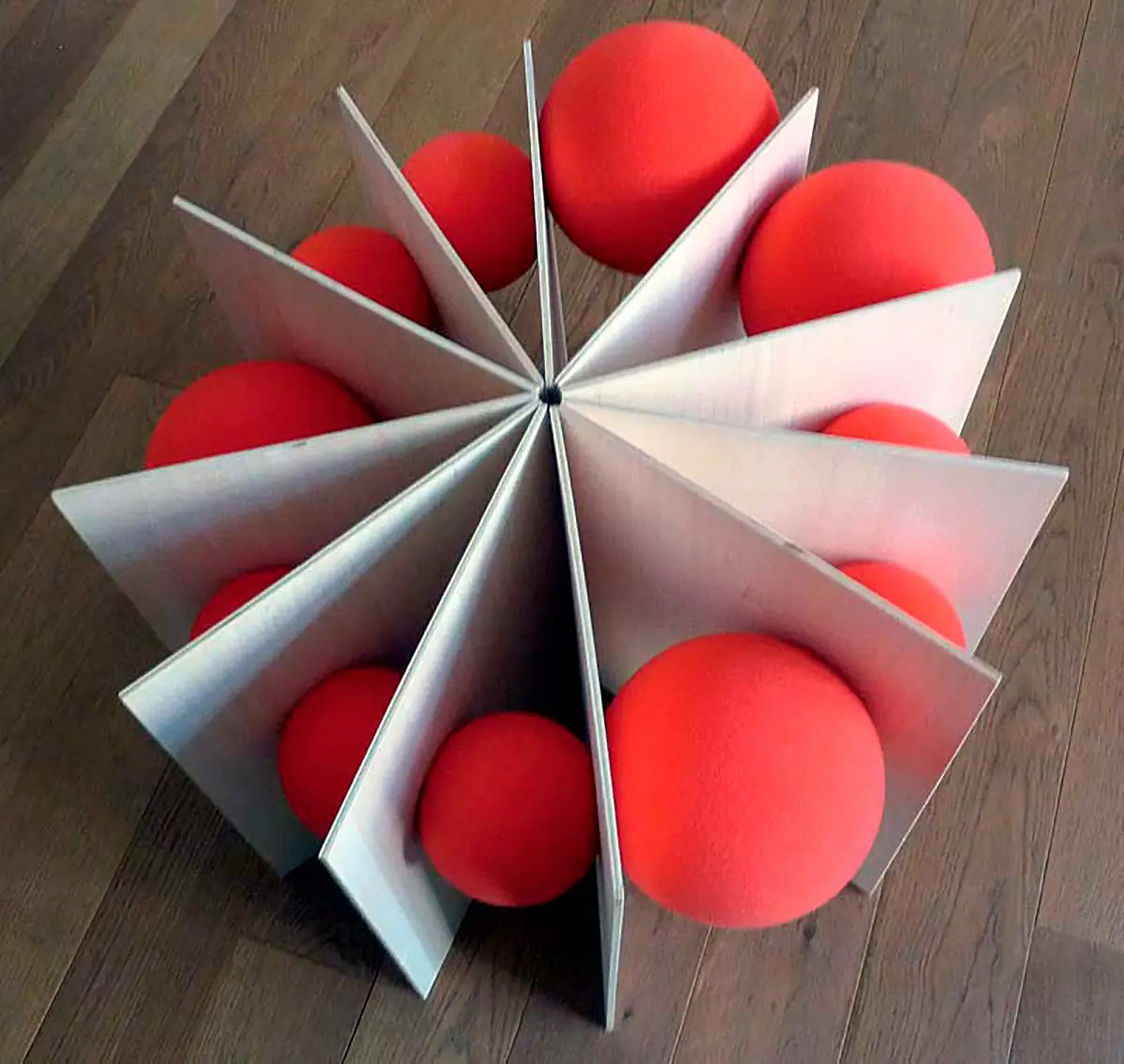
The exhibition also included two previously unseen sculptures, in glass and latex balloons, that deal with “the almost invisibility of air,” another leitmotiv in Guagliardi’s work. On the fourth floor of the gallery, there were three sculptures in wood and foam and a photographic diptych. “The physical element in the sculptures converses with the photographic work, which induces an essential question: in space, are we what supports or what is supported?” the artist reflected.
Despite the fact that she works on such seemingly intangible topics, there is a well-defined sculptural thought in Carla Guagliardi’s work. Her shapes always seek to display the behavior of her materials, generating their meaning on that basis through connections with science in “something between science’s ‘controlled experiment’ and the visual uniformity of minimalist aesthetics,” as Guy Brett explains in the Yearbook of the Künstlerhaus Bethanien, Berlin, in 2000.
With her repeated use of balloons, the artist wants to reveal the fact that “immaterial” air communicates through visual meanings rather than solid elements, which the artist often emphasizes by means of tension and hollowing. Meanwhile, the action of time warns that everything can disintegrate, and this insecurity reveals that purely physical and material conditions are never entirely free of the artist’s subjective intentions.
Another constant in Carla Guagliardi’s work is the contrast between a rigid structural aspect and more fluid and malleable components, as she groups iron and wood parts on balloons and glass. Lygia Clark’s philosophical precision and sensorial awareness, or even Helio Oiticia’s concept of the “suprasensorial,” influence Guagliardi’s work. Educated at the Parque Lage School of Visual Arts (RJ) and now living between Brazil and Germany, Guagliardi seems to perpetuate the legacy of these two Rio artists whose basic principles were experimentation and the participation of the viewer in the work of art. Guagliardi especially evokes Lygia Clark’s work, which expands even further the possibilities of sensorial perception.
These are works whose immediate appearance may not say much to their viewers, requiring a much more prolonged time for enjoyment and a radical shift in the usual relationship between space and time in traditional sculpture, where time is almost entirely ignored. Thus, “the anxiety and uncertainty generated by the dissolution of fixed structures are compensated by the discovery, in their interstices so to speak, of a new elasticity and fluidity,” says Brett in that Yearbook.
These peculiarities mark Carla Guagliardi’s delicate, sensitive work. For the artist, this is a clearly defined project to which she has devoted her work in recent years. “I believe that the work of art is always ‘in continuity’. My oeuvre is being built on that insistence, in a gradual and continuous process that is at times eloquent and at times silent,” she says. Although the presence of humans being is not one of its elements, it is to them that this work is addressed. The balloons slowly moving towards their hollowing refer to a primordial, pure state, a time of which mankind takes no part but which it contemplates with the independence of its negligible existence.
ALESSANDRA SIMÕES