
Xul y los pájaros, an exhibition of works by Carlos Capelán (Uruguay, 1948) begins with a mythical narrative about a character, Xul, from his birth in the village of Pu through his discovery of New York City. The story covers his search for Master Q, his encounter with a courtesan, the birth and death of his three children, his arrival on the Kingdom of Qi Xul, and his meeting with the Master, alongside whom he sets out for New York via the river Yi. The myth is marked by travel. By birth and death, and by symbols or images that seem unconnected yet radiant with meaning. Similar modes of narration are to be found later in the show.
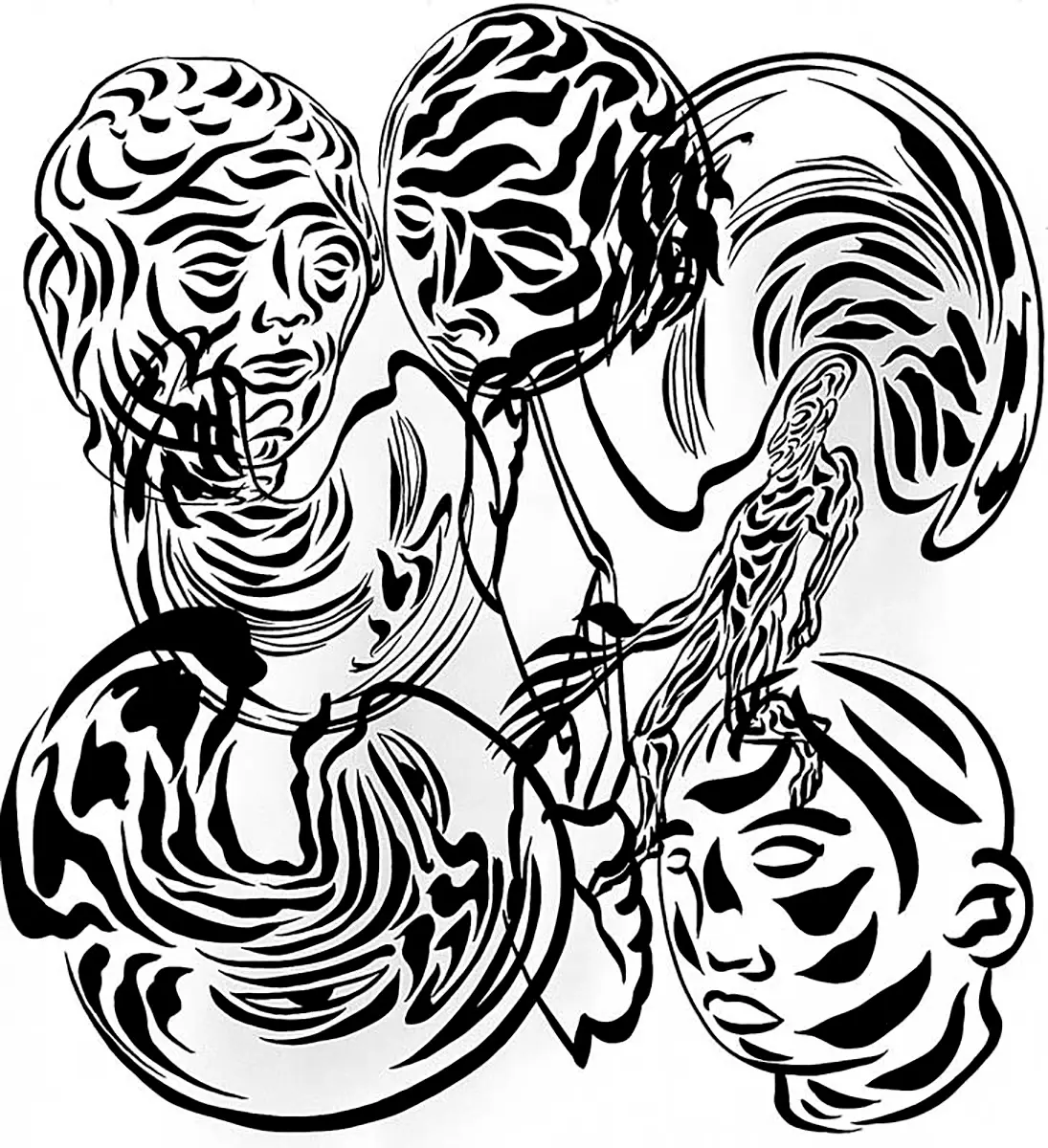
One face is repeated in different formats and techniques. It is in the engravings, in the paintings, in the large drawings made directly on the wall, and in the pages of books that unfurl like codices on the tables. A face resembling a stamp in black lines that narrow or widen, in constant curves, depicting the confused expression of a face covered in veins, wrinkles, or tattoos that suddenly contorts and twists to the point of resembling a whirl or a vortex. This way of working with lines is also found in certain bodies represented and in the writing on the books, which is also a kind of drawing.
The face could be that of a child, an indigenous person, an older person, or a younger man, resembling Capelán himself; Xul perhaps, moving across various constellations. In other works, the face intertwines with bodies or fragments of bodies in a whirlwind of lines that expand and contract in the paper on paper constructions or in black-on-white drawings, commingling also with the visual richness of the paint, when there is paint. The face is materialized and rematerializes as it enters different dimensions.
Capelán also works in objects. On the tables, his codices tell a story in graphic key, their longitudinally open pages are museum-like objects, a sculpture in the paper that is crumpled or unfolded like a map of the stars and their signs. In another installation, the register shifts to include chairs secured to the wall or the floor, set on piles of white paper that are perfectly arranged into blocks. Chairs that we associate with the educational system, and which confront a large face that is now a whirlwind of black lines on a white wall. A crossing of times and cultural forms.
The exhibition as a whole seems to also be narrating a myth. It moves in the domain of symbols more than in the domain of concepts, repeating icons, and expressive strategies through a variety of formulas that also allude to cultural representations. With mythical resonances and signs that cut across time and space, it is perhaps the (ciphered) narrative of the Latin American artist who leaves his small town and travels across many codes, operations, and territories, traversing tradition, modernity, and the contemporary in a journey where New York is a discovery rather than a conquest. We will find autobiographical signs and signs of identity in this story when we learn that its renowned author is a nomadic artist who has lived in the Americas, Europe, New Zealand, South Africa, and in his native Montevideo, adopting contemporary practices yet resisting any notion of avant-gardism.
In Capelán’s tale, we never do find out whether Xul and his Master reach New York. They saw the city and navigated “40 days to the West and 60 days to the South.” The story ends telling us that little is known of the city’s governor, “but it is said that he is blunt, powerful, and a complete mystery to himself.”
In parallel to Capelán’s show, another space in Galería Patricia Ready presented a series of photographs by Matilde Marín (Argentina, 1948), who began as a graphic artist and in the 1990s incorporated video and photography to her work. Proyecto Pharus developed after the artist read, in 2005 a “strange” news item, she says: “Lighthouses across the world are to be turned off since now we have GPS.”
Faced with the imminent loss of these constructions that still illuminate nocturnal navigation, Marín started photographing them from rugged coastal locations around the world; this work in progress has taken her to places like Iquique and La Serena, in Chile; to Punta Dúngenes, in the Magellan Strait, also in Chile; to Ushuaia, in the Argentine side of Tierra del Fuego; the English Channel; Iceland, Australia; Cape Verde, among others.
In ancient Greek, “pharus” means “the light that guides men,” the author notes; today, that light is on the verge of shutting down, pushed away by the evolution of technology. Feeling this ominous change, Marín sets out on a journey that seeks not so much “to change the world,” she says, but to “reveal and point out things in a different way.”
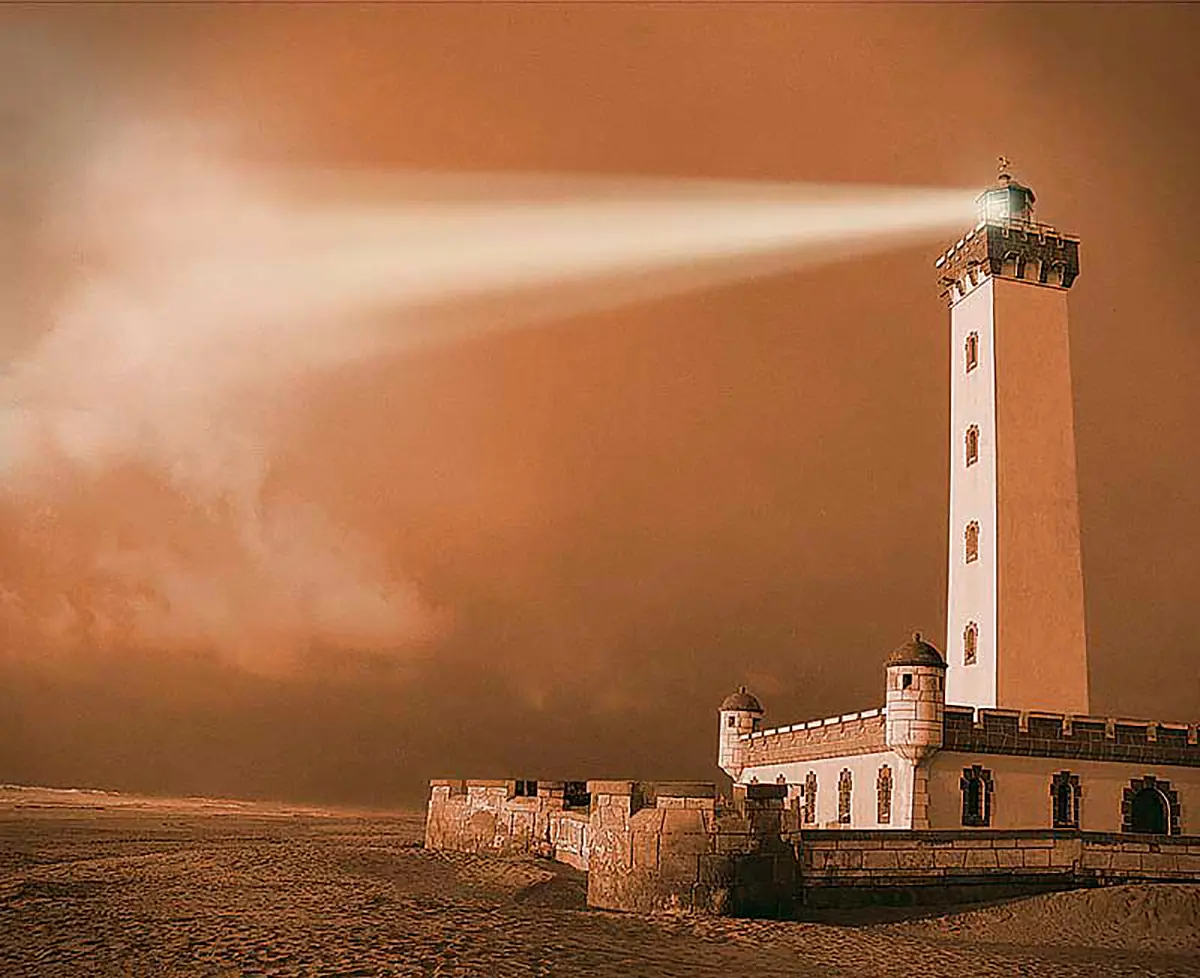
The exhibition presents for the first time part of this project. There are 14 analog black and white photographs, the record of 10 stations defined by unique, solitary shapes rising in vast landscapes to irradiate their light. More than a documentary sense of auteur photography, however, Marín works in a language that we understand as “contemporary art,” since she establishes a tension for both photography and its models, suggesting the existence of something beyond what is visible.
Marín’s treatment of her images is clean, as she works each photograph in a subtle monochrome that moves between gray, blue, sepia, and reddish hues to generate a veiling, a shadow, a fog where the image is nevertheless highly defined. This is an imagination of ghostly architectures erected in the middle of silent natural space. With the seas at ease, the focus is on the simple shape of the buildings, whose aesthetic variability goes from the idea of a solid watchtower to the fragility of a wooden turret, and even the highlights of modernist or avant-garde shapes. As traces of the human, they subtly reflect the history of their location and the links between art and poetry.
Thanks to Marín’s digital interventions, the light beams are foregrounded in lighter or brighter hues. The tower and its symbolism are important. We think of the mystery of the Tarot, in the sense of protection, of marking or a shift we can make, with its fall representing a defeat. But even more important is the light they emanate. A light that signals, alerts, guides, and, above all, resists darkness.
CAROLINA LARA B.