
A search for patterns and their meanings has lead Danish/Brazilian Christian Cravo to conjoin seeming opposites: excavation and edification, multiplication and division, the remembered and the foreseen. His methodology is as much a process of uncovering as it is of recovering.
After three successful series of striking black and white photographs portraying particular faiths and cultures, Cravo continues to evolve, training his lens on the wildlife and vistas of Africa. Visiting five countries on seven sorties, the artist has found a new way to uncover material and get to the very origins of existence. In doing so he has also found a new way to recover and express spirituality.
In his third exhibition at Throckmorton Fine Art, titled Shadows & Light, Cravo’s subject matter is familiar though eternally romantic and exotic: wild beasts, primordial lake beds, and sand dunes. His elephants and cheetahs recall the black and white photography of Peter Beard. Cravo’s images are more intimate and complex and they are enhanced by the warm hues of the platinum/palladium printing process.
Sand dunes at sunrise with their contrasting tonalities and sinuous contours recall the simple elegance of Edward Weston. And the aerial views of Lake Natron recall the pioneering landscapes of Emmet Gowin.
Building on those predecessors and others (including both his father and grandfather who were artists) Cravo further develops his own overarching concerns with the place and personal history. In this show, he investigates nature’s configurations and presents them in a context of abstraction. With these overtly painterly compositions and tightly controlled spatial arrangements, the series claims the new territory.
King of the beasts, a male lion rests on the ground, it's head erect, gazing to the left. Majesty, nobility, pride, confidence, and perhaps vulnerability —we can read these recognizable associations into the portrait. Cravo conjures them all with his skillful handling of light and shadow, clarity and softness, subjectivity and objectivity. The viewer’s eye is drawn to the lion’s, creating a symbiosis. Our mind intuitively reflects on what the lion might be “thinking.” In this engagement, in this emergence, Cravo expands our conception of perception. He takes us from the realization of nature to the nature of realization. Gradually our gaze proceeds from the lion’s gaze to the commanding mane and its myriad hairs. Here Cravo blurs the focus, lending motion, and timelessness to the stasis of the captured moment. The existential construct of the “one and the many” is subtly brought to the surface.
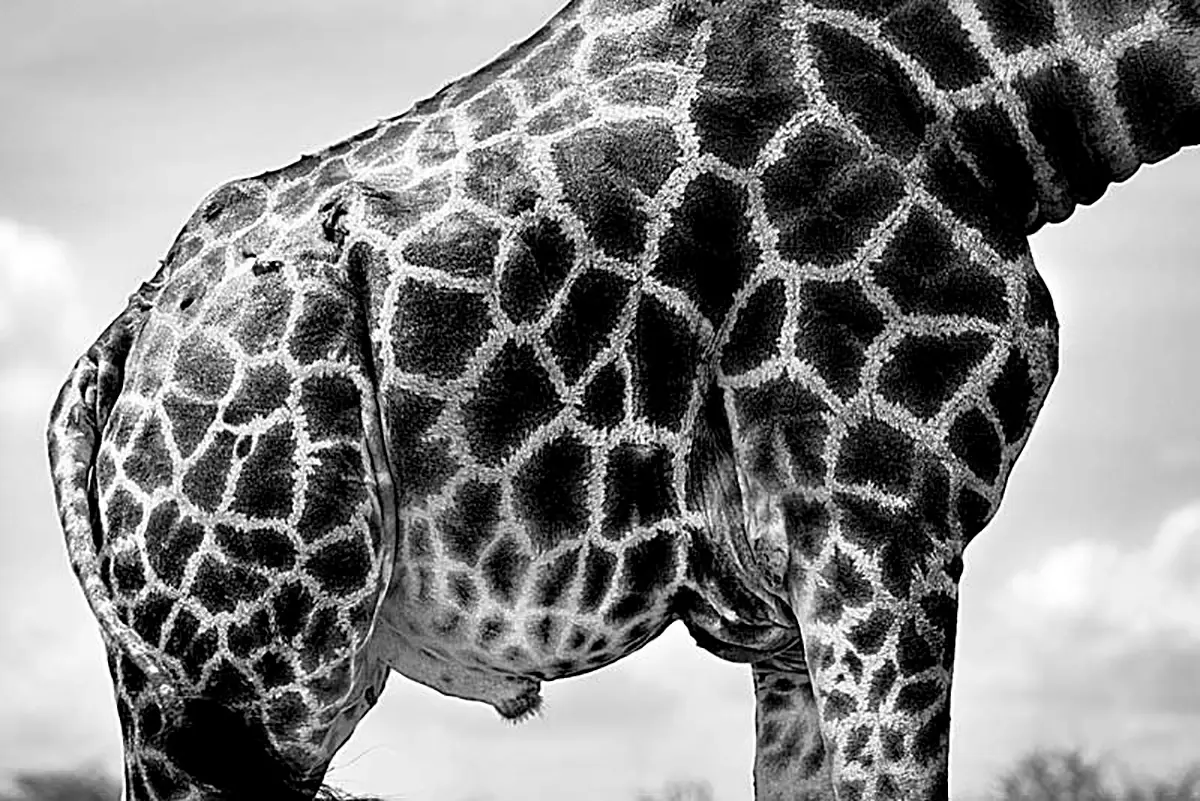
A giraffe in profile cropped to accentuate the flanks and belly, maintains enough of the animal to maintain coherency but directs the dialogue toward the overall pattern. Each irregular segment is outlined in bold, ragged white. Most of the segments have five sides though some have four and some six. The uniqueness of each unit comes to the fore as the eye is led around the tessellation, relentlessly comparing and contrasting the component areas. Here again, the relationship between the whole and its interlocking parts is central.
Cravo’s cropping provides a fresh perspective. A section of the snake and its recurring scales becomes a bar. Stretched horizontally under uniform gray light, it implies the geometry of a Mark Rothko painting. A close-up of a crocodile’s tough skin covered with armor-plating osteoderms triggers an epiphany on the subject of evolution.
Filling almost the entire frame, a zebra loses its identity as the bold stripes roll and swell across the surface. Here, Cravo evokes the spirit of Victor Vasarely’s famous Op Art painting also titled Zebra.
In a dramatic shift of scale, Cravo took pictures from high above Lake Natron in Tanzania. A tangled mesh of rivulets and channels crisscrosses an area of mudflats. Again, the emphasis is on abstraction, allowing for multiple connotations. Ribbons of erratic water become veins and roots, inviting us to embody ourselves in the refractions and tap into the depth.
Cravo also viewed dunes in the Namibian desert. In photographs taken at sunrise, he was able to split the landscape into two or three planes. Namibia desert III is sublimely elemental. The back of the dune in the foreground is totally black and stretches diagonally. The front is gray and white while the sky is all gray. Separating them, the dune’s ridge snakes into the distance with perfect, archetypal form. Adding a bit of detail to the trichotomous composition, a fine spray of sand can be seen blowing up from the dune’s crest.
Art critic Karen Archey has written, “A photograph is a contextualizing tool through which we organize our looking, gather information, and glean truth.” Cravo’s photographs are such tools. He is using his camera in a liberating way to isolate potent metaphors poised in graceful balances. His post-structural evaluation of codification furthers our understanding of the discourse between the real and the ideal, between sight and insight.
JEFFREY CYPHERS WRIGHT