
Curated by María Carlota Pérez for LA Artcore, an art center in Downtown Los Angeles, the exhibition Rhythm & Chalks presents the work of artist Fabiana Cruz (Venezuela, b. 1984), who combines elements of music and drawing to produce performances and video works. The exhibition Rhythm & Chalks includes three video pieces from her ongoing series Partition Linéaire, in which since 2007, Cruz has been exploring different methods to transcribe music in a similar way to the exercise of automatic drawing, but in contrast to this Surrealist tradition, she performs to musical compositions incorporating avant-garde gestures of performative experiments of the1960s and 1970s, which at times consisted of improvised subtle actions.
In these series of videos, Cruz seems to be responsive to the music she is listening to (audible to the viewer as the soundtrack of the piece), armed with chalk pieces she impulsively doodles her way on the sidewalk and street. Partition Linéaire #4: PaintSynth, 2010, for example, is a double video presented on the same screen, where the artist marks repeatedly with color chalk eight different points (or drawings) on the surface, emulating the rhythm of the musical score which was composed by her. In the previous work in the series, Partition Linéaire #3: Suite de Bach, 2009, on the other hand, Cruz utilizes strokes of white paint to create a visual representation of Bach’s Cello suite No. 1. The most recent edition of the same series, Partition Linéaire #5: Confutatis, 2012, is a more direct performance piece as we see Cruz’s body as she marks with chalk in hand a paved street in a diptych video format.
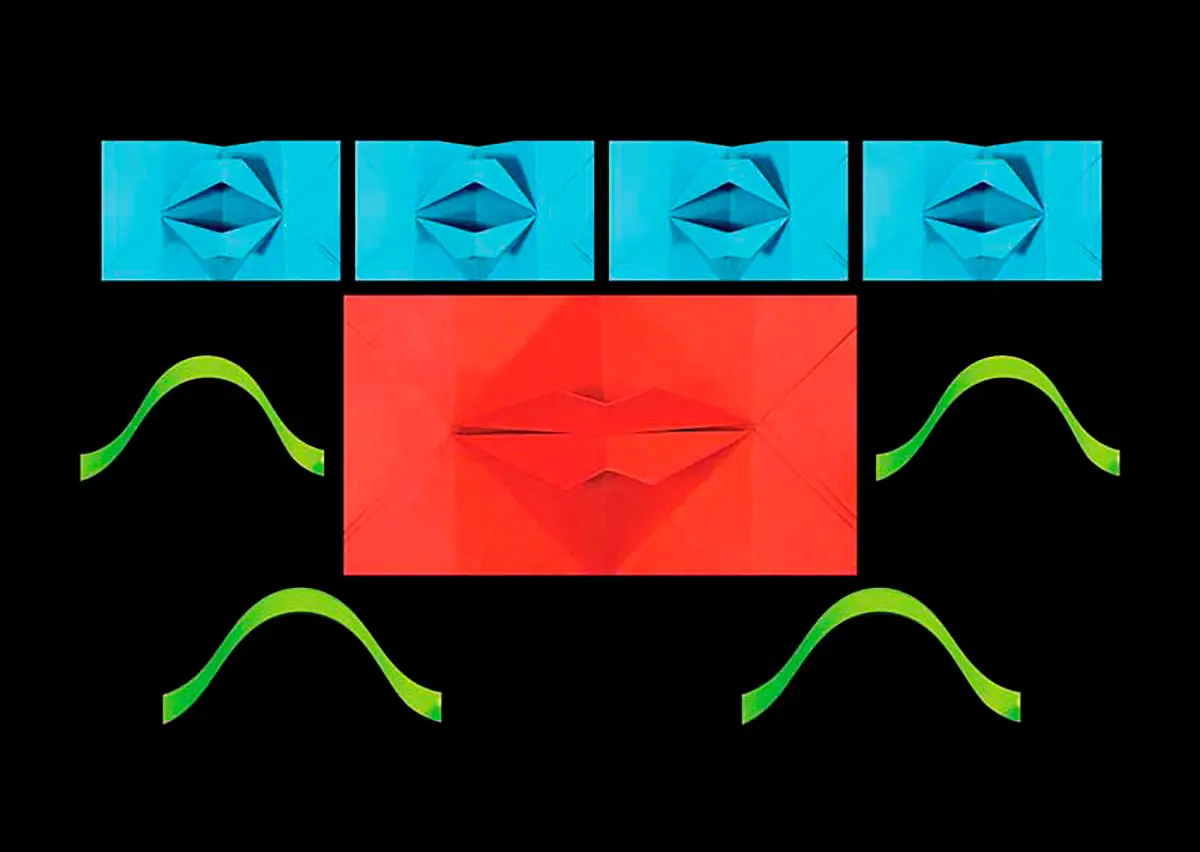
Her second body of work in a video presented in the exhibition consisted of a series titled Imaginary Instruments, a series which is more “musical” in comparison with Partition Linéaire, the latter being more preoccupied about issues of painting, drawing and the 2-D plane, while Imaginary Instruments focuses more in the performative aspect of music, is more playful in its interpretation of the idea of “translating” music into a visual final product. The work Imaginary Instruments #2: Acapella, 2010, is a bridge between the two due to the use of water, paint and hand strokes that “dance” to the music—a cover of the song Acapella by Kelis—and which according to the artist is a sequel to Partition Linéaire #4: PaintSynth, 2010.
The work Imaginary Instruments #1: Blackbird, 2009, features Cruz performing a cover of the song Blackbird by the Beatles, seemingly playing with the skin of her forearm and a bidimensional lute instrument which is at the same time an extension of her own body. A further study of these corporeal-centered musical covers is the recent piece of this series titled Imaginary Instruments #5: Settle Down, 2012, in which Cruz presents a chorus of lips made with paper, singing to Kimbra’s Settle Down. As the paper lips begin reproducing into lines of different colors and sizes, the video becomes a quasi-abstract geometric moving painting, even when we see her hands “playing” some of the lines that appear in the image emulating chords of an imaginary instrument. The exhibition also includes a digital print titled Hands II, 2012, which evidently represents the hands of the artist, covered with paint in different colors, smudged on a surface.
Fabiana Cruz’s experiments with music and art are related to modernist investigations and the relationship of color, line, and sound, nevertheless, her approach to these ideas is renewed and stimulating in the way she uses her own body as part of the piece, blurring the definitions of performance art, video, painting, drawing, etc., and thus being inclusive and encompassing of all. The exhibition Rhythm & Chalks presented a particular selection of Cruz’s works, especially by showing these two main series in contrast with each other and succeeding in presenting a sample of every aspect that is of interest and ongoing examination in the work of the artist.
SELENE PRECIADO