
From his beginnings in Havana in the 1980s, when sculpture in Cuba was mired between commemorative patriotic monuments —molded for its materialization in bronze and reinforced concrete— and a geometry with abstract-constructive foundations and almost entirely dominated by the use of steel, Florencio Gelabert broke with the outdated dichotomy between tradition and modernity and assumed the tenets of nascent postmodernity launched into the global scene by architect Paolo Portoghesi with the construction of his famous strada novissima at the 1980 Venice Biennale (architecture, design in general, and art would never be the same after that). But it wasn’t only this wide-ranging, seismic cultural shift that provided justification for Gelabert to appropriate, in his earliest reflections and investigations on the creative process itself, the rich art-historical tradition; the achievements of US post-minimalism, then dominant in galleries and museums around the world, had the same effect on his imagination, as did an appealing povera aesthetic praised in the most demanding European stages.
The initial works that emerged from such a superb confluence of factors, such as hybridization and admixture of concepts and forms, consolidated Gelabert’s incipient efforts to problematize, question, and transgress, at the young age of 20, the local sculpture tradition, and to introduce significant changes in the artistic practices through which new Cuban art attempted to gain a foothold in the public sphere and institutions, as well as among specialized audiences.
As early as 1982, and based on a genre as dear to art history as the landscape, Gelabert embarked on a serious investigation of materials and forms with the purpose of appropriating the necessary tools for, to the surprise of many, deconstructing the bare sculptural event. To this, he added an early vocation for theatricality and measured the use of illusion as co-protagonists of any artistic operation intended to stand on their head the established certainties of the three-dimensional field. Through schemes taken from “set design”, be it in small- or medium-format works that were nevertheless able to interact with institutional or alternative art spaces, Gelabert questions the notion of sculpture lays the foundations of a “new order” and understands the possibilities of a historical expression with strong academic and even popular roots in a better, more open, freer way, giving it new meanings in the national art scene.
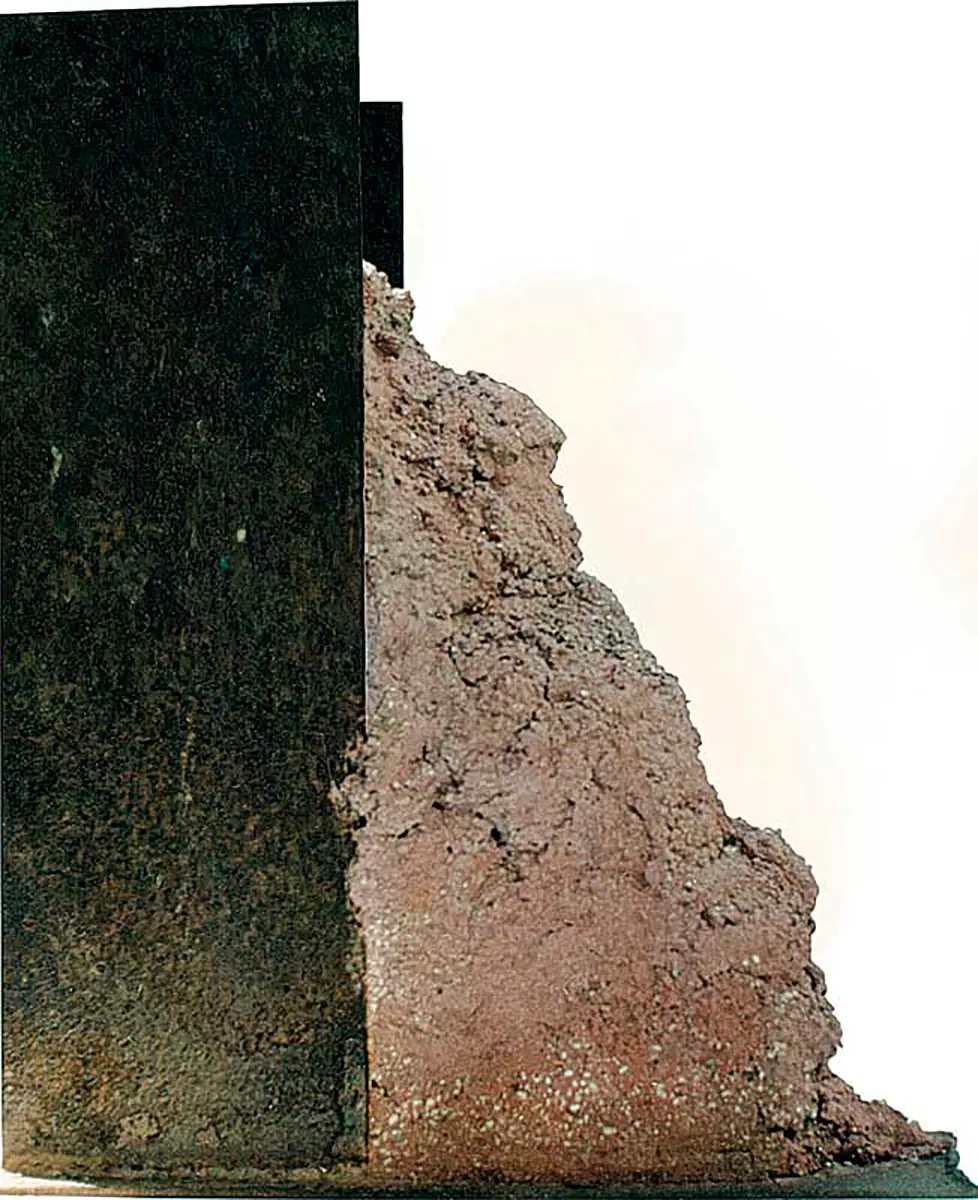
Obsessed with several ideas that explored the same phenomenon, Gelabert decided to investigate residues, the detritus of time in architecture (Homenaje a la columna, 1982, concrete and pigment), or to manufacture them with his own hands in order to transmit the vital élan of man-made things, thus restoring, to a degree, the immanent aura of the work of art, which was beginning to evanesce in an across-the-board convulsive, unsettling decade for the cultural field: from then on, both approaches were to identify Gelabert in the eyes of colleagues, audiences, and critics.
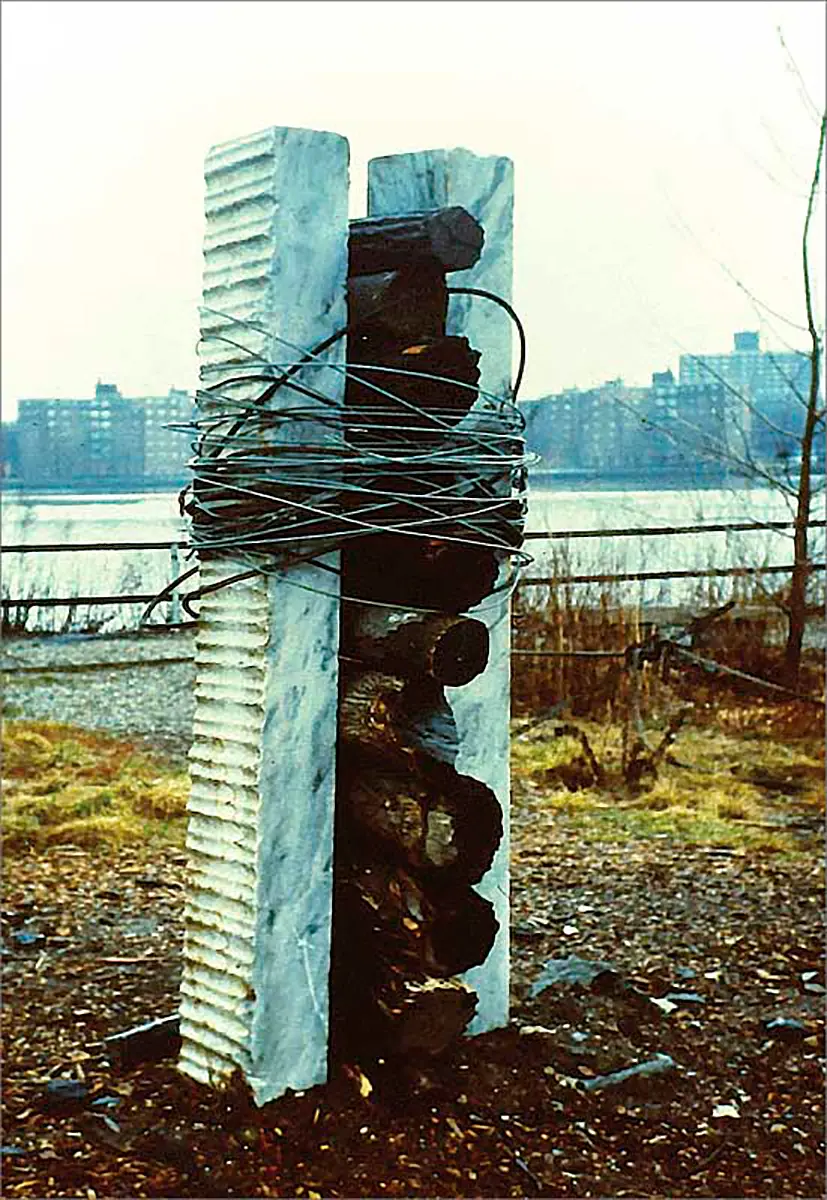
After his sudden rise, Gelabert’s early works and some later ones became more familiar with the complex universe of archeology, like notes taken from other creative domains, variants perhaps of an “imaginary architecture” —as he himself has put it in one of those so-called artist’s statements one so often encounters today— so as to allow him to reevaluate “the relationships between organic elements, nature, and technology” as seen with great clarity in Restos (1882), the series Juegos (1983), Relaciones (1984), and, later, in Columna (1985) and Compresión (1989), all ready to be placed in unconventional spaces such as hotels, interior and exterior gardens, institutions of any kind, and even in galleries and museums if that were the case. His concern was not the contemplation of the work in the strict sense, but a dialog with the materials and shapes, with the space and the general atmosphere surrounding it, in search of organic integration of the components and their disintegration (not paradoxical, as might be supposed) at the precise moment of their appearance as parts of a larger, richer whole.
Gelabert played with reality and with the viewer's desire, with the reality and the illusion of his materials, unconcerned with whether they had been collected, found, or manufactured. It was a way of seducing, of provoking innumerable suggestions, from doubt and disquiet to the unobjectionable discovery of a personal poiesis with a strong vocation towards identity. Seen carefully, all this derived from the contrivances and ploys that are at the root of the scenic arts, of the essentially theatrical, as if to remind us of that famous Cuban song from the 1950s, immortalized in Havana Night Clubs by La Lupe (and later embraced by writer Guillermo Cabrera Infante in his novels, and by filmmaker Pedro Almodóvar): “All you do is theater, pure theater…”
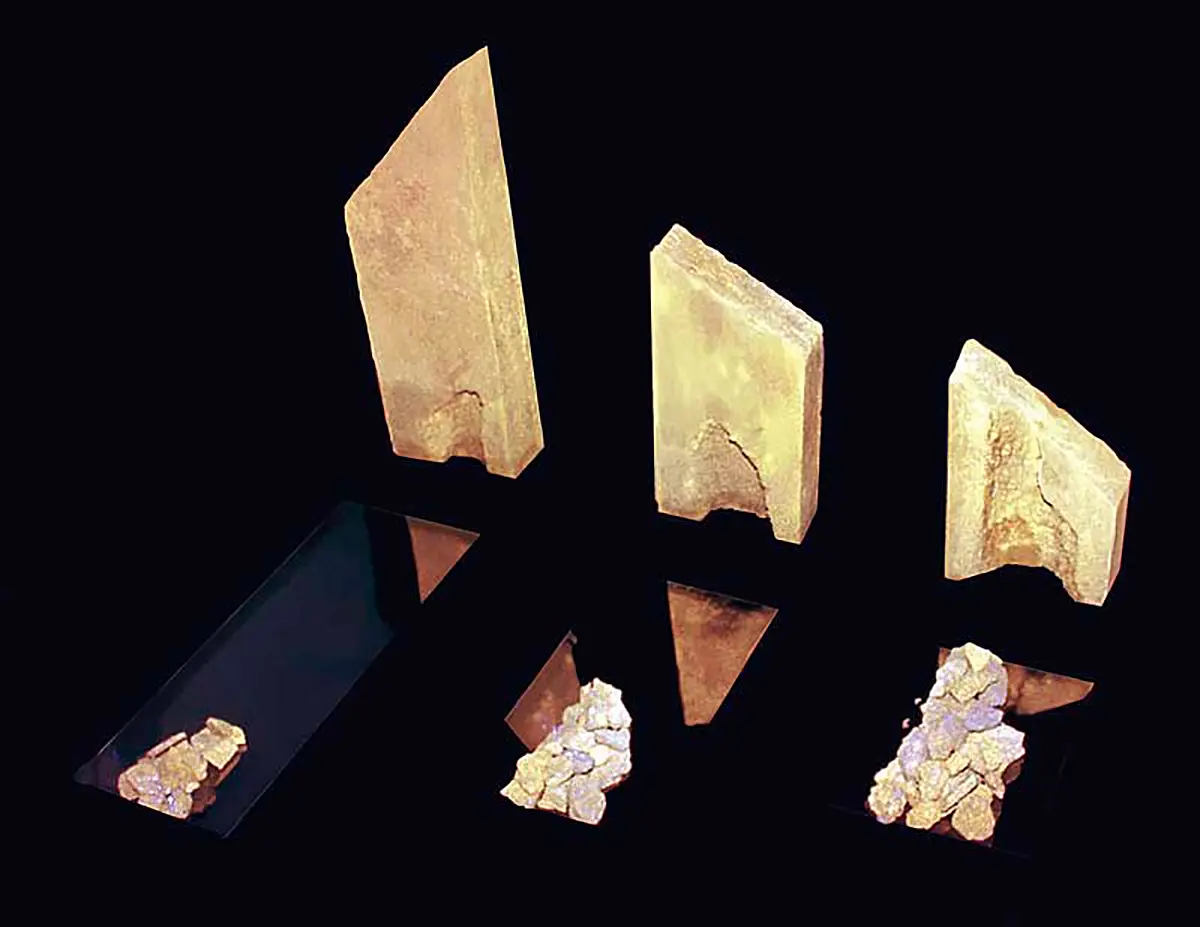
The hardness of the materials in use was part of Gelabert’s aesthetic code, even when they were part of a wall fragment: over time he added pieces of metal and mirrors, and, more gradually, organic materials. Each fragment was intervened with holes, and hollowings, so that few were confused about the body of the work: the notion of an expanded field for art, promoted by Rosalind Krauss in her 1979 essay Sculpture in the Expanded Field, was for Gelabert yet another revelation arrived precisely when he needed it the most when historical notions of beauty were still in play across Latin America, notions about the unity of the work, the lights and shadows that emerge from each volume and shape, the mastery of craft through time, the persistence of a figurative approach with academic and modernist roots.
Gelabert was an ill-fitting piece in the puzzle of contemporary Cuban art; it wasn’t easy to place him within any of the dominant trends, despite the openness and impact, inside the country and abroad, of other young artists of that decade. Gelabert drastically altered the rules of the game with his 1984 exhibition Esculturas at the Casa de Cultura de Plaza in Havana, more influenced by what was happening outside Cuba than by the local scene, whatever its virtues.
International recognition came quickly. Gelabert began exhibiting in spaces in Venezuela, Panama, and Mexico during the second half of the 1980s, and finally, in September of 1990, he decided to resettle in the United States (where he had obtained an artist’s residency at the Socrates Sculpture Park, in New York City). The US experience (especially in Miami, where he lived for a while) promoted a series of complex shifts in his work —including the presence of ancestral cultural elements connected to religiosity, as well as political elements through recognizable symbols— fostered by a propitious environment for social discussion, debates about immigration, hybrid cultures, multiculturalism, Latin America, exile (observable in Prisionero de sí mismo, 1997; Trabajo sagrado, 1996; Espacio ocupado, 1998).
In the last decade, theatricality has continued to dominate Gelabert’s sense of space, and, in consequence, the meaning of many of his works. Not in a raw state but filtered now through the same neo-conceptualism that is palpable in a significant region of the art produced in Latin America, the Caribbean, and Cuba in the 1990s and 2000s, the implications of which are still with us. It is in these works where Gelabert finally incorporates nature (after his initial attempts in the late 1980s), as well as human residues (present now with greater subtlety) and industrial detritus, so organically and with such coherence that at times they merge into one another and boundaries are swept away without any difficult exclusions.
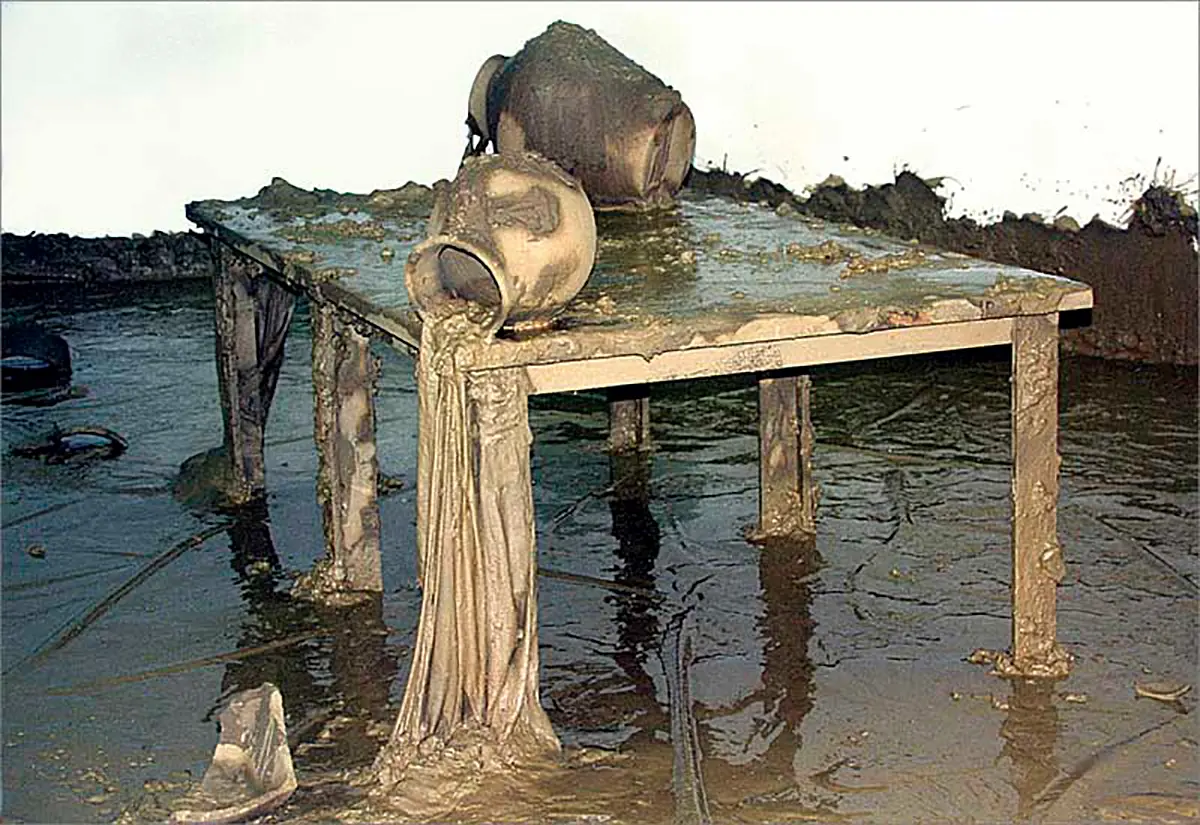
The architectural remainders (walls, foundations, columns, beams) that had given rise to so many of his works are now accompanied by manipulated human residues (such as feces), jars, garbage of all kinds, rusty pipes, spilled water, and so forth; their final concert of shapes unfolding in space challenges and provokes even further the acquiescent sensibility of viewers unaccustomed to this type of revelation and relationship.
In that sense, Gelabert’s discourse moves more towards the intellectual, thanks to the variety of ideas he recycles—and is able at the same time to produce—without abandoning for an instant the initial spirit of investigation that situated him in specific instances of Cuban artistic postmodernity. And it moves also to reinforce the aesthetic, even as he increasingly acquires a greater awareness of the problems affecting the contemporary human condition. In that shrewd skill to integrate so many elements, in his ability to surprise us with new conceptual, structural, and aesthetic processes, resides Gelabert’s commitment to an important vector in contemporary art: one that does away with the sheen and luxuriant sparkle of expensive materials, auctions, and fairs, the curatorial and collecting marketplace.
Gelabert’s commitment is to mankind, to nature, to the environment: this is to say, it is a social one. In exploring new locations and new arrangements for his objects, sculptures, and installations, he proposes a new way of thinking about vast regions of the material and spiritual world. He makes possible a greater variety of interpretations for signs and symbols, without concern for their classification or their localization in one or another contemporary trend.
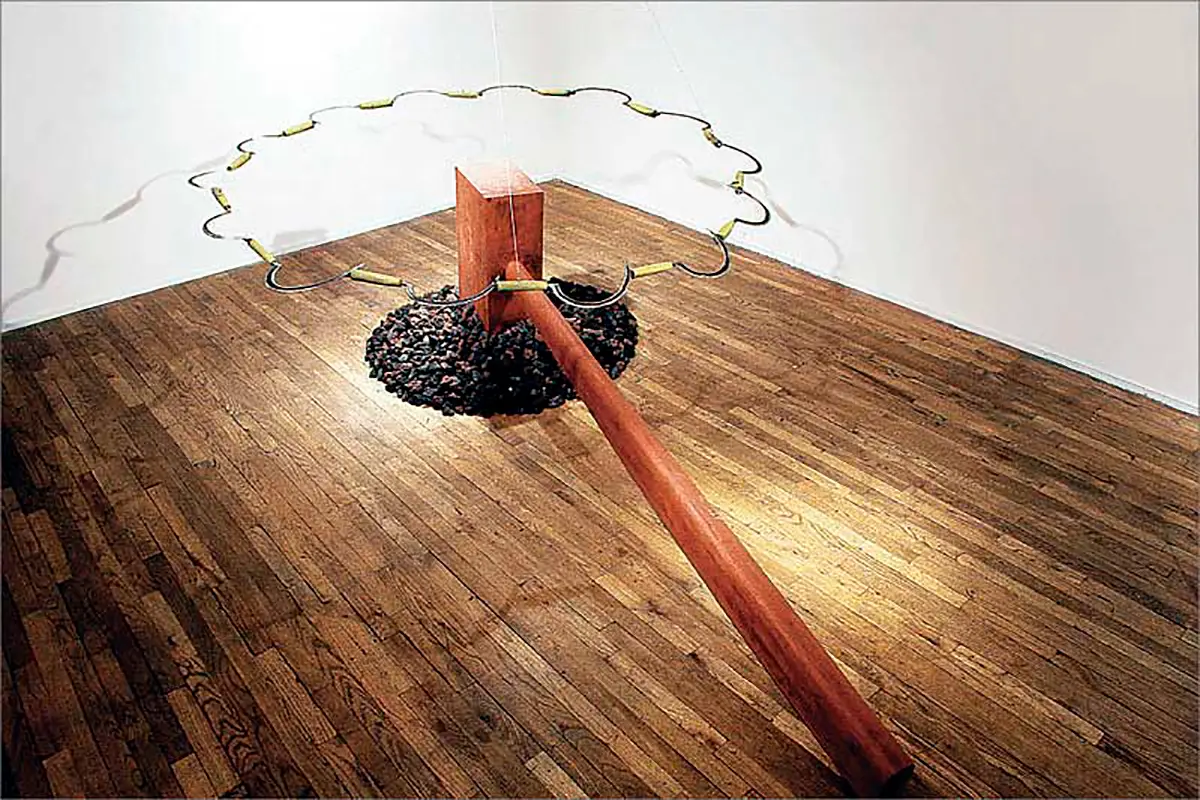
In this way, Gelabert finds fertile territory for the creation of miniature landscapes —small displays of expansive, unknown geographies— as if animated by a bonsai attitude toward creation. Like a landscape artist holding on to painting, he creates landscapes on the floor or on walls using polymers, oil, and acrylic in many colors, with artificial plants that reveal an unprecedented three-dimensionality capable also of supporting false steel, false wooden beams, like integral parts of their composition. This is the apotheosis, the delirium of the supra-real turned extremely physical, tangible, and real.
In this sort of structural paradox resides one of the most appealing elements of Gelabert’s most recent production, exemplified with prevision in his exhibition Huellas, at Villa Manuela Gallery in Havana, in November 2011, which also was an emotional and significant reunion with the Havana public after almost 30 years since his previous presentation there.
The exhibition, comprised of four large installations, interrogated the assumed (at least in the Cuban scene) boundaries between object and sculpture, projecting itself with caution and respect towards sensitive local situations of an economic and social nature.
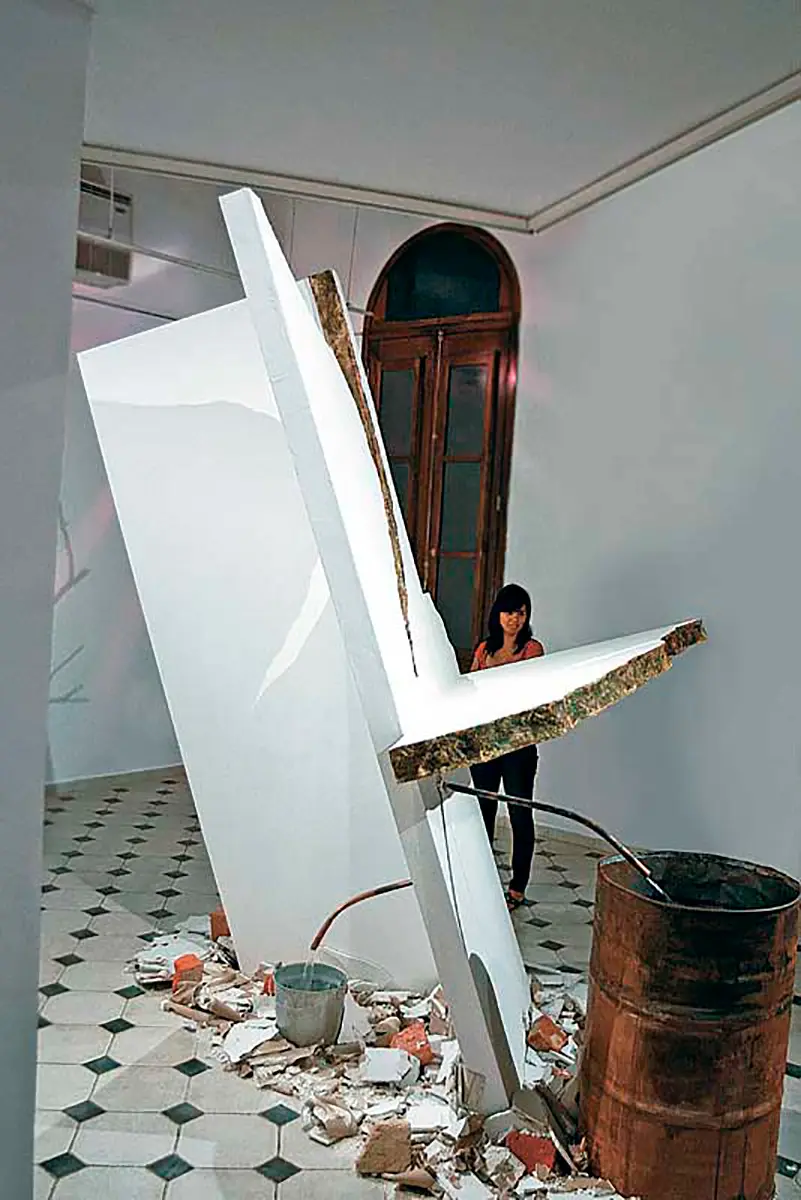
The largest sculptural and objectual installation, El sitio (plywood, tree branch, copper tubing, metal bucket, water pumps, and hoses, 2011) welcomed visitors to the gallery’s first space, occupying it with a surprising monumental effect. The remains of domestic items and walls, and the water constantly being spilled, brought to mind the physical decay of large areas of the city of Havana, impossible to ignore and assumed now by the art institution.
Next, La salida (plywood, Pladur, papier mâché, polyester resin, artificial plants, and oxide paint, 2011) presented with violence two fragments of the beam, supposedly in steel (actually built in plywood), abruptly protruding from the gallery wall in a kind of devastating, almost hallucinatory Munchian scream. Meanwhile, across from this work, is Salidero (PVC tubing, food, and feces, 2011), a thin, straight pipe announced with its fall from above the spillage of detritus expelled to the gallery floor. A humble work, it attenuates the fanfare around the previous ones: the show’s dramaturgy (conceived in the best theatrical sense) finds here a propitious moment for resting and meditation.
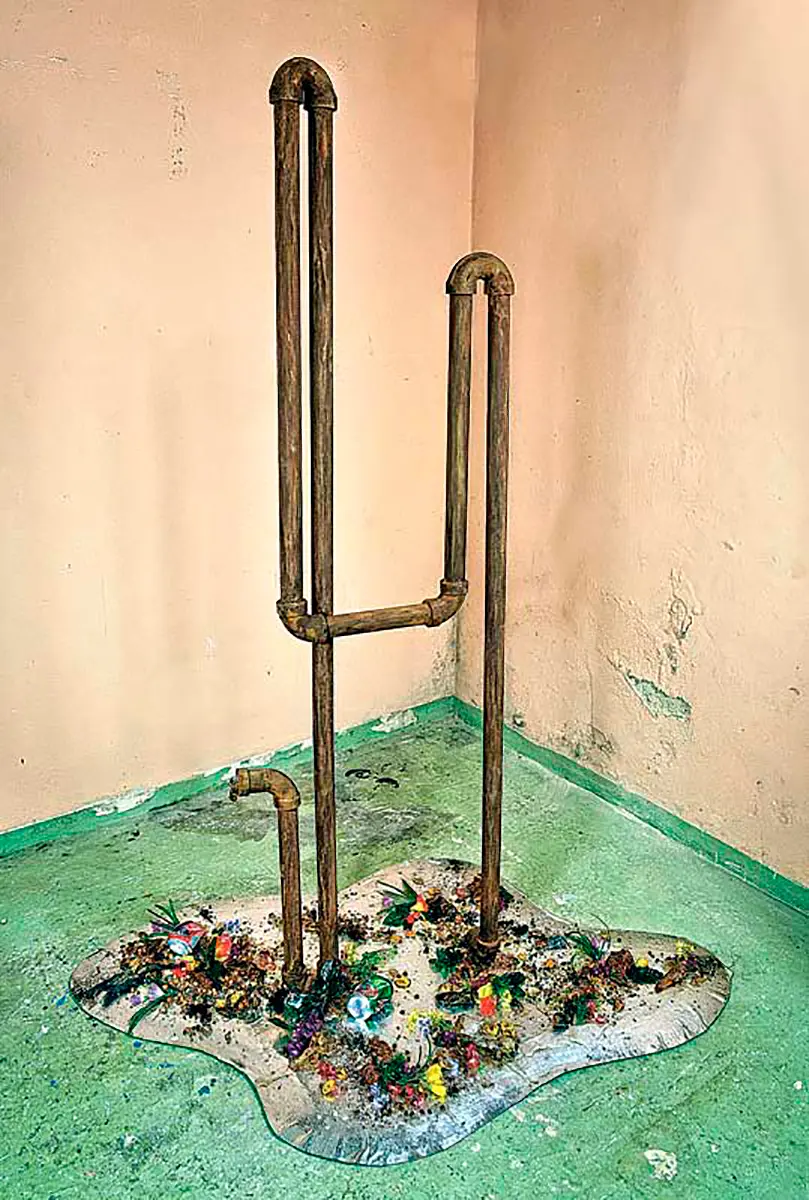
Finally, as if in closing, was La cañería II (PVC tubing, papier mâché, food, polyester resin, and artificial flowers, 2011), a hybrid sculpture that explored the interior of architectural space by displaying the open veins through which water incessantly flows towards various parts of the building, or comes to die, and end of its journey, next to piles of garbage and human detritus, accepting of its fate. A thin pipe folded almost into the shape of the letter M, lives in laborious harmony with diverse elements that become one by fore of their daily, hourly, permanent intertwining, their familiarity, their acceptance as part of the household, neighborhood, and urban landscape.
This is the drama of modern and postmodern cities, wherever they are; it seems impossible to ignore or escape. Even though the scale of these works had to be adapted to the gallery’s reduced space, they are forceful metaphors of a wider world that some insist on hiding or choose to discuss in costly international symposia. Gelabert is here a chronicler of his times, of his era. Thus, his view of reality has widened considerably, like a photographer zooming his lens to capture the detail that will say it all in the most synthetic and simplest way possible.
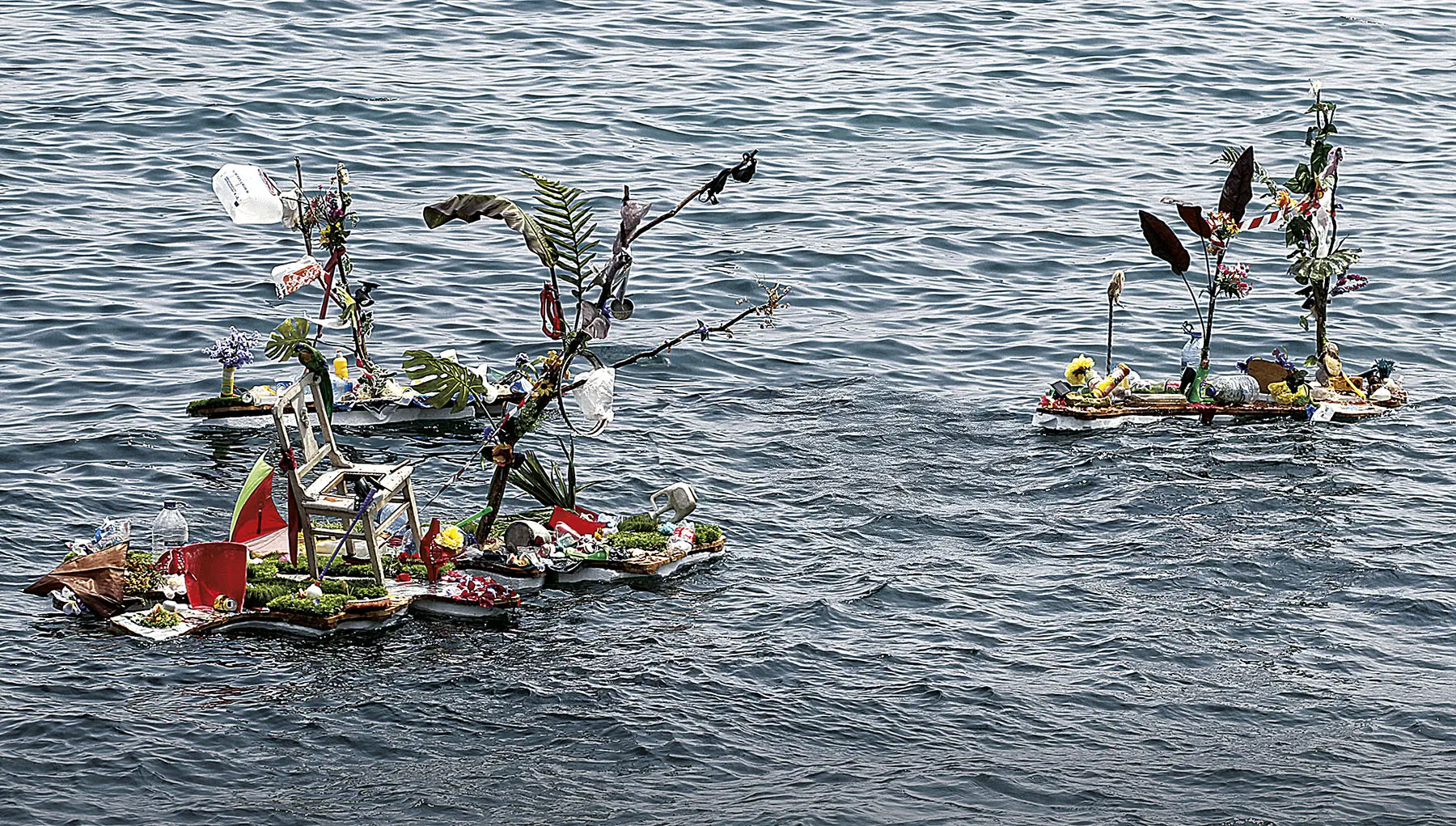
Months later, invited to participate in the 11th Havana Biennial (May-June 2012), Gelabert created Islas… para un amigo, an ephemeral installation exhibited as part of the collective project Detrás del muro, whose general location (with works by almost 20 artists from Cuba and abroad) was the public boardwalk known as El Malecón. Gelabert’s work was three silhouettes, or small plywood islands, mounted on Styrofoam sheets approximately 25m long and 2.5m wide and anchored to the rocky Havana shoreline. This new work altered our perception of the Malecón, not only with its physical appearance but also as a reflection and continuity of a line of work that seeks to visually impact its viewers through the use of discarded pieces of furniture, plastic containers, tree branches, artificial plants, and an assortment of colorful residues illuminated by solar panels after dusk.
Silently, Gelabert’s Islas… invaded the Cuban coastline and, at the event’s opening and by way of performance, Gelabert cut the steel ropes that connected them to the ocean floor, in an act of complete liberation that gave birth to a work of art in search of new horizons in the vastness of the seas.
Each in their own space, both actions (the Huellas show and the Islas… para un amigo installation) reasserted the continuities and coherence of Gelabert’s work over time and corroborated his sustained interest in seducing the viewer’s gaze, intelligence, and emotions.
NELSON HERRERA YSLA
Art critic and curator.