
What alchemy is Gabriel de la Mora (Mexico, 1968) after? What generative moment for art that dives into the occult not to unveil and reveal, but to transmute its vestiges and reify the affective forces so unleashed, which return as objects of art, art-things, in limpid minimalist atmospheres subject to the laws of a unique system of order and inextricable beauty? De la Mora’s craft is driven towards the exploration of the limit zones of art and life, in search of residues that will make it possible to grasp something that cannot be said or to reach what the Greeks called parresia: the freedom to say it all. But he does this by transmuting the materiality of existential time, above all, into an aesthetic of the absolute, where silence breathes.
The title of Hal Foster’s Compulsive Beauty, cited by curator Willy Kautz in his book Pulsión y método: Gabriel de la Mora, helps crack open a passage into an oeuvre made almost devilish by its rigorous and painstaking transformative destruction. Working through “serial repetition”, as Kautz points out, the artist rejoices in the contemplation of the residual, and his art becomes an unsettling series of strangely beautiful remainders; alternatively, he can move towards the reconstruction of objects that have been destroyed (scratched, veiled, torn, pulverized, among other operations), infusing them with an aseptic quality, a kind of purity or, if you will, an absence of memory and its attendant guilt.
The operation of writing “(…) all the things I have done and have never told anyone and nobody knows about me” (2009) only to erase them and make them into perfect cubes, is paradigmatic. In a way, it is a kind of alchemy that works with psychic residues, with the substance of life itself, in an incessant pursuit of the transmutation of chaos and its energies into impeccably crafted works of art. Gabriel de la Mora gives new life to the legend of the lapis philosophorum with systems that have their own laws: exhaustive counts; a circularity that connects a personal destiny with the destiny of the father; taxonomic systems that are as rigorous as they are subjective; manual endeavors so outsized that they don’t seem susceptible of completion without the favor of certain gods; and a diverse series of mirror-based procedures that include inverted writing.
De la Mora operates with what is veiled, boring down to its deepest roots only to erase afterwards the path into the center of the mystery and, once discovered, dissolve it in such a way that all we find in each work is a vestige: this is the artist-as-Minotaur who guides to the center of the labyrinth anyone who dares to enter, yet only allows fleeting glimpses of his presence, residual modes of energy that nevertheless contain in their potency the material, aesthetic, and conceptual catalyzing forces that have made different ritual series, repeated perhaps in search of salvation, possible.
Where critics often demand biographical silence, we need to proceed contrary to the erasures executed by de la Mora and re-inscribe certain data, openly restoring its ontological quality to an oeuvre that emerges, especially starting at age 25, as an inner exploration and descends, in a first great cycle closed at age 39, to the darkest substratum of the psyche, literally to the very coffin of his ancestors, which he excavated in order to connect the biographical lines of his living and his death. This process culminated in the exhibition Brújula de cuestiones (2007) and it closes with a ritual of symbolic death: the video of the action titled Gabriel de la Mora vs. Gabriel de la Mora, where the artist destroys, on the day of his birthday, a piñata made in his likeness using molds of his body, which functions as a performance-combat with the figure of the father whose name he shares.
A new cycle starts at that juncture, with works that can push themselves close to the dissolution of form and figure yet are made with the materials contained in the body, carrying its full load of genetic information, its millenarian symbolism, and the chaotic complexity of life: blood, human hair, although it can also use pages from pornographic magazines and even blank sheets of paper, among a variety of found materials—bills in various denominations, scratched acrylic and small unicell balls—and, of course, fire, selected by an omnivorous urge to devour the intelligible and manufacture, even if in a contrived way, a meaning. These works sit astride the line of time and are pulled at by two contrary forces: conscience and the desire for an art that endures, an art that aspires to eternity, and the parallel quest of the black and white as a totality, the silence of that nothingness that contains the cycles, the returns, the pulse of everything that, in a word, has been.
From the Subversions of the Veiled to Time as Absolute
The structuring of identity through the gaze of the father, the search for the father and his symbolic murder, determine the construction of Gabriel de la Mora’s language, which cannot be duplicated inasmuch as it has been extracted from the very forces of the subconscious and transformed into sign and material with manual processes so painstaking that can bring others to the limits of exasperation, yet are assumed by de la Mora through his subjection to the contemplative bridle of repetition, where he finds sudden illuminations to generate new works.
The artistic journey began at the age of 25, after the death of Gabriel de la Mora; at the funeral, the deceased’s son discovered that, before marrying, his father had been a Catholic priest in the city of Colima and has reinvented his fate at 39, erasing all traces of his previous history. Confronted with the revelation of this hidden life, the artist suddenly understood the fiction of a photograph depicting events that never took place—his mother’s white-dress wedding—and in some way, the sediment of his later works began to be articulated there.
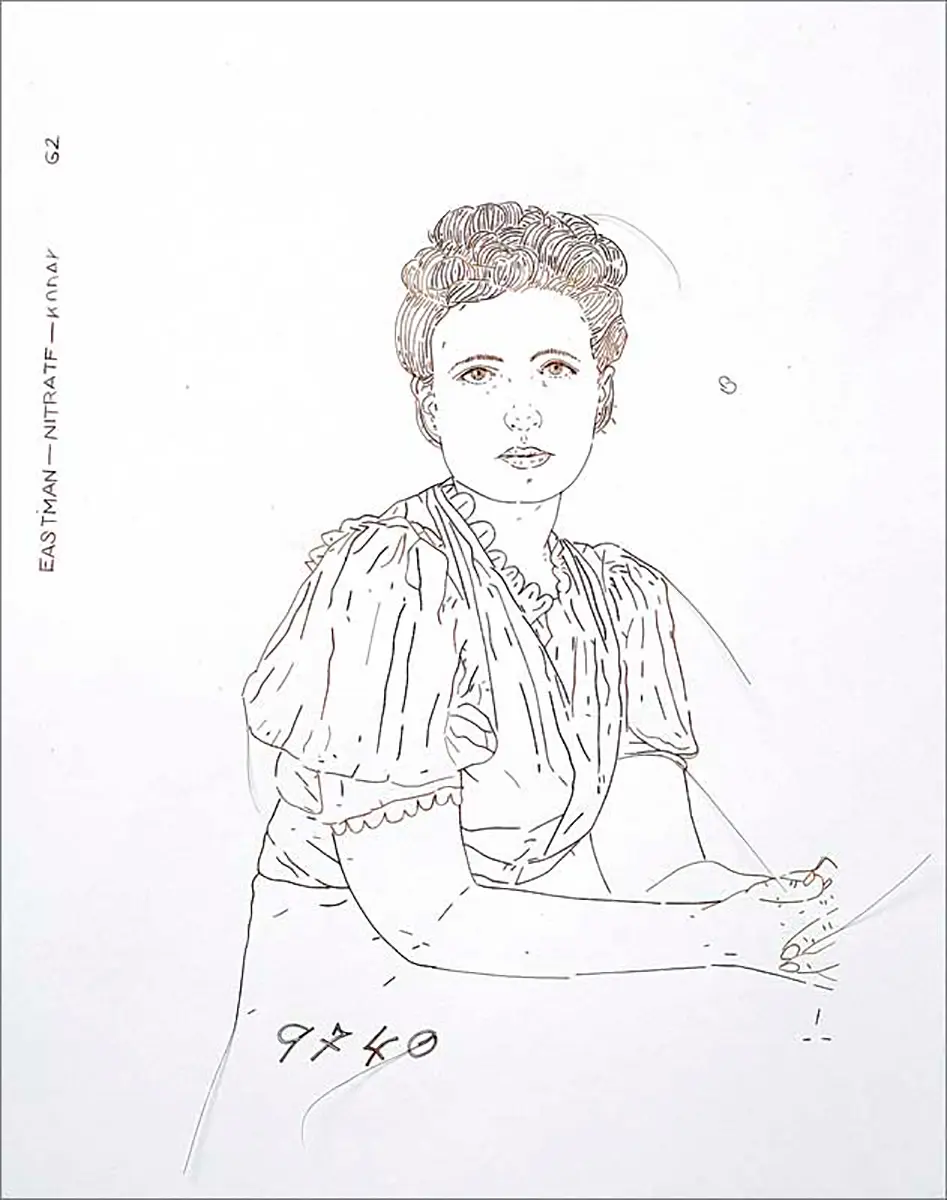
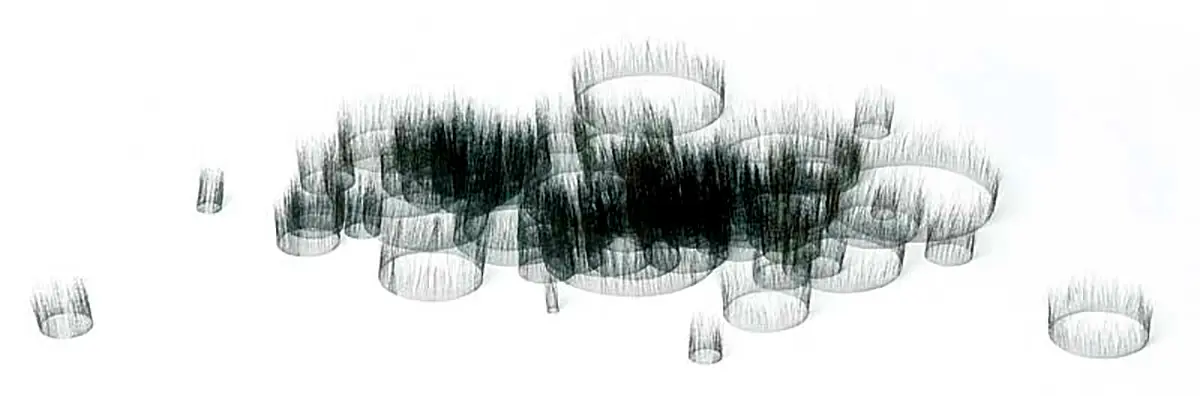
In a vertiginous three-year process, de la Mora gradually moved away from the practice of architecture, which responded to the conservative demands of his family and engaged in a series of descent and breaks, embracing previously repressed aspects of his personal and artistic identity. After his first exhibition—La inconsciencia de la vista, 1996—he left Mexico in order to continue his education. Arriving in New York City—where, four years later, he received a Fulbright scholarship to attend the Master’s program at Pratt Institute—de la Mora shaved his head and started using hair as a substitute for lines. It is the start of a long exploration of draftsmanship using this material loaded with genetic information that continues to grow even after death, which will allow de la Mora to produce unsettling portraits with tracings that contain the subject’s own DNA, culminating much later in three-dimensional abstract works such as that landscape of shadows and circles containing the fragile matter of a hair and the dimension of infinity.
But in this first great cycle—voluntarily closed at the same age when his father changed his identity—Gabriel de la Mora (son) carries out a series of subversions, and transmutations, of what is hidden in the family constellation. In fact, family chronologies are one temporal axis giving structure to the language and procedures of his work, continuing with an exercise performed as revealed by Miguel González Virgen by the father in the wall of his Colima home, where he kept a written record of deaths along with philosophical axioms and even calculations that resembled prophecies based on the past. A conception similar to the cyclical understanding of the Ancient Mexica, who saw in the black mirror of Tezcatiploca other times and other places, the world of the ancestors, and the memory of the still to come. While at the death of his father de la Mora understood that the content of El manumiso, the novel penned by the older man, was, in reality, autobiographical, his disquiet was resolved in 2007 into maximal formal purity by reducing the entire textual content to a total of 7 kg and 212.5 grams of pasta letters that were placed alphabetically in 38 acrylic containers. Recording the duration of a work’s execution, its exact date, or counting with eerie precision the number of hairs used to bring a face to life, are equivalent to laying the foundations for a mode of truth by creating mathematics of the unintelligible through encoding and classification operations that contain, in their very exhaustive character, the paradigm of the true. -If I say that it is the exhumed hair of my father, it is because it’s true; if I say that there are 38,242 hairs, it is because there really are, he said in an interview with María Minera, who refers to Isaiah Berlin when talking about de la Mora’s work in the catalog for the 2012 exhibition Ruido Blanco: “I wish to be the master of my domain, but my borders are long and unsecured; I must thus contract them in order to reduce or eliminate vulnerable areas.”
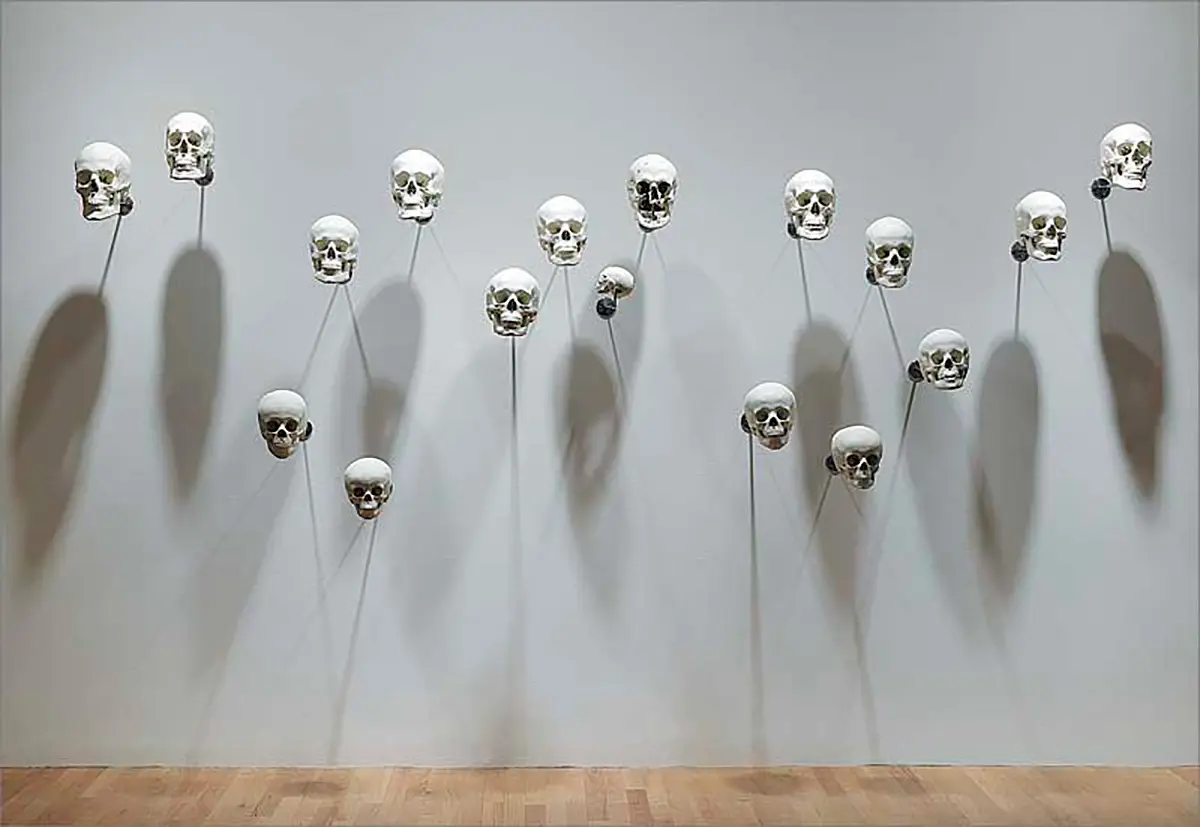
The installation Memoria I, 2007, a family portrait made using the skulls of three generations of the artist’s family reconstructed in scale on the basis of their tomographies, implies a kind of continuity and a at the same time closing of the family chronology kept by the father in the house’s wall. The exhumed skulls of his father of a sibling who died at birth enter, along with the other, still living ones, that ever-lasting domain created by art.
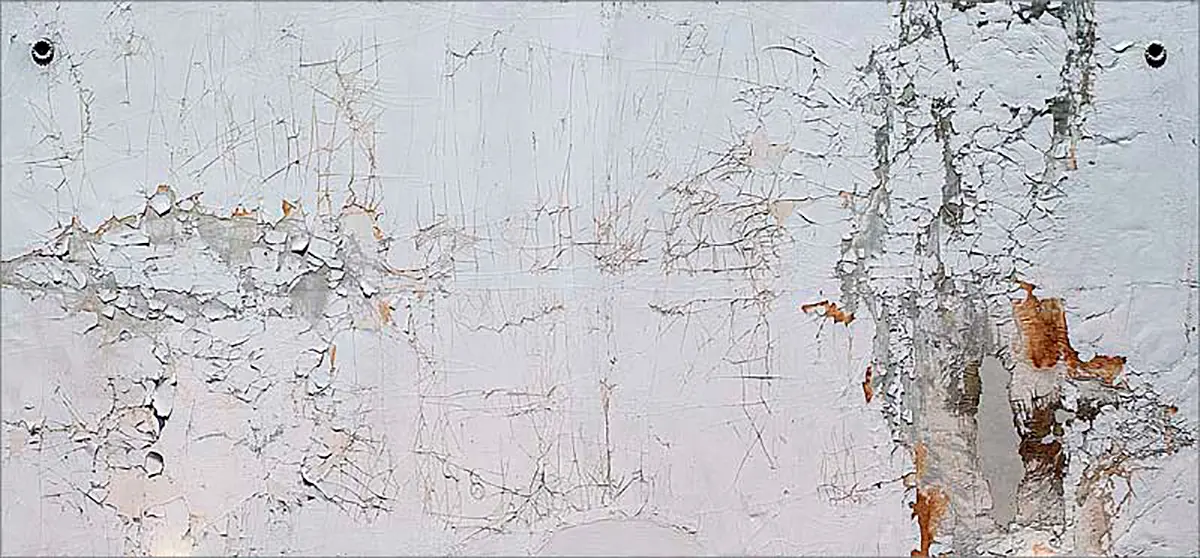
The series created by de la Mora in the last six years with panels from old homes or fragments of walls are an alternative way to “register the life of a place, its energy,” where there no longer exists any figurative evocation but a mode of contemplation of the passage of time and intervention that presupposes that implies the transmutation into the art of that which is “on the verge of dying for architecture.” Thus, the work Altamirano 20 I—a three-dimensional fabric panel “salvaged” as a painting—dislodged from the ceiling of an 1882 mansion. As a way of making a monument to “those 130 years of energy accumulation,” invisible to those who remain unfazed by the crumbling of an old building, de la Mora restores it. In this way, his language promotes a reflection about the artist as a creative being who, with his constructions and destructions, joins forces with the function of time and proposes an experience of a mode of totality in the very dissolution of forms and figures.
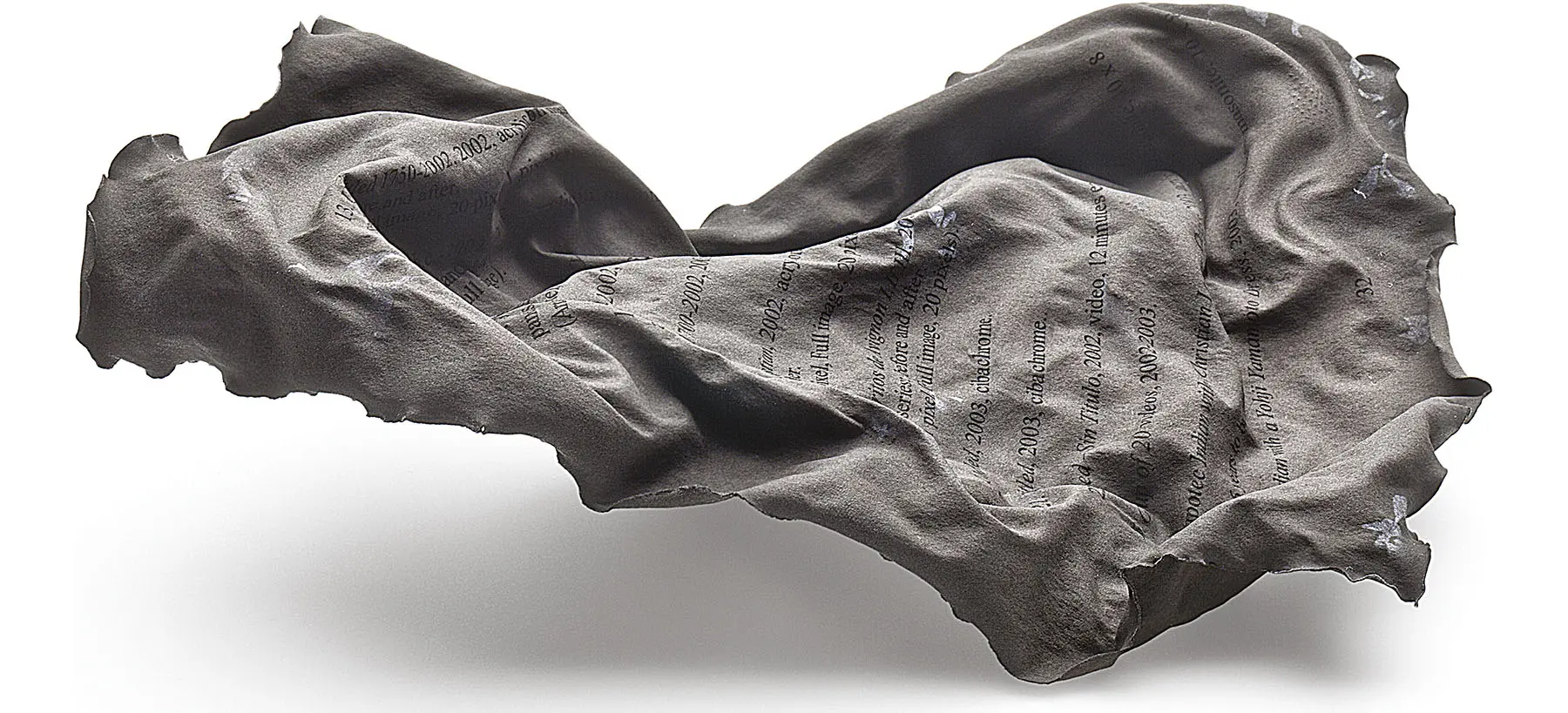
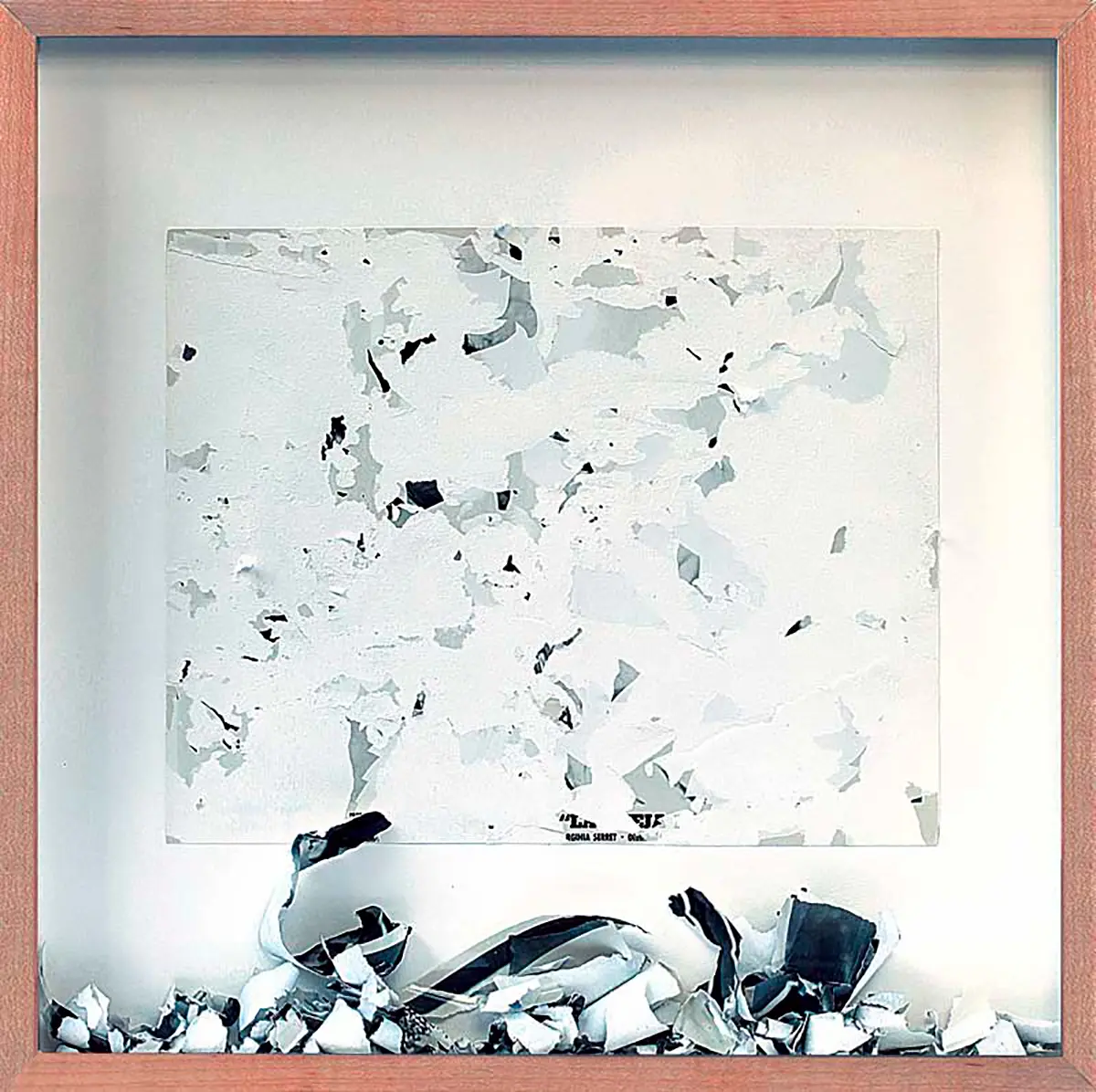
The artist began Brújula de cuestiones by combining the fictitious portrait of the mother as a white-clad bride with a photograph of the true mise-en-scene of the mother as a widow 42 years later; he will now explore aesthetics of the absolute, speculations on nothingness and wholeness, using objects found in the least haphazard way: officiating repetitive rituals, like someone carrying put ceremonies that bring the nature of the fragile closer to the eternal. In Papeles quemados, we observe a transition from white to black; there, transmuted by fire, a two-dimensional leaf becomes an abstract black sculpture in an operation that the artist also performs on the exhibition catalog or his graduation thesis.
This transition and flight from family chronology in search of the absolute broadens the possibilities of his materials and expands the frontier between painting, sculpture, and drawing. With his eyes closed, Gabriel de la Mora creates volumes in black plastic paintings for the blind, who will see them with their hands. The artist himself joins the effort to see the invisible and to materialize what cannot be grasped: an energy that is beyond time. Or, he collaborates with the god Chronos and erases pages from pornographic magazines, hastening the moment of that nothingness sung by the poet Netzahualcoyotl: “Like a painting, we will fade away.” In that sense, he can just as well present the readymade of a decaying daguerreotype. Indeed, de la Mora believes that only time will complete in some works what he has started to pick at and that when this happens there will no longer be any vestige to see.
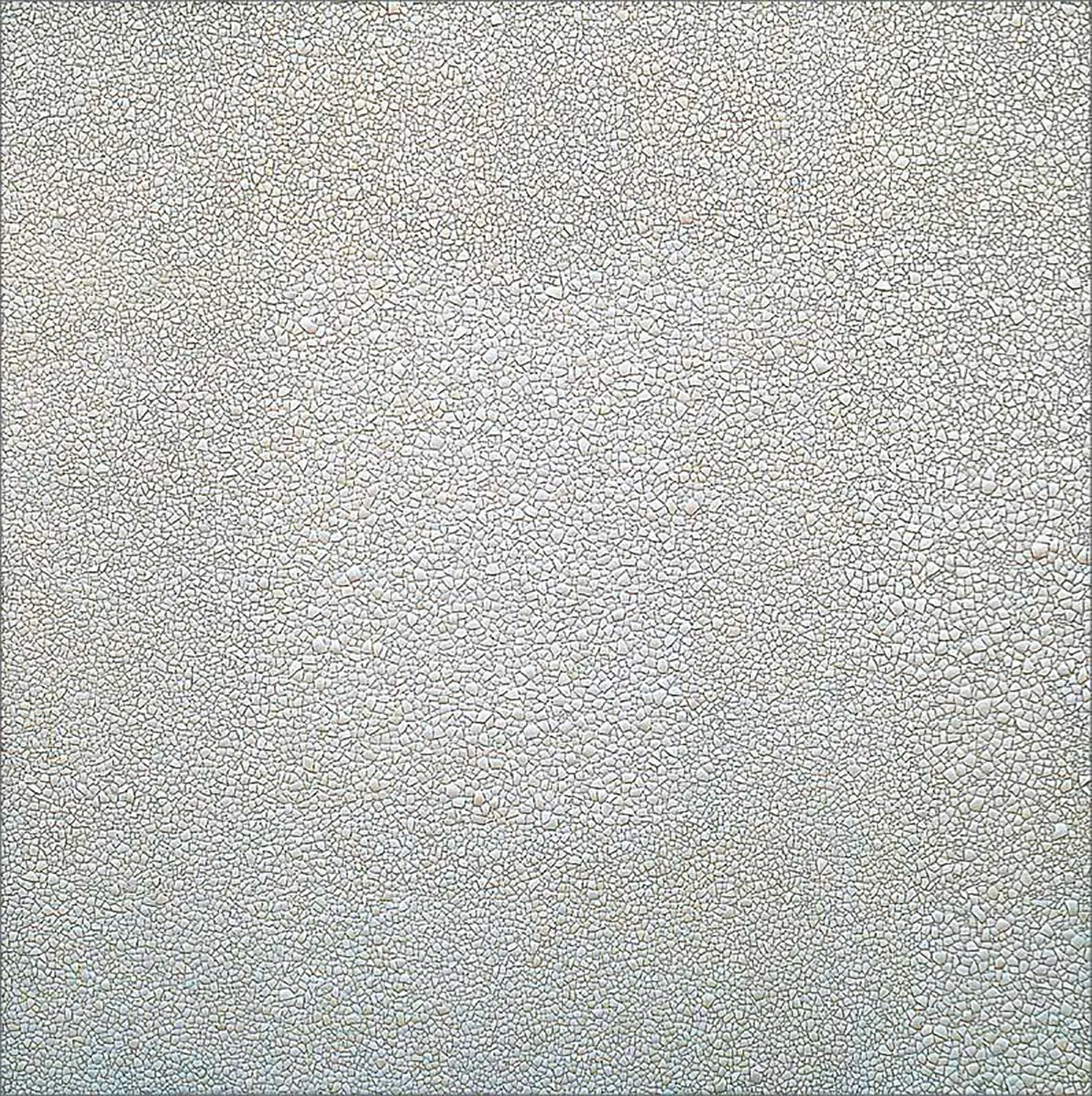
In the pristine appearance of his puzzle 48, created in 2010 with that number of pieces painted entirely in white, or in his acrylic Dominó in the same color, where there are no traces of numbers, we find an attempt to devour forms by erasing all accidents, everything that is contingent, in order to achieve a kind of quietude, an experience of silent contemplation. Other playfully conceptual operations that imply a passage to the three-dimensional or the bi-dimensional, such as the transformation of books on conceptual art into sheets of ground paper that, examined closely, may reveal some letters, bring to mind ancient meditation teachings about the illusion of events and the incessant buzzing of the mind, as well as the impassibility of the soul confronted the essence of what is. There is a brilliant playfulness in the series Originalmente falso, emerged from a hunt for fake pieces that began in 2010 as a research project, and was subjected by the artist to a peculiar process of transformation since 2011, as he did with a fake 1934 Dr. Atl that turned out to contain a different, anonymous painting under the imposture on its surface: he carefully scratches away the fake oil and, mixing the pigment thus extracted with linseed oil, he creates an original monochrome which he then presents as a diptych with the residues of the falsification. The delicate manual operation is a comment on the multiple fictions of the marketplace.
The gesture of transmuting unpronounceable memories, or elements like the hair of ten individuals, or the dust accumulated over many days in his study, into the shape of that geometric solid that is the cube—black or white—is equivalent to a philosophical position. The artist seems to be freeing himself from the dense complexity of existence through the action of his work. But at the same time, he uses art to “contaminate: the silence of inorganic things with the disquieting dynamism of life: in the translucent boxes of his series Mesas, de la Mora encloses and unfurls objects such as the small, crushed body of a hummingbird—the ancient symbol for the soul in Teotihuacan—painted in black; or a network of circles woven in human hair on the mesh of a mosquito net. In another series, he worked on Masonite with his own blood to the point of turning the surface into a substitute of human skin, marked by signs, creased by memories and words, even wounded.

Perhaps in such oscillations of form that erase the vestiges or put themselves forth as new ones on the basis of transmutation, blacks and whites, life and death, event and nothingness, what we find tied by a single invisible material that the artist attempts to appropriate and before which he kneels, is time, lord of the absolute. Not even the artist-minotaur, the architect-alchemist, can avoid being devoured by time: black and white paintings that become sculptures are part of the execution of rituals under the aegis of time. Every cipher of information—that vast counting of pieces, like the 28,443 fragments of eggshells in one of his works—refers in the last instance to units of time, a calculation of the passage of life measured by the artists by means of incessant repetition, achieving through it, paradoxically, a form of originality that situates his oeuvre in the space of the long-lasting. Even if the artist knows, like the Texcoco poet, that nothing remains here for long, since in the end “everything vanishes.” His study is a kind of laboratory where the existential time of organic things is transmuted into formal works of art, but also where invisible things such as emotional traces are materialized into objects. Perhaps his alchemy is to transfer into everything he touches a fleeting form of immortality so that at some point it allows us to see the absolute. Gabriel de la Mora has finished his initiation and knows how to transmute the unintelligible aspects of existence into a precise material where the invisible breaths.
* Images illustrating this article are courtesy of Sicardi Gallery, Galería OMR, and NC-arte.
ADRIANA HERRERA
Independent writer and curator based in Miami.