
The work of Germán Botero claims for itself the legacy of the minimalist art and land art traditions, where architectural and sculptural forms generate a direct dialog with the landscape, working in small scales (some of his works could very well be understood as models for monumental projects) and in much larger ones, such as the works the artist has installed under commission in places like Guilin and Changchun in China, Gaurdalavaca in Cuba, and Seoul in South Korea. But beyond this visual arts inheritance, Botero is able to open up a new horizon where a certain anachronism imprints the works with a fascination for archaeology.
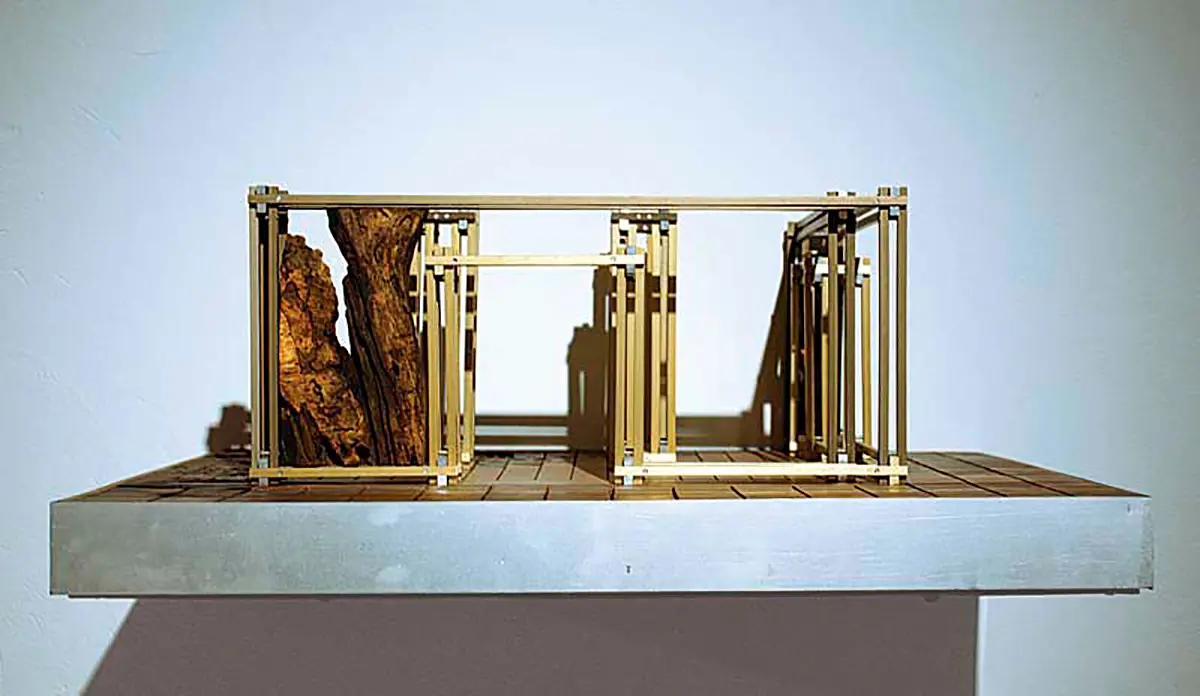
Confronting the works on exhibit at Rojo Galería, viewers encounter small sculptural worlds that remind us of the human drive to regulate and control nature. Perhaps the works where this idea is best materialized are Portal (2010) and El patio de los vientos (2010), both in aluminum and wood. Using pieces of wood gathered in the area where he has lived for a few years and already sculpted by nature, mainly by the waves of the Caribbean Sea, creates sculptures of a well-regulated and controlled geometry. Carefully cut and stacked cubes of this material form a board supporting aluminum structures that, in turn, become containers for small pieces of wood, some subtly intervened without veiling the carvings created by water and time. In the first sculpture, Botero directs our gaze to those metallic architectures captaining precious vestiges of wood. In the second sculpture, the board is divided into two: one section finely sanded, another section where color and bored-through wood smoothly dialog about the natural and the artificial, the intervention of nature, and the intervention of the human hand.
Some works are sure not to pass unnoticed by viewers, such as the one titled Tumba Indígena (2009), created using recycled wood. Displayed vertically on the wall, this work lets us see a striated floor with two hollows. This “tomb,” carefully framed by wood cubes that harmonize like the surface of two sculptures mentioned before, generates a certain tension that reminds us of the at times difficult dialog between past and present.
Also made in wood, Terrazas Tayronas (2009) is another work that will be noticed by the public: a series of carefully harmonized cuts form a topography similar to that found around the Santa Marta's Sierra Nevada inhabited by the Koguis, an ancient people who are the guardians of a sacred region where nature and humankind coexist in mutual respect, which has gradually been transformed into a tourist attraction. This work reminds us of human efforts to tame topography, transforming it into the remains of a people that will little by little become a thing of the past.
But one work in particular in this exhibition by Germán Botero was truly fascinating, and all those who had a chance to see it will undoubtedly agree with my appreciation: Coro (2012) is a real masterpiece. This work uses palm tree seeds and is a forceful metaphor for death. Nothing more striking and precise than to make a bunch of seeds, in principle a synonym for life, into metaphors for death: subtly intervened, these seeds become veritable human skulls. A unique chorus where the hollows and mouths of the seeds-skulls, set information one after the other, sing a melody that cannot be dissociated from the contemporary moment: the environmental and social impact of the oil palms that have transformed the landscape and their cultural dynamics, for instance in the Middle Magdalena region in Colombia. Where before was a population, today there are large expanses seeded with oil palm trees. A strange chorus of skulls in strict formation sing a silent melody that punctures our eardrums; there is nothing more deafening than silence.
This exhibition by Germán Botero presents us with formally convincing works where time, landscape, and materials such as wood and aluminum create a harmonious dialog that insists on actualizing the past in the way archaeologists do. These works go beyond a purely visual aesthetic enjoyment where our gaze wanders, as a child immerses in impossible architectures, into reveries and daydreams. The experience is augmented by our olfactory perception of the aroma emanating from the wood in which the works are made.
RICARDO ARCOS PALMA