
The School Gallery, located at the end of a picturesque patio in the Marais neighborhood, exhibited some recent works by Marie Orensanz (Mar del Plata, 1936). In an area particularly surrounded by prestigious exhibition venues, such as Centre Georges Pompidou, Musée National Picasso Paris, and Musée d’art et d’histoire du Judaïsme, along with several galleries like Yvon Lambert, Xippas, KarstenGreve, Marian Goodman, and Chantal Crousel, this young and very dynamic gallery—which also exhibits Julio Villani, a Brazilian artist who lives in Paris—presents a series of rather “intimist” works where the timeless quality of a confirmed artist prevails. The group of works exhibited includes drawings, collages, photographs, white marble sculptures, and metal sculptures. The exhibition is almost entirely dominated by the use of an omnipresent white. It is a challenge to an art world saturated with images—often violent—and color—often loud.
The universe of Marie Orensanz is all refinement and subtlety because the whites and blacks she has been using for some years now allow her to experiment and play with reflections and contrasts—in this case with shadows and with lights when she uses black—that solely a gaze that takes the time to observe can truly appreciate. Orensanz proposes a central theme: time. It is a notion that not only permeates her work but one that today means “knowing how to see.” It is a skill acquired with patience to allow the gaze to discern; knowledge that often is lost in the omnipotence of a temporality dominated by speed and zapping. Marie Orensanz elaborated a conceptual and constructive work by associating the rigor of a reflection on space to several materials (paper, cardboard, objects) and by introducing writing and symbols—transformed into an intimate graphism—as essential icons from her aesthetic and meaningful discourse. The intellectual and formal tenacity and coherence of her artistic project, the “path” that follows, working in search of new materials or new solutions for her conceptual, spatial and aesthetic mechanisms and strategies, constitute the main center of a proposal that questions itself and the world, without trying to conquer territories undermined by the globalized artistic mediatization. Marie Orensanz’s art is an art of reflection, domain, and gesture, both of the intimate and the public, art of dialogue and of sharing, of fidelity toward oneself and desire.
With titles like Dé-flagration (drawing and collage on paper, 79x59.5 cm, 2011) and In-volution (triptych, 99x204 cm, 2011) the large drawings and collages at the entrance are testimonials of the new visual resource chosen by the artist: the exhibition of glued cutout forms that sporadically rise from their support in a sort of a controlled whirlwind. The edge of the paper or the tracing paper is carefully folded and the shadow obtained to create the essential relief. A delicate black graphism in ink outlines the space and underscores the deconstruction, as it offers the gaze a more organic and sensual corporeity and skin than its pure geometric forms. The induced floating state cause by the levitation of the paper opens a new, fresher, space and the movement generated by the contrasts between light and shadows create a stable-unstable relationship where, nonetheless, order prevails over disorder. “Exploded marble,” or marble cut in a rustic manner, inspired Orensanz’s new spaces. For her this explosion is a way of going beyond the framework, metaphorically speaking, without having to get rid of the axle. Everything eventually finds order or gets dispersed through this narrative center. To enjoy the freedom of expression is, according to the artist, to “overcome or surpass oneself in order not to be dominated.”
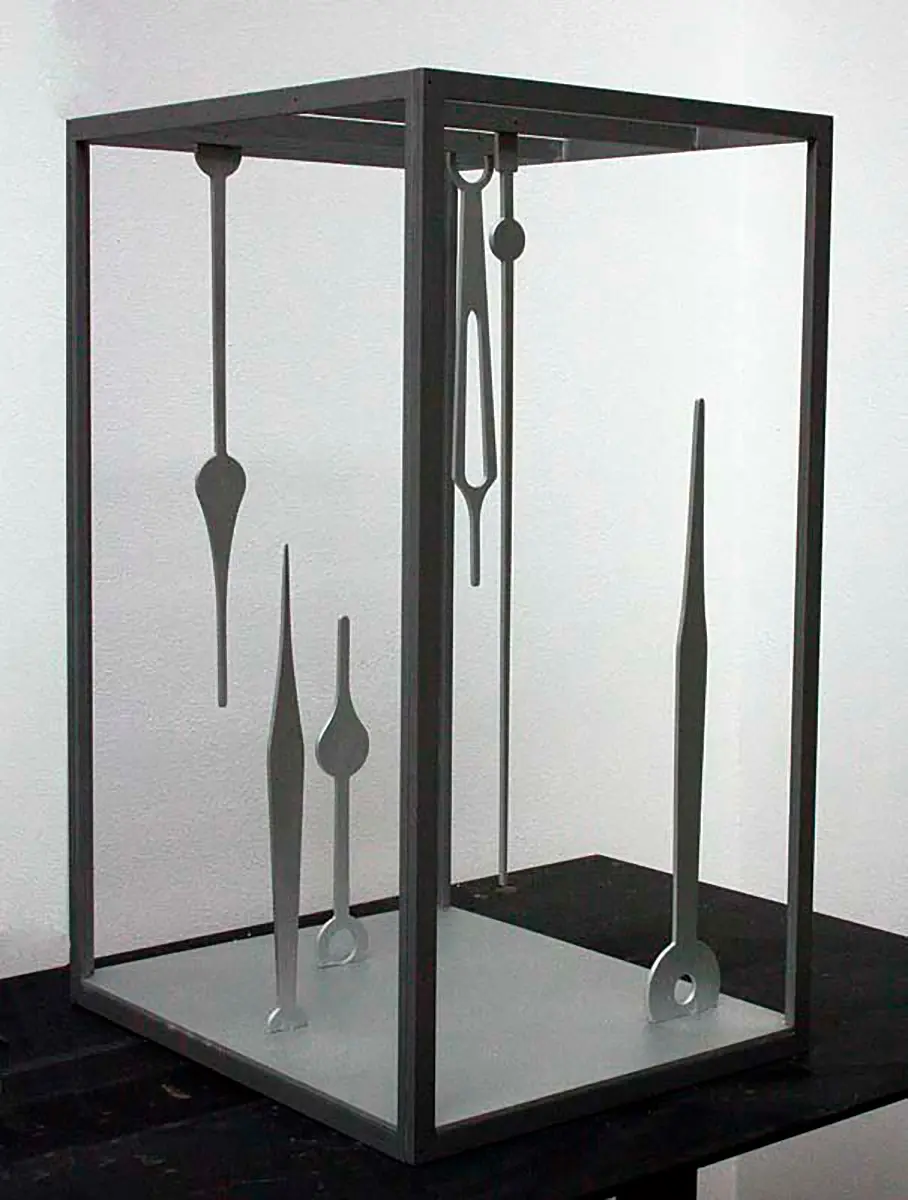
The folding, already present in her six oldest marble sculpture-totems (80-90), once again reappears in her drawings and confirms that the coherence of work in which thought, form, and three-dimensionality are inseparable. A recent sculpture (monumental draft) titled Au-delà du temps (Beyond Time, watch hands, aluminum, 40 x 30 cm, 2012) must be observed and understood with its shadow projected onto the wall, to reveal our own fragility through time, so we can become aware of the passing of time, of the brevity of our presence in this planet and, therefore, of the ephemeral dimension of all things. The eleven photograph panels titled Sanstitre (Untitled, 40x104 cm c/u, 2012) are formed with details from her drawings, works that the artist regarded as fragments from all fragments, and one which requires a concentrated reading.
The work by Marie Orensanz is not gratuitous. Without being openly political it is nonetheless influenced by a preoccupation the artist has been driving her work since the beginning of her career: to create a connection, to establish a dialog with viewers; mediations without which her work loses all meaning.
CHRISTINE FRÈROT