
Since her beginnings as an artist, Matilde Pérez (1917) has been a special case in the Chilean art scene: in the late 1950s, she was part of the Rectángulo group (later called Forma y Espacio), at the vanguard of geometric abstraction in the country. However, she soon distanced herself from it, seeking to move beyond the traditional painting’s frame. In the 1960s she moved to Paris, where she attended Victor Vasarely’s workshop. After her return to Chile, Pérez intensified her investigations in kinetic art and became a local pioneer of that movement, working on new materialities and formats, collages, sculptures in acrylic and metal, murals, and works in the public space, as well as mobile and light objects and experimenting with the use of electricity, all in a context that resisted innovation.
A teacher as well as an artist, her contributions did not achieve the recognition they deserved until 1999 when the Museo Nacional de Bellas Artes devoted to her work a large exhibition titled Ojo móvil.
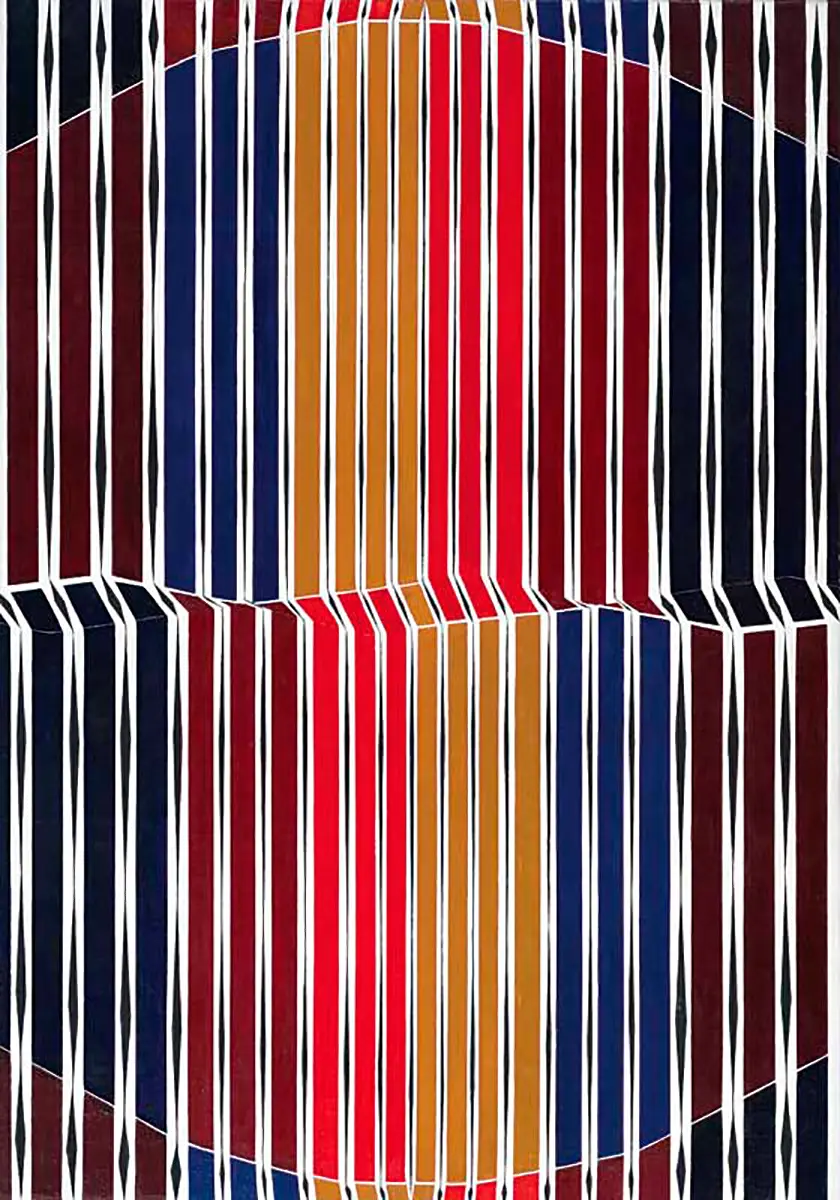
In the decade of 2000, Matilde Pérez’s presence reached a larger stage beyond Chile’s borders. In 2006 she was included in the Chilean delegation to the Mercosur Biennial (Porto Alegre, Brazil), and in 2007 she took part in Lo(s) Cinético(s), a landmark exhibition at the Museo Reina Sofía in Madrid. In 2011, meanwhile, her work traveled to several spaces in Europe for solo shows. In Chile, her work has been presented in several galleries, echoing a sort of boom of kinetic art seen especially in the international market, with the revalorization of other Latin American contributions like Julio LeParc, Carlos Cruz Díez, and Jesús Rafael Soto.
Matilde x Matilde: espacio móvil, an exhibition at the Telefónica Foundation Gallery, catches the artist after a tribute received at the Pinta Art Show in London. Curated by Ramón Castilo after two years of research, it is the largest approach of an exhibition for this artist who, at the age of 95, continues to investigate and takes advantage of any opportunity to travel inside Chile or abroad every time her work is exhibited. Quite a character is Matilde Pérez, with a body of work that is universally appreciated.
This selection of collages, paintings, kinetic objects, documentary videos, archival material, and the reconstruction at the scale of her emblematic Túnel cinético (1970, Chilean-American Institute), reveals Matilde Pérez’s obsessions, strategies, and work processes. Her sketches in graph paper unveil signs representing shapes and colors, a kind of ciphered map or secret code.
One section revisits Pérez’s production prior to geometry when she was still linked to the Universidad de Chile’s Fine Arts School, where she studied, and to figurative painting. One key work here is Las sillas, from 1953, which shows her motion towards the simplification of forms; in it, the motif is repeated, decontextualized, in a visual play that highlights rhythm.
With her insistent work on optical illusion and motion, abstraction, color, light, and shadow, Matilde Pérez generates sensations of transit. It is important to include the viewer in these conceptual journeys that reformulate our experience of the work as time and space.
Some images are repeated time after time. Like a circle inscribed inside a square or a diamond shape, shapes inside segmented shapes that fuse in virtual movement and are reconstructed by means of collages, engravings, and paintings, using wood and punch-cut cardboard, acrylic on acrylic, plastic, or mirrors, or in kinetic objects in a varied chromatic range. Without losing our sense of wonder at her capacity for analysis, the rigor of her studies, and the minute way in which Pérez structures her elements in pursuit of her objectives, at times a question emerges about how much of a formula is there in these exercises that—we believe—should be more than synthesis and motion, more than the tension between craft and technology, or the relationship between architecture and design.
We hear the resonant echo of a magazine headline from the 1960s, displayed on a case at the show’s entrance, which wondered, in the context of the emergence of the new abstract-geometric tendency: “Op, Pop, Art?, Bluff?”
There is a possible key for answering in the experience of the tunnel. The exhaustive analysis displayed in the structuring of shapes, colors, and materials, produces at times a certain lysergic effect that shifts our perception from the visible realm to a new dimension. The image of the square within a circle within a diamond, combined into molecules aligned like a minimalist mandala, suddenly brings to mind surrealist artist Roberto Matta’s idea of the open cube, a total work of art with different modules that would include every morphological psychology and introduce the viewer to a multi-dimensional universe.
CAROLINA LARA B.