
Os Gêmeos at the Institute of Contemporary Art in Boston was Brazilian identical twins Otávio and Gustavo Pandolofo’s first solo show in the United States (“gemêos” means “twins” in Portuguese). The twins began their practice in 1987 with street art, graffiti, and public murals in their native São Paulo. Along with the exhibition, the artists created two large murals in Boston, one in Dewey Square, at the Rose F. Kennedy Greenway, and another in the Revere Hotel, in the Boston Common.
The exhibition at the ICA, curated by adjunct curator Pedro Alonzo, included thirteen works and highlighted the artists’ injection of influences from New York graffiti and hip-hop into Brazilian culture and life, through large-scale, colorful canvases and wood panels. The works featured cartoonish yellow figures that are characteristic of Os Gêmeos, clad in brightly colored suits and presented in scenes that moved from the New York City subway to some Brazilian fields. Alonzo decided to include works that directly connected with New York’s urban scene, such as Back in the Days (2008), with characters influenced by hip-hop inside a graffiti-covered subway car, and Untitled (2008), where a group of characters populates the subway tracks in the city’s vast underground network. Alonzo noted that when the twins began their career in 1987, New York’s graffiti and hip-hop culture had already seeped through Brazilian youth culture through music, movies, and photographs. This influence, and the rebellious freedom of street art, drove the artists to start working with sprays and homemade paints in the creation of their São Paulo murals.
Two works, in particular, Dentro do arco-iris, e assim (2010) and The Last Station of Spring (2010), presented a new turn on Rauschenberg “combined” painting through their integration into oil and spray paintings, linear drawing, and found objects such as wood, mirrors, bottles, and even crushed cans of Arizona Tea. The Last Station of Spring represents in its left section a tree finely carved in triplex, a window—with real blinds—framing a surrealistic blue sky, and a floating figure. To the right, a larger figure sticks one hand on an adjacent panel to extract spray-painted flowers, while one of its shoes dangles from its other hand over tiny, colorful buildings. The twins’ surrealistic, imaginative tendencies are made more impressive when, through a somewhat static and overlong narrative that viewers could access using their cell phones, one learned that this work had been completed in four frantic days.
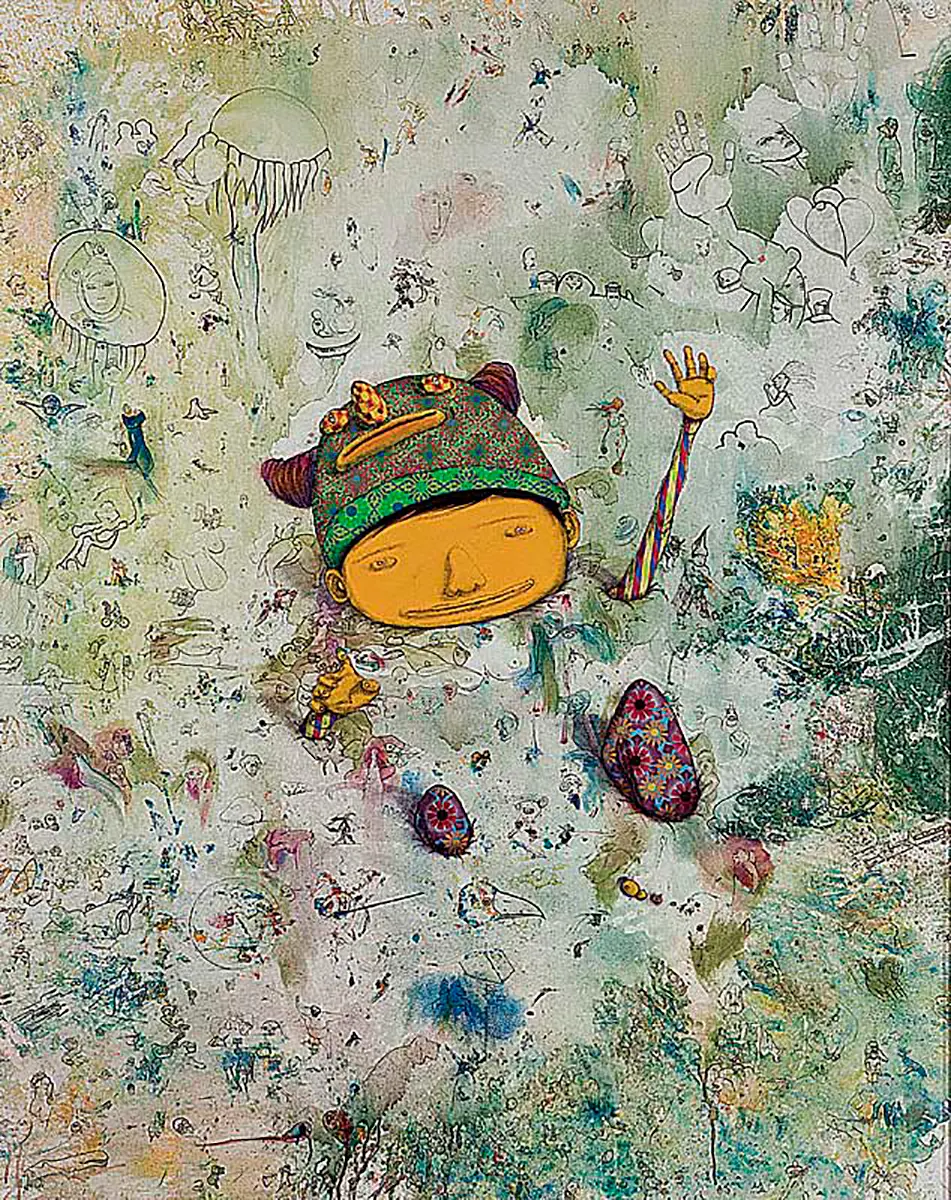
In another notable work, Untitled (2012), the twins used mixed media on canvas. At the center of this work is a yellow-colored cartoon character whose colorful outfit was made with stencils and spray paint. The central figure was literally immersed in the canvas, while vaguely drawn figures around it emerged from what at first glance seemed to paint spills and stains, to create a clod-like playground for their strange and imaginative tales.
Os Musicos, from 2008, occupied a large portion of the second gallery and expressed the twins’ habit of including audio samples and music in their work. In this case, it was a keyboard encased on a resplendent wooden structure, intended to generate an audio sequence through thirty rectangular speakers, all painted like faces producing sound from their mouths. Unfortunately, viewers could not touch the keyboard; the performance could be heard on the third Saturday of each month. Even those who missed it could imagine, after seeing the colorful, weird figures on exhibit, the powerful cacophony of sounds, voices, and rhythms that this work wanted to provoke.
The twin’s 70 x 70 feet mural at the Rose F. Kennedy Greenway, funded by the Massachusetts Department of Transportation, the Boston Art Commission, and the City of Boston, generated heated debate due to the fact that the large leaning figure, which filled the entire space of the Dewey Square Air Intake Structure, was interpreted as an Islamic terrorist. Its large face was hidden behind a red shawl so that only the nose bridge and the semi-torn eyes were visible. One thing consistently left out in the debate around the mural was the twins’ explicit reference to Brazilian culture through the figure’s lively outfit and the richly saturated colors. With their folkloric and imaginative drive, Os Gêmeos made explicit and repeated allusions to Brazil, but this aspect of their work was something that US audiences perhaps didn’t immediately recognize. This tells us that the exhibition is already establishing a legacy: to introduce the contemporary US art world to the richness and diversity of Brazilian popular culture, especially significant since the 2016 Olympic Games will be held in Rio.
VIRGINIA ALLISON HARBIN