
Radamés “Juni” Figueroa (Bayamón, Puerto Rico, 1982; a representative of the urban-eclectic gaze/proposal whose first impact was felt at the turn of the Twenty-First Century, and which also encompasses such local artists as Sofía Maldonado, ISMO, Omar Velásquez, Rito Cordero, to mention but a few) is an innately urban artist who has always been involved in the cultural activities of Puerto Rico’s poor/marginalized communities and with them developed a series of “street” characters of great depth, impressive reflections of the world we live in today.
Early in his career "Juni" Figueroa impressed the local cultural scene with multi-sensorial artistic actions in different public housing complexes (Puerto Rico’s Residenciales) and poverty-stricken areas, which combined painting with wall projections, music (he is also a musician and a good one!), dance, socio-political messages, etc., to awaken in the locals—children, youths, adults, older residents—both a sense of creativity/fun and the freedom to express themselves at all levels. Later, he mesmerized art critics and collectors with his powerful—and at times controversial—style of new figuration, which eventually resulted in several local awards and invitations to exhibit his works in fairs of such caliber as ARCO and Art Basel Miami Beach.
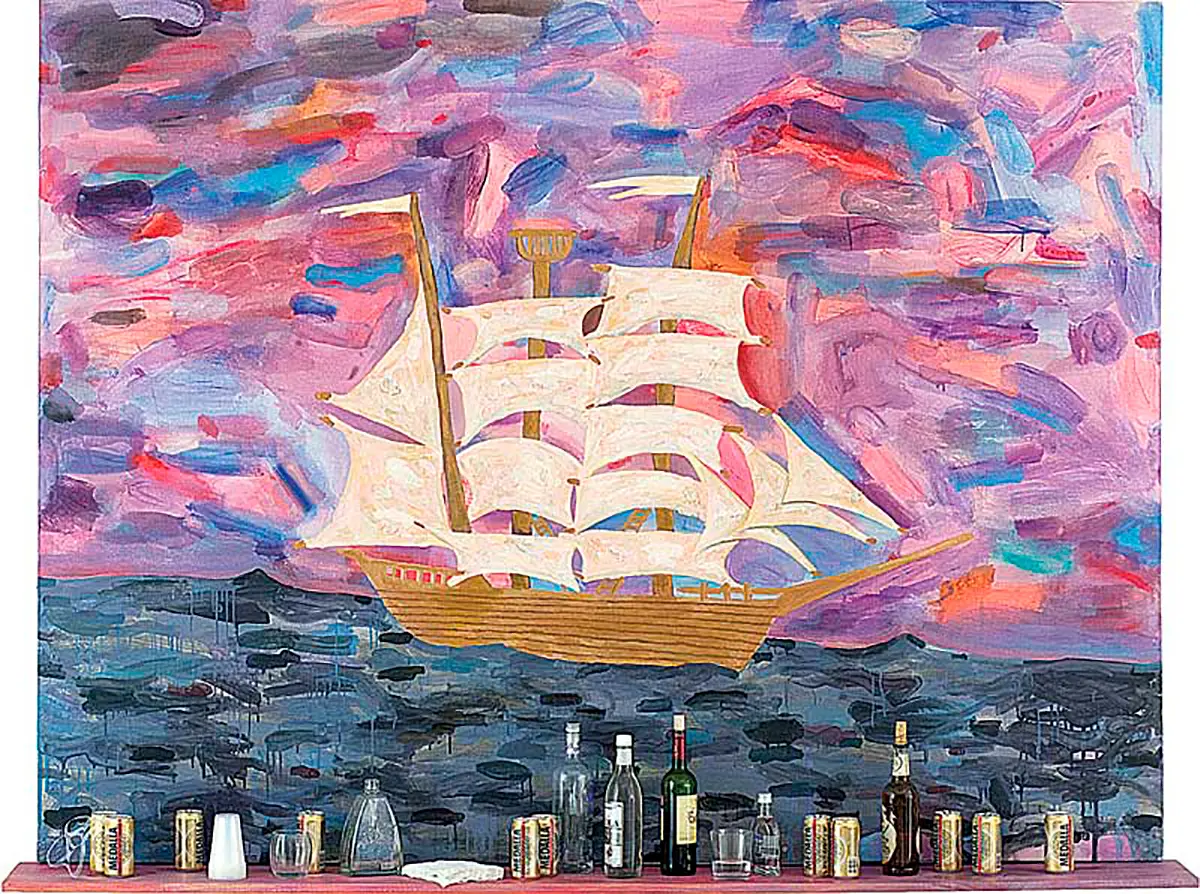
In his recent show at Roberto Paradise Gallery, titled Get Out if You Can, Juni Figueroa presents an interesting look at the new modalities of piracy that define our times. The work was initially based on the story of a cruise ship captain who, drunk and amoral (a symbol of the new piracy, according to the artist), caused with his crass negligence a disaster that we all “lived” in our globalized world, and produced the almost-sinking of his ship and the death of many of his passengers. The captain’s egotistical and cowardly performance was censored by the whole of society. Get Out if You Can is based on this new pirate. A cry of “every man for himself” that demonstrates, to an extreme degree, what happens with other modern pirates like those Wall Street bankers or those irresponsible and lazy teachers.
The artist’s concern with socio-economic injustices and class inequities are not new. And we all know that piracy has always existed, in ancient Egypt and Mesopotamia, in the seas of Asia, after the Discovery of the Americas, and now with narco-pirates, all of whom want to acquire riches by brutal and sanguinary means in order to someday achieve social recognition, and even titles of nobility (Sir Francis Drake).
What took place in the Mediterranean is far away from the Caribbean, and “Pirats of the Caribbean” has little to do with us. What "Juni" Figueroa critiques is those who possess power and are thieves; they are captains not of the ship but of finance, multinational corporations, churches, legislatures, presidential palaces. Figueroa critiques the fact that a good segment of our reality has been reduced to thievery, lying, fraud, plundering, trickery; the fact that our nations live under siege by these new white-collar, impeccably educated pirates.
Although the exhibition must be considered as a whole, a single installation, Figueroa’s paintings stand out in Get Out if You Can, for instance Sal si puedes, a Seventeenth-Century pirate ship across which we find a bar with rum, vodka, beer, etc. This brightly colored work reflects the influence of De Kooning, Basquiat, the entire New Figuration, and one of Juni’s most important teachers: José Lerma. Also, we see here "Juni" Figueroa’s complete mastery of abstraction and the freedom of movement that even allows him to experiment with pointillism. Another important work is El capitán cretino. Here—as in Capitán Concha— we find a primitivist/Bad Painting style that immediately grabs our attention. But the focus is the pirate captain’s stupidity and his power to inflict damage. Finally, we have Capitán güirero, a captain playing the guiro, a Latin American instrument that, with the clave, keeps time in our post-colonial music.
Juni Figueroa’s characters can always be seen as part of an urban bestiary, inside or outside our reality, who provoke both laughter and compassion and move us towards social, political, and existential reflection. At times, they are grotesque; at times, adorable.
MANUEL ÁLVAREZ LEZAMA