
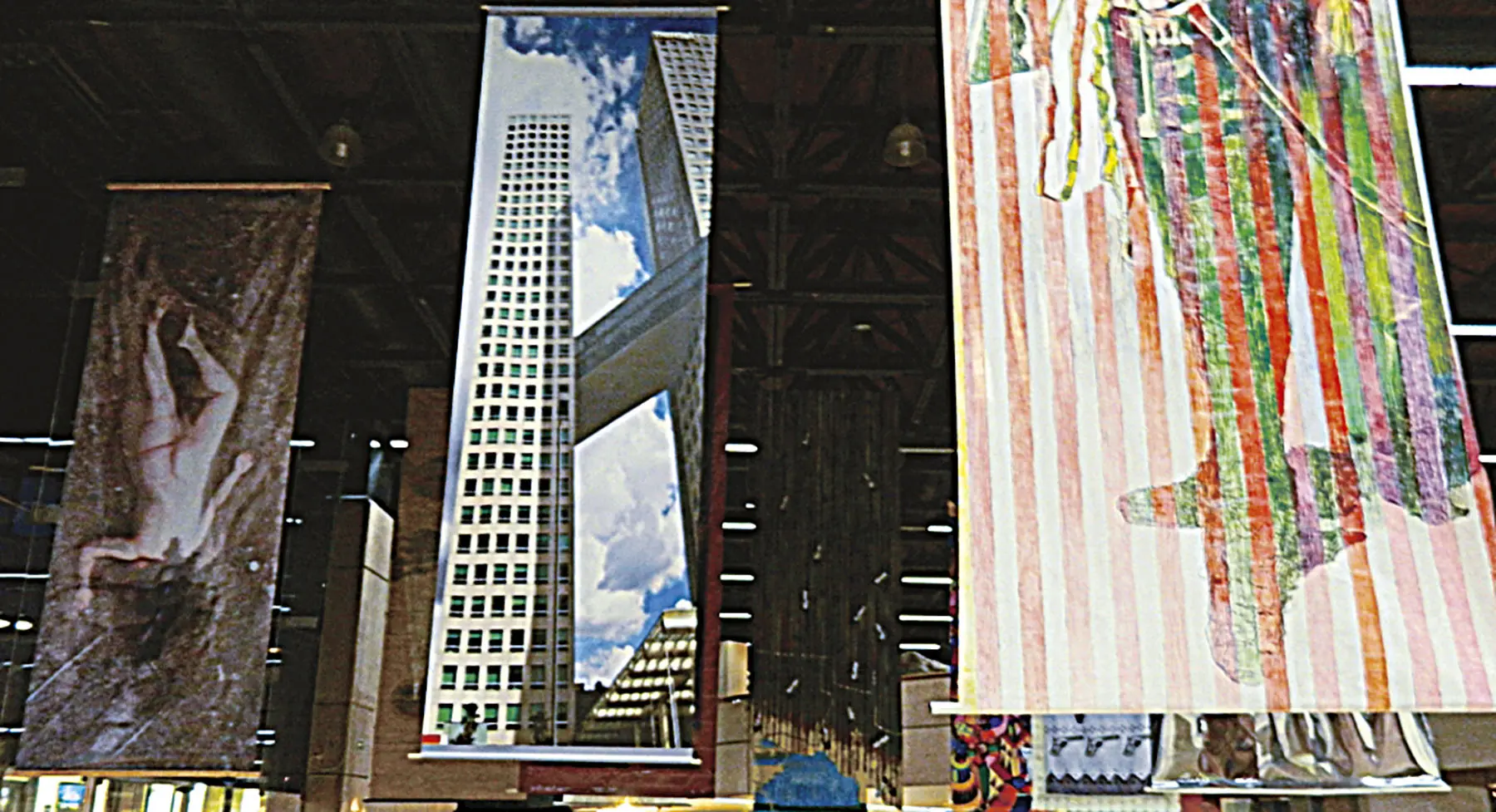
With almost twenty years of existence, the International Biennial of Standards reached in ES2012, its 7th edition, a level of maturity that both consolidates its long trajectory and certifies its validity as a space for the debate and revision of visual proposals by contemporary creators.
For the first time, all the award recipients from previous editions were on exhibit. The presence of works by Helen Escobedo (Mexico), Eduardo Tokeshi (Peru), John Valdez (USA), José Morales (Puerto Rico), Daniel Joseph Martínez (USA), Delcy Morelos (Colombia), Ricardo Lanzarini (Uruguay), Aldo Guerra (Tijuana, Mexico), Paulo Climachauska (Brazil), and Ana Quiroz (Mexico), produced one of this edition’s strongest symbolic spaces.
Placed in a circle in the ample lobby of the Centro Cultural Tijuana (CECUT), these outsized artworks, the protagonists of previous editions and clear favorites in the media’s coverage of the event, were all now face to face, as if looking at each other forming a kind of memorial for this International Biennial of Standards.
The unusual gathering of these works made evident not only the various expressive methods of the participants in each edition, but also the profiles of the juries that, often transferring their own intimate obsessions, made clear what seen from a distance of years is a kind of visual record of preferences, philias, fashions, strategies, and discourse that now are medullar to the history of this Biennial.
The 7th Biennial, which, like all its predecessors had Marta Palau as its curator in chief, generated a distinct dissociation between its 22 participants. Among the artists selected for the event named as important as Felipe Ehrenberg, Arnaldo Coen, Marta María Pérez Bravo, María José de la Macorra, Carolina Paniagua, as well as the eventual winner, Flavio Garciandía.
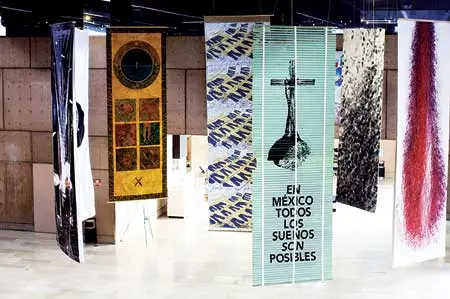
It was, at any rate, a compact group of artists who are highly representative of the history of contemporary art in Latin America, who, regardless of their potent and propositive trajectories, sent in works whose divorce from the spatial and formal considerations require for this particular event caused their entries to be seen only in perspective, revealing a conceptual and perceptual distance from the spirit of the standard.
Except for the winning entry, the works by the artists mentioned below made clear that, despite their impeccable aesthetic craft, which has made them influential in the visual-arts field, they are patently removed from current expressive strategies, which resulted, in this version, in a kind of aesthetic dissonance.
With his Declaraciones (or Advertencia: Estas Declaraciones No Constituyen una Obra de Arte), Flavio Graciandía convinced the jury—comprised of Bélgica Rodríguez, from Venezuela; Rachel Weiss, from the US; and the author of this note, from Mexico—that his proposal was undoubtedly a conceptual compilation of contemporary ideas in connection with artistic life and its norms.
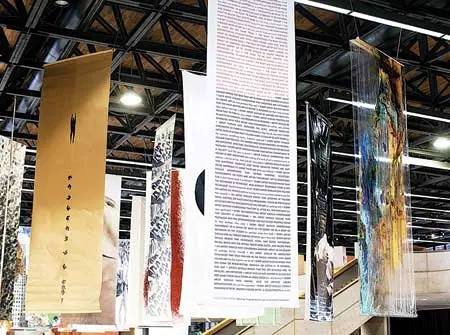
Full of humor and irony, this standard, created as an impeccable typographic design in red and black, includes statements such as “The right of all artists to abandon any style, even their own, and return to their style”; “The right to like Botero (or whoever it is one likes)”; an artist must nor depend on the consumption of toxic and/or addictive substances in order to produce (or yes, why not)”; and the now-classic ‘Every artist must know that technique is a technique, and that without technique, there is no technique (Teófilo Stevenson Dixit)”. Tens of such declarations, one after the other and separated only by punctuation, are found in Spanish on one side and in English on the other.
Staking clearly different ground than the first-prize winner, the work of Carlos Tapia, in a merely costumbrista vein anchored more in the domain of the artisanal, didn't obtain a unanimous vote, although it did get a majority; its second prize polarized the selection of award recipients in the extreme. Cats atop small cars, church cupolas emitting light rays, a small-town landscape, and colors common to traditional Costa Rican textiles help situate this standard more in the terrain of the decorative than in the field of a revision of the topics that for years have characterized the Biennial of Standards.
The only mention awarded by the jury went to Teresa Villarreal, whose Vecinos cercanos was an important piece of commentary on the inequalities inside urban concentrations, highlighting the formal differences of contemporary agglomerations. On one side of her standard, we find a very contemporary building, a clear architectural proposal. It is one of the new behemoths erected in recent years in the Santa Fe area of Mexico City, which coexist with heterogeneous and disjointed popular settlements dating from decades ago.
Originally classified as “irregular settlements”, these homes began their lives in what was then the city’s periphery. Built by the hands of their inhabitants, these housing groups display an aesthetic one often finds in many Latin American cities. The problem of overcrowding due not only to population growth but also to internal migration is one of the key issues for contemporary urban planning.
Camila Cárdenas’ work reflects these key issues. She explores the adventures of “The Beast”, a train that begins its journey in Mexico’s southern border and carries emigrants seeking to enter the US, who along the way suffer theft, abuse, kidnappings, and receive scarce help, mostly from humanitarian or civil associations, as in the case of the “Patronas”, who gather when needed as the train crosses their communities to distribute water and food to passengers literally handing from the wagons on their way to their American Dream.
Las Fauces de la Bestia is the title of Cardenas’ work, notable in its economy of means. Inscribed on one of its sides is the sentence “Free transit for Central Americans”, and on the other, the names of the main cities the train—about which there are already films and documentaries—touches along its route.
Like any event of this kind, this 7th Biennial of Standards was not free from moments of alarm. One of those invited by the chief curator was Ángel Valrá. A Tijuana-based painter, known locally for his rebellious and turbulent personality, Valrá sent a piece that did not fulfill the curator’s expectations, although it did conform to the general requirements for entry. It was a Mexican flag, made to the event’s specifications for standards (500 x 180 cm), featuring each and every one of the orthodox elements of the national emblem, including the national seal and the colors.
There was a risk of incurring a violation of Mexico’s existing laws for the use of national symbols, and the jury, while not finding any artistic reason to exhibit and evaluate Valrá’s submission, decided to heed curator Marta Palau’s request and retire it from the Biennial Evidently, and as was to be expected, Valrá was not happy. On the day of the award ceremony, Valrá—discreetly—supervised the distribution of flyers that positioned and vindicated him.
Along with the artists mentioned, this edition featured works by Lola Bolarín Marín (Spain/Mexico), Adal Maldonado (Puerto Rico), and Jonidel Mendoza (Venezuela). From Tijuana, Ulises Figueroa, Carolina Castañeda, Arturo Varela Acuña, Abel Salazar, and the Colectivores group (Ricardo Silva, Alejandro Jara, and Pablo Vega). From Mexicali, Gabriela Buenrostro, Francisco Coronado, Eder Lindorfe, Cristina Luna Ávila, and Marco Miranda.
The Biennial of Standards, seemingly reinforced and proofed against the political and budgetary troubles it must surely have confronted, is one of the reference points in the Mexican north, specifically in the border area with the United States, where two bustling cities with a great cultural presence like Tijuana and San Diego coexist against all encumbering procedures and reveal that migratory flows go beyond the mere physical crossing of inspection stations.
The key to the event’s future and the possibility of its survival reside not as much in budgetary concerns as in the strategic design of insertions into the current circuits for the circulation of cultural goods, which will receive, undoubtedly with pleasure, anything that comes with the support not only of the solid history of the Biennial of Standards but also its adoption of the most up-to-date expressive forms.
The topics for discussion gain greater currency today inasmuch as Mexico and the United States establish complex agendas around migration, commercial, tariff, weapons circulation, and drug trafficking issues. Collateral to this, transnational companies impact regional microeconomies, which are beginning to timidly raise their voices in concern regarding transgenic seeds and adverse labor conditions, or simply turn their gaze towards local histories.
All this is in the foundational spirit of the Biennial of Standards as conceived by Marta Palau. Just as it is possible to make a reading of its history based on the award winners, now in the exhibit, it is imperative in this regard not to obviate the motivations that are the Biennial’s origin and for it to remain, adapted to contemporary modes of expression and using current languages, a bastion for communities of visual creators who have demonstrated, throughout the Biennial’s more than twenty years, how much remains to say, reveal, evidence, denounce.
SANTIAGO ESPINOSA DE LOS MONTEROS