
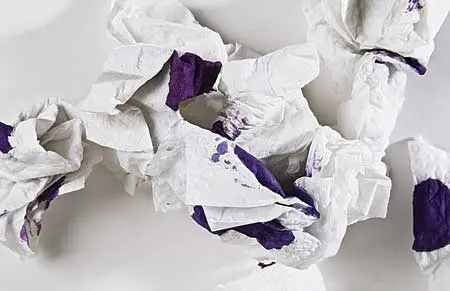
Multifaceted artist Alberto Asprino (Maracaibo, Venezuela, 1952) presented at the space of Fundación D.O.P. a photographic installation created from images taken more than 10 years ago of discarded tissue used by citizens after voting. Consisting of more than 120 photographs and one video, the installation entitled Antropometrías Indelebles (Indelible Anthropometries) aims at portraying these random marks left by the indelible indigo blue ink that remains as a sign that one has exercised the right to vote after cleaning the little finger.
An initial reading of the series of patches refers to painting. Many of the photographs portray irregular traces similar to expressionistic landscapes. We cannot escape the fascination prompted by finding a horizon, a sunset, and that which appears to be a rough sea, in these simple monochrome stains. The selection created by Asprino, a tireless student of the landscape theme and of the work by Armando Reverón, reveals with highly poetic sense the beauty of randomness, expressed in the trace of an unconscious gesture that, as result of this record and selection, showcases its poetic potential.
Alberto Asprino studied architecture and eventually began his artistic career in 1975. He is also a curator, cultural promoter, and museographer. He has participated in a large number of national and international exhibitions including 16 solo shows. In 2003, he was granted the Arturo Michelena Award. For many years Asprino’s work has relied on discarded materials worn by the time that he recycled in his assemblages. In recent years he has ventured into the field of photography. He uses it as a medium that allows him to express himself by relying on the argumentative distance found in the syntax of contemporary art.
Following this sort of archeological method that is representative of his work, Asprino began to collect—with difficulty and having to overcome the strict safety regulations of the electoral process— the stained tissues. His initial idea was to approach the ink marks as landscapes, by keeping in mind Yves Klein’s experiences and work with the female figure used as a vehicle to deliver and shape the canvas with paint.
Later on, this work with collecting discarded material led to other experiences like video and photography. The fact that the artist had decided to present photographs of the tissues and not the tissues themselves imposes a distance that maximizes my second reading of this installation.
Conversely, the video that is part of the work shows a wastepaper basket from a voting room reproduced in a studio. Relying on technological resources, Asprino reproduces sounds and close-up images of the wastepaper basket. We observe how the stained napkins little by little fall one after the other as they pile up. This simple and everyday act is magnified by the time imposed by the take, the edition, and the sound; elements that confer another dimension to this casual act. Thus, work acquires a second reading that politicizes it. On the other hand, Asprino’s artistic tessitura has never been overt but rather poetic and intimate. His approach to objects results in remembrances. His love for waste materials has nothing to do with ecological advocacy, memories, or with the remnants, time leaves in our souls. Thus, his political commentary is internalized and results in the mark as landscape, as one of the souls of the individuals in the country, where politics are hypertrophied and where part of our dreams and hopes are left imprinted in these tissues stained with indigo blue.
This is why Antropometrías Indelebles is absolutely inscribed in the Venezuelan political context, as it also offers a profound commentary on the voting approached from an intimate and personal perspective. That which we speak of, our hopes, the emotions that in this singular environment flows inside us and that will surely also leave its imprint on a tissue; a piece of paper that is no longer a hygienic accessory, but that has become a plane on which we leave the stamp of our “wanting to be.”
KATHERINE CHACÓN