
The exhibition titled Running River consists of eleven small- and medium-sized works by Brazilian artist Artur Lescher (São Paulo, 1962). This is Lescher’s second solo exhibition at the Alejandra Von Hartz Gallery in Miami. These eleven works showcase the continuous dialogic relationship between Lescher and space as well as the tangible qualities of the works and their interaction with the architecture; constant preoccupations of a conceptual artist who essentially works with volume and its spatial intervention on several scales. The exhibition presents a selection of pieces that belong to several major bodies of work, as is the case of the series entitled Metaméricos and Rivers or other individual pieces that expand a five-year span of artistic endeavor.
Lescher possesses an impeccable mastery of the use of proportions, whether in his monumental installations, as in his recent grand installation Inabsência, 2012, at the Pinacoteca del Estado de São Paulo, in which an inverted tin and wood dome hangs from the building’s patio of lights. It transcends the mere sculptural space and establishes a dialogue with the surroundings and an understanding of the space itself. Or like in the small pieces that are also part of Running Rivers, where Lescher studies the complexities of volume, the concept, and importance of the space. His work encapsulates the predicament of that relationship of constant flow between man and nature—his constant reflection on the space and the physical phenomena like gravity, tension, and weight—as it also reverberates in the relationship between viewers and the work.
One of the exhibition’s central premises is the relationship that is established between the materials—most of these recycled natural materials, like Brazilian woods, steel, bronze, etc.—and the manner in which one element influences the other, as well as the industrialization processes and mechanics involved in the production of the pieces in every scale. On one hand, Lescher’s long structures juxtapose the poetic conception of the work while, on the other, they also embrace the brute force of industrial machinery and the delicate manufacture of the handcrafted object.
There are several processes that stem from the legacy of Neo-Concrete Art that deserve particular attention when dissecting Lescher’s work: sensibility and the humanization of geometry, the use of metaphors or non-metaphors—in other words, the planned encounter of ideas and materials to generate another thing— and the understanding of the work as the product of a process that involves the act of doing with the act of being.
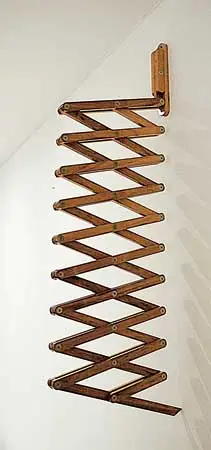
In the works that form the series Metaméricos, created with pieces of wood attached together with hinges, Lescher confers the line—which the artist interrupts with the hinges—through the construction of linear and modular fragments,an animal quality reminiscent of the segmented bodies of insects. Each work is configured in a different manner according to the artist’s will and the changes generated through movement. As each piece acquires a new shape and each posture suggests a new gesture in the space, Lescher plays with the boundaries and outlines of the objects and with the very limits of the spatial installation itself; all-the-while multiple readings and lives are generated.
It is precisely the word “Metaméricos” that speaks of numbers or structures whose segments evoke that intrinsic relationship between the human and the very instruments of mathematical and spatial measurement—such as a compass, ruler, sextant, etc.—that allow human beings to locate themselves and define their relationship with time and space. For Lescher, each segment is used to form a work that has its own slightly particular measurement. Even when two pieces may appear to be identical, such measurements are stated in the description of each work to convey that there is nothing random in his process.
We also find works that show Lescher’s interest in other sensorial dimensions that are not necessarily based on nature per se: these are simple forms that rely on basic geometries, as it occurs in the work Livro # 1 (Book No. 1, 2012). It depicts two vertical rectangles created with Brazilian hardwood and attached together with a bronze hinge. Both the title and the form itself suggest an open book that challenges, through the word that names it, the boundaries between abstraction and figuration.
For Lescher the work itself is solely the ulterior consequence of a process that involves dreams, desires, gestures, words, and the construction of images/forms based on these poetic triggers. From this point of departure, Lescher’s work than can be translated—beyond formal and the matteric considerations—into a series of elements that generate paradoxical relationships that address nature and its interaction with human beings and the non-functionality of the object-matter—that in these instances appear to cease to exist as such as a result of its own transformation. Thus, Artur Lescher’s body of work speaks of those continuous relationships of instability, equilibrium, tension, and silence that manifest themselves as provocations between objects and men, between ideas and results.
AMALIA CAPUTO