
One of the most important artists from the prestigious Generation of the 1950s in Puerto Rico, Domingo García (Coamo, Puerto Rico, 1932) at 80 years of age has entered his ninth decade of life, and he is obviously worried about the legacy in the history of art of his country and the Americas. Although García remains very active in the field of painting and sculpture, it is clear that he wants to make sure that the works that he most treasures, his Icons, and Gods—monumental paintings about those whom he regards as the most important players in the history of Puerto Rico, especially with regard to the country’s independence—can be appreciated as a unity.
With an innate talent and an extraordinary education (New York, Chicago, London), and having completed several important scholarships and continuously excelling as an innovative landscape painter, extraordinary portraitist, and self-portraitist—able to render dramatic and provoking gazes, an area in which he creates to this day as he works on his autobiography. Because of the extraordinary Caribbean eroticism of the nude female figure; the lyrical, effective and attractive expressionism of his stunning flowers/vaginas in his still-lifes; the wonderful drawing and engravings of phenomenal aesthetic synthesis; the powerful serigraphs and etchings subscribed to POP; and, finally, because of his recently created, intense and latent, wood or bronze sculptures; Domingo García, one of the few living and active artists of the Generation of the 1950s—Julio Rosado del Valle, Rafael Tufiño and Augusto Marín have died in recent years—has already secured an honorable place in the history of Puerto Rican art and culture.
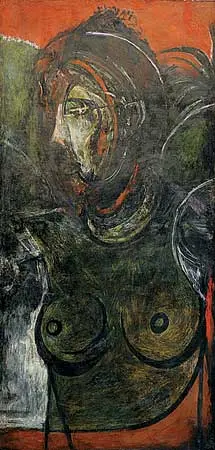
In Icons and Gods, Domingo García combines a small retrospective that also includes new works never before exhibited, 17 paintings, and one bronze sculpture—Juracán, the name Taínos use for hurricane—in total. But the central purpose of this exhibition is to once again exhibit his “Icons” and “Gods.” Although they have been exhibited on many occasions in Puerto Rico, there are still young people who do not know them.
The first works that attract our attention are his monumental paintings—9 × 5 ft.—that convey the syncretism of Puerto Rico, the Caribbean, and Latin America. They include images of Atabeira and Aguebana II, Taíno indigenous people; the Sacred Heart of Christendom; and Changó, God of war from the Yoruba religion of Nigeria, the place from where most of the Caribbean and Brazilian slaves came. Because the slave population was smaller in Puerto Rico, that type of syncretism never developed there—although a strong spiritualist tradition did emerge. To secure its survival, the Yoruba religion eventually became Santería in Cuba, Voodoo in Haiti, and Candomblé in Brazil.
Domingo García regards the following people as Icons of the Puerto Rican history/culture: Juan Ponce de León, the first Puerto Rican governor before he left for Florida in search of the Fountain of Youth; Ramón Power y Giralt, Puerto Rican delegate to the courts of Cádi in 1812; Roman Baldorioty de Castro, José de Diego, Roman Emeterio Betances, Pedro Albizy-Campos, Lolita Lebron, Blanca Canales, Juan Mari Brass, all defenders of the Puerto Rican independence, first from the Spanish and then from the 1898 United States invasion. There is also the scholar, philosopher and politician, and one of the fathers of Pan-Americanism, Eugenio María de Hostos; first Puerto Rican to ever be elected governor of Puerto Rico and founder of the controversial, contradictory and shameful Commonwealth of Puerto Rico—that at a certain point in time lifted the island from poverty but that eventually brought economic and identity problems to the island—Luis Muñoz-Marin; and Ricardo Alegría, responsible for establishing a policy of conservation that has allowed Old San Juan to maintain its colonial beauty, and also the founder of the Instituto de Cultura Puertorriqueña, after failing to achieve the creation of a Ministry of Culture.
The images of these Icons and Gods are not realist portraits of the characters or personalities in them, but free and provocative interpretations of their actual images. In many of them, Domingo García is able to capture their historic and existential essence. Created under the canons of German expressionism, these paintings—impressive for their epic size and the gaze on each of the protagonists—present a part of the history of Puerto Rico with great effectiveness.
Domingo García has approached two Aristotelian thoughts: “The work of art exists solely as a form that tries to mimic as much as possible that which it represents,” and “The work of art must give body to the secret existence of things.”
I think that the government of Puerto Rico or any other institution interested should conserve Icons and Gods as a unity. Its aesthetic and didactic value is great.
MANUEL ÁLVAREZ LEZAMA