
The return to figuration brought new energy to the work by Dudi Maia Rosa. In his recent solo show at the Galería Millan, in São Paulo, the Brazilian artist resumes the direction that characterized his works from the 1960s and 1970s, when he would produce canvases and sculptures using diverse techniques to render works in which the presence of the figure predominated. Now, his current work revises his own origins without being repetitive. Rosa achieved a singular balance during his artistic trajectory: the treatment of figuration with the strength of abstraction.
If there are still any consensuses in art theory with regard to the use of the term “abstraction” (after all, it has been demonstrated that nothing is free of significance, not even a blank canvas), in the case of Rosa that difficulty becomes even more evident. The great strength of his work of the last decades precisely resides in the creation of abstract compositions that, bestowed an extraordinary poetic vigor, even evoke a certain dramatic climate.
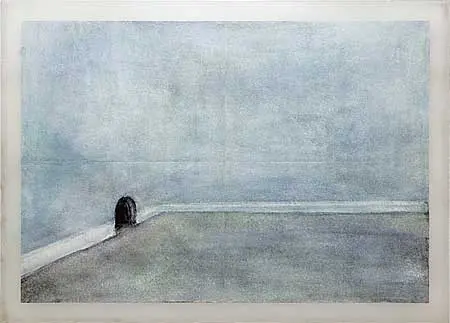
Most of the works are rendered on fiberglass surfaces, in which the process of fusing the color and the gestural layers generates surfaces full of nuances. There are paintings with three-dimensional characteristics, with thick matteric density and highly suggestive—all of these aspects are emphasized through the use of synthetic resins that contribute to a vast variety of translucencies and tonal ranges.
The visual exuberance continues to be present in Rosa’s current work. The use of explicit figuration strengthens his pieces even more with its unexpected narrative appearance. Entitled Cábulas, the paintings pay homage to his time in school, when he discovered the artist in him, drew constantly and “cabulaba” (skipped) classes. The predominant medium, watercolor, has its referent in the catalog of his first solo exhibition at the Museu de Arte de São Paulo Ass is Chateaubriand (MASP), in 1978, when he created a catalog with pencil and watercolor.
This current exhibition presents in monumental size painting themes like landscape and still-lifes. Among the most representative images are the portraits of interior environments of homes devoid of any human presence but with singular perspectives, like the corner of a table with a telephone, a section from the back of an easy chair, or a small rug with a hole made by a mouse.
It is fair to say that Rosa has always created a “figurative abstraction” that confirms the influence of the Escola Brasil, a group he belonged to and whose most representative member was the artist from São Paulo Wesley Duke Lee. In 1980, Rosa began creating paintings that moved toward abstraction, as he employed supports of unusual shapes—triangles and semicircles—and explored more graphic art and textures. In some works, he inserted writings like biblical quotes or defined figures.
During this period it is possible to confirm dialogues between Rosa’s proposals and the work of Russian-born US artist Mark Rothko (1903-1970), whose monumental paintings convey an effect of contemplation and transcendence to viewers. Rosa made this aspect more prominent through softly imprecise forms that confer a foggy, and yet, palpitating quality to the surface of the work. During the decades that followed, Rosa remained loyal to compositional schemes that constitute a sort of abstraction with motifs. To him, the notion of painting in itself did not impede the eradication of expressiveness; just as the minimalist matrix of many artists from his generation prescribed.
Now Rosa appears to be moving toward the universe of this process, as he creates highly abstract figurations. There are fewer elements arranged in the space, diagonal perspectives result in anti-classical planes and large dimensions, among other characteristics that transform the few signs of reality into elements that address themselves, as they elicit great satisfaction in the viewers. In this manner, Rosa reveals the coherence and maturity of his old aesthetic principles.
ALESSANDRA SIMÕES